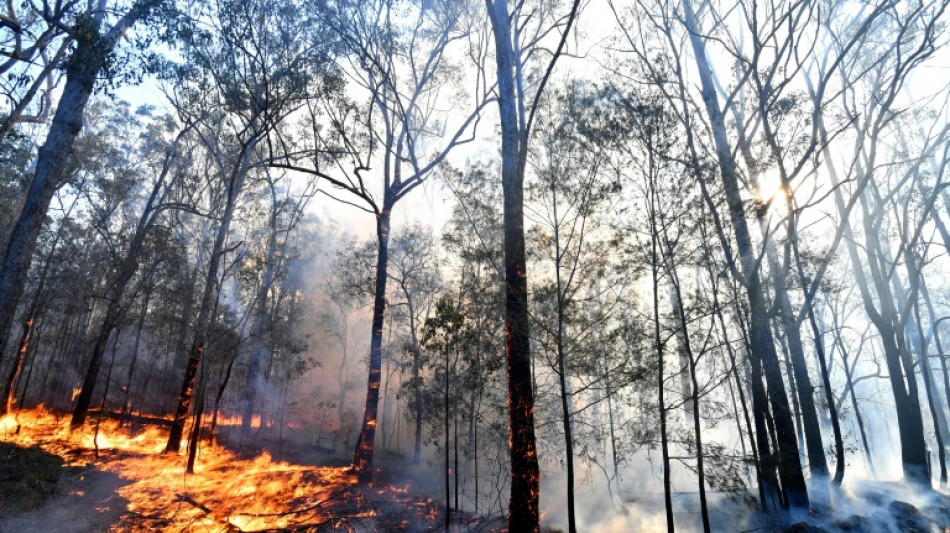
Australia lists small wallaby, snake among new endangered species / Photo: SAEED KHAN - AFP/File

 Drone owners rush to offload devices ahead of Beijing ban

 Trump's beef policies irk Texas ranchers, testing their loyalty

 Nvidia, OpenAI CEOs to attend Xi dinner at White House

 Anthropic picks Accenture for in-house AI safety evaluation

 Balogun returns as Monaco beat Lens to continue strong Ligue 1 start

 'Pause' on overt repression in Venezuela, but reforms still needed: HRW

 Global stocks mixed as yen falls despite Bank of Japan rate hike

 Cuba hit with seventh major blackout of the year

 Murray out with concussion so Wentz will start for Vikings

 UN chief 'deeply regrets' US visa refusal to Abbas for annual meeting

 England quick Carse to face no charges over alleged nightclub assault

 Mancini brings nine newcomers into the first squad of his Italy comeback

 Czechs level Davis Cup tie against USA as South Korea eye Finals

 New France boss Zidane confirms Mbappe as captain after naming first squad

 California governor signs order to explore AI 'kill switch'

 Head leads run spree as Australia win Zimbabwe ODI series

 In-form Raphinha wants to finish career at Barcelona

 Warren Buffett steps down as Berkshire Hathaway chairman

 Carrick confident Man Utd can 'work through' tough time

 Mbappe ends Nike partnership to join Swiss brand On

 Liverpool boss Iraola puts Bournemouth love affair on hold

 'A disaster' if Man City do not win says Maresca after flawless start

 Kerry James Marshall: American 'blackness' painter celebrated in Europe

 Spain coach De la Fuente offers 'full support' to people of Ceuta

 Russia seizes assets of Nestle, French firms over West's Ukraine support
Australia's government vowed to stop plant and animal extinctions Tuesday as it listed the grey snake and a small wallaby among 15 new threatened species.
Many of Australia's unique species are clinging to existence, their habitats shrinking from human activity and extreme events such as the 2019-2020 Black Summer bushfires, wildlife groups say.
Prime Minister Anthony Albanese's government announced a new 10-year scheme to try to halt the slide into extinction of 110 "priority species" and to shield 20 "priority places" from further degradation.
It set out an aim of preventing any new extinctions of plants and animals while conserving at least 30 percent of Australia's land mass.
Wildlife groups blame Australia's poor record in protecting its unique species largely on habitat destruction, accelerated by global warming and resulting extreme weather.
The Black Summer fires burned through 5.8 million hectares in eastern Australia and killed or displaced an estimated 1-3 billion animals.
"The Black Summer bushfires in particular have seen devastating results for many species. We are determined to give wildlife a better chance," said Environment Minister Tanya Plibersek.
"Listing species as threatened under national environment law is a critical step in protecting the species and habitats in need of urgent help."
- 'Extinction capital' -
Australia's attempts to protect its wildlife so far had not worked, the minister added.
"Australia is the mammal extinction capital of the world," she said.
Among the 15 plants and animals listed as threatened are the endangered mildly-venomous grey snake of Queensland, the vulnerable small parma wallaby -- threatened by bushfires and predators -- and the endangered small, wingless matchstick grasshopper, which is sensitive to drought and frequent bushfires.
Listing a species as threatened offers it protection under environment conservation law.
Wildlife groups welcomed the government's goal of preventing any new plant or animal extinctions.
The objective "is ambitious but essential if future generations of Australians are to see animals like koalas, mountain pygmy possums, greater gliders and gang gang cockatoos," said the Australian Conservation Foundation's nature program manager Basha Stasak.
"Stopping the destruction of wildlife habitat is the key to achieving this objective."
Stasak called on the government to strengthen national environment law, saying it had failed to protect animals, plants and ecosystems.
- 'Downward spiral' -
Scientists had estimated the cost of tackling Australia's "extinction crisis" at Aus$1.69 billion ($1 billion) a year, Stasak said.
A five-yearly State of the Environment report released in July painted a picture of wildlife devastation on land and sea.
It cited the clearing of millions of hectares of primary forest and mass coral bleaching on the Great Barrier Reef caused by marine heatwaves.
WWF-Australia called for investment in recovery plans for all threatened species.
"Australia's wildlife and wild places have been on a dangerous downward spiral," said WWF-Australia chief conservation officer Rachel Lowry.
She welcomed Australia's target of zero new extinctions, saying it matched the goals of New Zealand and European Union member countries.
Lowry pressed the government to set out and fund a recovery plan for the more than 1,900 threatened species in Australia.
"This plan picks 110 winners," she said.
"It's unclear how it will help our other 'non priority' threatened species such as our endangered greater glider for example."
The government said giving priority to certain species and locations would deliver "flow-on benefits" to other threatened plants and animals in the same habitat.
A.S.Diogo--PC



