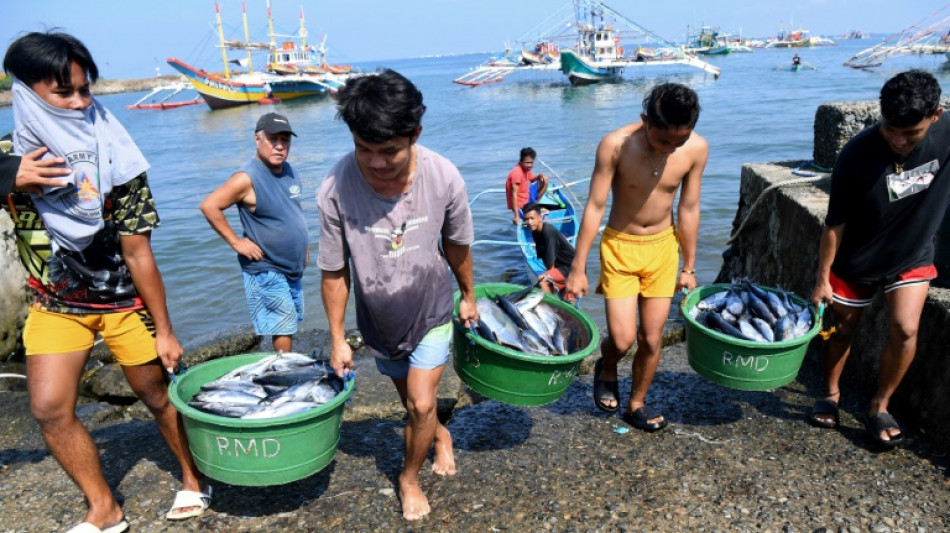
Filipinos fishing on frontline of China's battle for disputed sea / Photo: Ted ALJIBE - AFP

 Drone owners rush to offload devices ahead of Beijing ban

 Trump's beef policies irk Texas ranchers, testing their loyalty

 Nvidia, OpenAI CEOs to attend Xi dinner at White House

 Anthropic picks Accenture for in-house AI safety evaluation

 Balogun returns as Monaco beat Lens to continue strong Ligue 1 start

 'Pause' on overt repression in Venezuela, but reforms still needed: HRW

 Global stocks mixed as yen falls despite Bank of Japan rate hike

 Cuba hit with seventh major blackout of the year

 Murray out with concussion so Wentz will start for Vikings

 UN chief 'deeply regrets' US visa refusal to Abbas for annual meeting

 England quick Carse to face no charges over alleged nightclub assault

 Mancini brings nine newcomers into the first squad of his Italy comeback

 Czechs level Davis Cup tie against USA as South Korea eye Finals

 New France boss Zidane confirms Mbappe as captain after naming first squad

 California governor signs order to explore AI 'kill switch'

 Head leads run spree as Australia win Zimbabwe ODI series

 In-form Raphinha wants to finish career at Barcelona

 Warren Buffett steps down as Berkshire Hathaway chairman

 Carrick confident Man Utd can 'work through' tough time

 Mbappe ends Nike partnership to join Swiss brand On

 Liverpool boss Iraola puts Bournemouth love affair on hold

 'A disaster' if Man City do not win says Maresca after flawless start

 Kerry James Marshall: American 'blackness' painter celebrated in Europe

 Spain coach De la Fuente offers 'full support' to people of Ceuta

 Russia seizes assets of Nestle, French firms over West's Ukraine support

Filipino fisherman Mariel Villamonte had spent years plying the turquoise waters of Scarborough Shoal in the South China Sea for snapper and grouper -- until a Chinese coast guard vessel water cannoned his boat.
That was in 2012, around the time China snatched control of the small ring of reefs from the Philippines, and he has not dared go back.
"Their ships are made of steel, ours are made of wood," said Villamonte, now 31, recalling how two Chinese vessels chased his outrigger before blasting it with high-pressure water.
The fishing ground, tapped by generations of Filipinos, is one of many potential flashpoints for military conflict over the South China Sea.
China and Taiwan both claim sovereignty over almost the entire sea, while the Philippines, Vietnam, Malaysia and Brunei have competing claims to parts of it.
Trillions of dollars worth of ship-borne trade passes through the waterway annually and naval vessels from the United States and Western allies sail through it regularly.
Of all the claimants, China has in recent years forced its stance most aggressively.
Hundreds of Chinese coast guard and maritime militia vessels prowl the waters, swarming reefs, harassing and attacking fishing and other boats, and interfering in oil and gas exploration, and scientific research.
Analysts say Beijing's aim is regional supremacy and control over all activity in the waters -- and it is using its might to bully smaller rivals into submission.
"They really envision themselves to be the centre of this region, economically, politically and militarily," said Jay Batongbacal, director of the University of the Philippines's Institute for Maritime Affairs and Law of the Sea.
"What they want is that eventually the weaker nations simply give up and leave them there just to avoid a problem."
- 'Chinese Dream' -
China often invokes the so-called nine-dash line, a vague delineation based on maps from the 1940s, to justify its claims over the South China Sea.
The Philippines brought a case before an international court disputing China's stance. The tribunal ruled in 2016 that Beijing's claims have no legal basis.
China has since ignored the ruling, and tensions with the Philippines eased after former president Rodrigo Duterte set aside his country's legal victory and courted Chinese businesses instead.
Ferdinand Marcos Jr, who took over from Duterte in June this year, has pledged to uphold the court decision and insisted he would not let China trample on Manila's maritime rights.
But in the decade under President Xi Jinping, who is expected to secure a record third consecutive term in office this month, China has dramatically expanded its presence in the sea.
Xi's desire for control of the waters is not about fish or fossil fuels, said Greg Poling, director of the US-based Asia Maritime Transparency Initiative (AMTI).
His main objectives are realising the "Chinese Dream" of national rejuvenation -- Xi's vision of restoring the country to perceived past glory -- and securing his political legitimacy.
Poling said generations of Chinese leaders had made increasingly "absurd" claims to the sea, leaving Xi with no choice but to "assert claims to everything".
Satellite images published by AMTI show China's land-reclamation efforts in the waters have vastly outstripped those of all other claimants combined.
Since 2013, it has ripped up roughly 6,000 hectares (15,000 acres) of reef to create about 1,300 hectares of new land for artificial islands in the Spratly archipelago, said Poling.
The militarised islands -- complete with runways, ports, and radar systems -- enable Chinese vessels to patrol as far south as Indonesia and Malaysia.
Apart from destroying fish breeding grounds and smothering marine life with sediment, experts say Beijing's actions contravene international law.
Under the 1982 United Nations Convention on the Law of the Sea, which China helped negotiate, countries have exclusive rights to natural resources within about 200 nautical miles of their shore.
China's claims extend as far as a thousand nautical miles, which Poling said was "wildly inconsistent" with the law.
"The rules that protected China as a developing coastal state now seem like an unfair constraint on a China that believes that it should be able to impose its will on its neighbours," he said.
- 'Thief in your backyard' -
China's seizure of Scarborough Shoal has robbed Villamonte and other fishermen in Cato village, in the northern province of Pangasinan, of a key source of income.
Their families began fishing there in the 1980s when bigger boats enabled them to make the 500-kilometre round trip. It was full of fish and offered life-saving shelter during storms.
Now, the fishermen say they mainly rely on "payaos", floating devices that attract yellowfin tuna, anchored away from the shoal and left alone by Chinese boats.
After decades of overfishing by countries surrounding the waters, the men have to spend longer at sea and resort to catching smaller fish.
Even then, they sometimes struggle to break even.
Despite the risks, Filipino fishermen still try to enter the shoal to top up their catch.
Christopher de Vera, 53, said members of his crew have gone inside under the cover of darkness, leaving them feeling like "a thief in your own backyard".
But he said the shallow waters no longer teem with fish after the coral was "decimated" by Chinese giant clam harvesters.
- 'Worst nightmare' -
China's growing assertiveness has not been seriously challenged by Southeast Asian countries due to deep divisions over how to respond and fear of retaliation if they do, according to analysts.
The 10-member Association of Southeast Asian Nations (ASEAN) is split between those with close ties to China, such as Myanmar, Cambodia and Laos, and others that are warier of Beijing.
Their differences have hampered negotiations between China and ASEAN for a "code of conduct" that would govern behaviour in the sea.
Talks have dragged on for 20 years as Beijing, which prefers to deal directly with its smaller neighbours, went on an island-building spree.
The United States is widely seen as the only nation powerful enough to push back, but there are concerns about its reliability.
President Joe Biden hosted ASEAN leaders in May to signal Washington's long-term commitment to the region in the face of China's growing clout.
But decades of inconsistent policies and perceived neglect of the region have damaged Washington's image.
"Southeast Asian countries are simply not willing to place their bets on the United States," said Shahriman Lockman of the Institute of Strategic and International Studies in Malaysia.
China has previously used deadly force to back its claims and its recent war games around Taiwan, which it considers part of its own territory, rang alarm bells across the region.
Chinese and Vietnamese forces engaged in clashes in 1974 and 1988 in which dozens of troops died.
For now, Beijing appears keen to avoid war while pursuing its expansionist drive.
"They are masterful at avoiding crossing that threshold by being shrill about their protestations, this wolf warrior diplomacy, that is designed to intimidate and get you to give in without fighting," said John Blaxland, an international security and intelligence expert at the Australian National University.
And its tactics are working.
Poling said the sea could become a "Chinese lake" as the growing risk and cost of operating there forces out Southeast Asian fishermen, oil and gas companies and coast guard.
Villamonte used to regularly make 6,000 pesos ($105) per trip when he could fish at Scarborough Shoal. Now it can be as little as 2,000 pesos, or nothing at all.
Fishing is all he knows -- his father and grandfather were fishermen -- and his "worst nightmare" is losing access to the rest of Philippine waters.
"My family will go hungry," he said.
burs-amj/ser/qan
V.Fontes--PC



