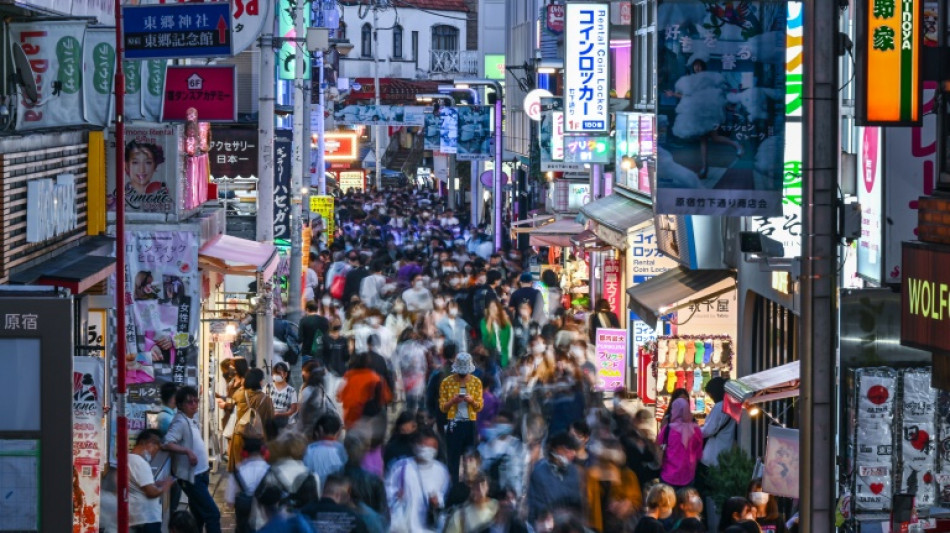
Net-zero in fashion, but clothing giants struggle to cut emissions / Photo: Richard A. Brooks - AFP/File

 Drone owners rush to offload devices ahead of Beijing ban

 Trump's beef policies irk Texas ranchers, testing their loyalty

 Nvidia, OpenAI CEOs to attend Xi dinner at White House

 Anthropic picks Accenture for in-house AI safety evaluation

 Balogun returns as Monaco beat Lens to continue strong Ligue 1 start

 'Pause' on overt repression in Venezuela, but reforms still needed: HRW

 Global stocks mixed as yen falls despite Bank of Japan rate hike

 Cuba hit with seventh major blackout of the year

 Murray out with concussion so Wentz will start for Vikings

 UN chief 'deeply regrets' US visa refusal to Abbas for annual meeting

 England quick Carse to face no charges over alleged nightclub assault

 Mancini brings nine newcomers into the first squad of his Italy comeback

 Czechs level Davis Cup tie against USA as South Korea eye Finals

 New France boss Zidane confirms Mbappe as captain after naming first squad

 California governor signs order to explore AI 'kill switch'

 Head leads run spree as Australia win Zimbabwe ODI series

 In-form Raphinha wants to finish career at Barcelona

 Warren Buffett steps down as Berkshire Hathaway chairman

 Carrick confident Man Utd can 'work through' tough time

 Mbappe ends Nike partnership to join Swiss brand On

 Liverpool boss Iraola puts Bournemouth love affair on hold

 'A disaster' if Man City do not win says Maresca after flawless start

 Kerry James Marshall: American 'blackness' painter celebrated in Europe

 Spain coach De la Fuente offers 'full support' to people of Ceuta

 Russia seizes assets of Nestle, French firms over West's Ukraine support

The world's fashion giants have pledged to trim their carbon footprint but that goal remains elusive at a time "fast fashion" is all the rage -- a topic in the spotlight at the UN climate summit.
With a chance to strut their climate commitments at COP27 talks, clothing brands and manufacturers discussed global warming -- but some admitted that their pledge to halve emissions by 2030 and reach net-zero by mid-century may be a stretch.
"Are we there yet? Of course not. Are we on track? I would say ... maybe," Stefan Seidel, senior head of sustainability at Puma, told a panel at the COP27 in the Egyptian seaside resort of Sharm el-Sheikh.
Greenpeace and other groups have urged the sector -- already under fire for often exploitative labour practices -- to slow down or end the wasteful trend of mass-producing low-cost clothes that are quickly thrown away.
Fast fashion, they charge, uses up massive amounts of water, produces hazardous chemicals and clogs up landfills in poor countries with textile waste, while also generating greenhouse gases in production, transport and disposal.
The fashion sector was responsible for four percent of global emissions in 2018 -- about the same as Britain, France and Germany combined -- according to the McKinsey consultancy firm.
Some 30 firms -- from retail giants H&M and Zara owner Inditex to sports apparel rivals Adidas and Nike -- signed up to the Fashion Industry Charter for Climate Action at the COP24 summit in Poland in 2018.
At the time they pledged to cut emissions by 30 percent by 2030 and to be net-zero emitters by mid-century.
A year ago they set the new, more ambitious goal of slashing their CO2 emissions by half by the end of the decade, with more than 100 companies now signatories to the pledge.
But meeting the target is a major challenge for an industry with long and complex supply chains that span the globe, industry insiders admit.
- 'Difficult and costly' -
Industry figures at COP27 barely mentioned the "fast fashion" business model, which critics say is at the heart of the problem, focussing instead on ideas around the use of renewable energy in factories and regulation.
But greening the entire supply chain and introducing climate-friendly standards among suppliers of raw materials and factories is a monumental task.
Leyla Ertur, head of sustainability at H&M, said the Swedish firm has more than 800 suppliers.
And Marie-Claire Daveu, sustainability chief at Kering Group, which owns luxury brands Gucci and Yves Saint Laurent, said: "Even us, we're not big enough to change all the supplies chains. That's why collaboration is key."
Ali Nouira, an Egyptian manufacturer, told another COP27 panel that certification bodies do not even exist in the region.
"When we manufacture, we need to have all the right certifications and the carbon footprints and all that, and for a small brand coming out from Egypt that is extremely difficult and also costly," Nouira said.
"We also manufacture for other brands, in Europe and other places," he said. "And we're pressured to have the certifications and also to go down with our prices, so they can continue to make the profits they make."
- 'Leap of faith' -
Nicholas Mazzei, head of environmental sustainability at online retailer Zalando, said there had been a culture change in developed countries, with banks offering lower interest rates to companies that commit to a net-zero target.
"If you make that transformation, you may end up paying nothing because the loans are so low the costs are basically free," Mazzei said.
But suppliers face big costs as sewing clothes in factories requires more energy than that used by retail stores at the end of the supply chain.
"We need, at a far bigger scale, more renewable energy than brands do," said Catherine Chiu, vice president of corporate quality and sustainability at Kong Kong firm Crystal International Group.
"Even if we install solar panels in all of our 20 plants, that would only represent 17 percent of the energy consumption of the group," she said.
Delman Lee, vice chair for sustainability at TAL Apparel, another Hong Kong garment manufacturer, said it has been decarbonising its operations for a decade.
But with subsidiaries in countries including Vietnam and Ethiopia, it is complicated to navigate the different regulations, Lee said.
Aiming to become a net-zero business "is a leap of faith commitment," Lee said. "You commit to something you don't know how to achieve."
N.Esteves--PC



