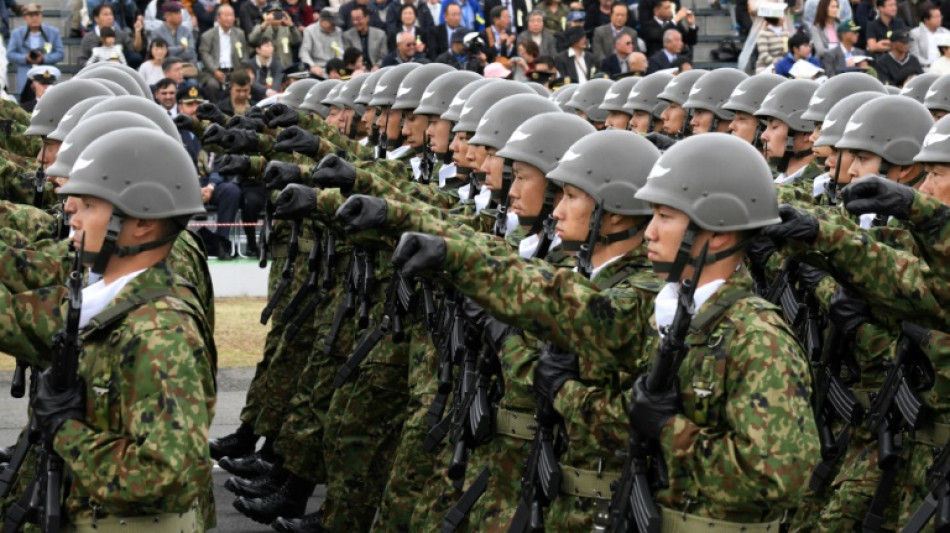
Japan approves major defence overhaul, warning of China threats / Photo: Kazuhiro NOGI - AFP

 Man City chairman defiant over reported Premier League charges

 Germany ready to 'walk through fire' for Klopp, says Tah

 At least 16 killed in Russian and Ukrainian strikes

 Powerful storm pummels US Northeast

 Bangkok declares disaster after homes flooded, roads submerged by heavy rain

 Norris calls for errant Colapinto to be banned for causing Baku crash

 Russell finds himself again and prepares to heap pressure on Antonelli

 South Korea hold nerve to win Asian Games basketball gold

 Russell holds off Verstappen to claim imperious victory in Baku

 Russell holds off Verstappen to win Azerbaijan Grand Prix
 India's Kohli says 2027 ODI World Cup will be his last

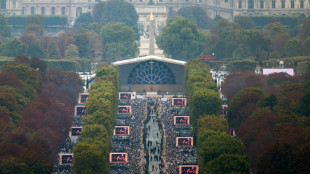 Huge crowds cheer Pope Leo along Champs-Elysees ahead of Paris mass

 Putellas wants to bring 'winning culture and mentality' to London City

 Rare Italian opera returns to Moscow after nearly 120-year hiatus

 Pope to celebrate giant Paris mass after 'peace' appeal

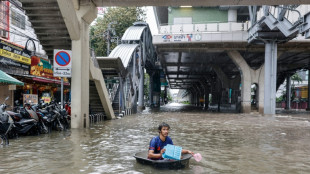 Homes flooded, roads submerged: Bangkok declares disaster over heavy rains
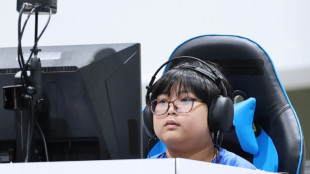
 Ahead of Paris mass, pope urges life together in 'dignity and peace'

 Austria 'ghetto' language classes leave children to repeat school
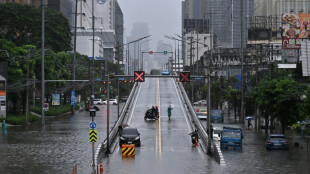
 S.African women runners arm themselves after string of killings
 'I felt embarrassed': Japan eSports whizz-kid, 11, wins Games gold

 Indonesia fires threatens critically-endangered orangutan: IUCN

 Bangkok declares flood disaster across city
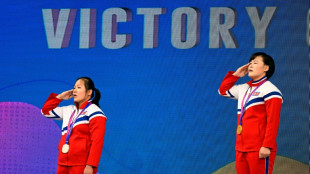 'World records not enough': North Korea weightlifters target Olympic gold rush

 Iran proposes Hormuz plan, Trump reportedly refuses

 El Nino rewrites the menu in the world's top restaurants
Japan's government approved a major defence policy overhaul Friday, including a significant spending hike, as it warned China poses the "greatest strategic challenge ever" to its security.
In its largest defence shake-up in decades, Japan vowed to increase security spending to two percent of GDP by 2027, reshape its military command, and acquire new missiles that can strike far-flung enemy launch sites.
Prime Minister Fumio Kishida told a news conference he was "determined to remain resolute in our mission to protect and defend the nation and its people, at this turning point in history".
"In our neighbouring countries and regions, the strengthening of nuclear missile capabilities, rapid military build-up and attempts to unilaterally change the status quo by force have become even more pronounced," he said, evoking Russia's invasion of Ukraine as an example of the changing times.
Polls suggest Japan's public largely backs the shift, but the changes could still be controversial because Japan's post-war constitution does not officially recognise the military and limits it to nominally self-defensive capabilities.
The moves are outlined in three defence and security documents approved by the cabinet Friday.
They describe Beijing as "the greatest strategic challenge ever to securing the peace and stability of Japan", as well as a "serious concern" for Japan and the international community.
In response, the government plans to raise its defence spending to two percent of GDP by fiscal 2027, bringing Japan in line with NATO member guidelines.
That marks a significant increase from historic spending of around one percent and has sparked criticism over how it will be financed.
The money will fund projects including the acquisition of what Japan calls "counterstrike capacity" -- the ability to hit launch sites that threaten the country.
The documents warn that Japan's current missile interception systems are no longer sufficient, and Kishida said counterstrike capacity "will be essential in the future".
- 'Radically strengthen' -
While Japanese governments have long suggested that counterstrikes to neutralise enemy attacks would be permissible under the constitution, there has been little appetite to secure the capacity.
That has shifted with the continued growth of Chinese military might and a record volley of North Korean missile launches in recent months, including over Japanese territory.
Still, in a nod to the sensitivity of the issue, the documents rule out preemptive strikes and insist Japan is committed to "an exclusively defence-oriented policy".
"Japan's adherence to the three non-nuclear principles, the exclusive defence policy and its progress as a peaceful nation will remain unchanged," Kishida said on Friday.
The counterstrike capacity will involve both upgrading existing Japanese weaponry but also buying US-made Tomahawk missiles, reportedly up to 500.
Other changes include the establishment of a permanent joint command for Japan's armed forces as well as enhancement of its coastguard.
Core army troops in the southwestern islands will be doubled, and logistics strengthened "to enable the rapid deployment of troops from all over Japan" in an emergency, Kishida said.
Among the documents is the National Security Strategy, which is being updated for the first time since its 2013 launch.
Its language on relations with both China and Russia has hardened significantly.
The strategy document previously said Japan was seeking a "mutually beneficial strategic partnership" with Beijing, a phrase that has disappeared from this iteration.
Instead it suggests a "constructive and stable relationship" and better communication.
And while Japan's strategy document once called for enhanced ties and cooperation with Russia, it now warns that Moscow's military posturing in Asia and cooperation with China are "a strong security concern".
China's foreign ministry urged Japan on Friday to "reflect on its policies".
"Japan disregards the facts, deviates from the common understandings between China and Japan and its commitment to bilateral relations, and discredits China," ministry spokesman Wang Wenbin told reporters.
However, the White House said the overhaul would "strengthen and modernise" Japan's military alliance with the United States.
The strategy contained in the documents represents a major evolution of Japan's military posture, according to Chris Hughes, professor of international politics and Japanese studies at the University of Warwick.
"The Japanese government will depict these changes as necessary, moderate and wholly in line with previous defence posture," he told AFP.
Still, "they are going to, in the words often used by the (ruling) Liberal Democratic Party itself in policy documents, 'radically strengthen' Japan's military power", said Hughes, author of the book "Japan as a Global Military Power".
A.F.Rosado--PC