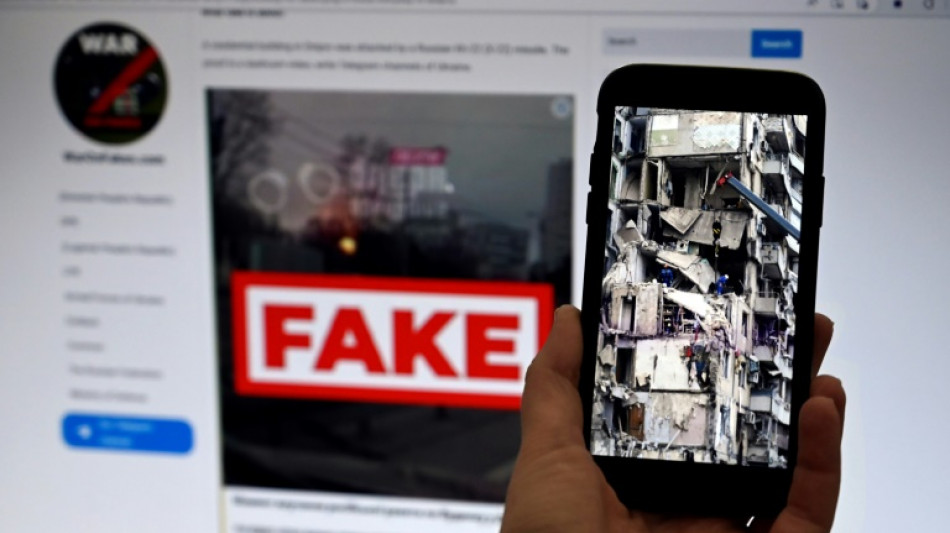
Fake 'fact-checks' seek to obscure Russian role in war / Photo: OLIVIER DOULIERY - AFP

 Messi on target again but Miami downed by Columbus
 In Washington's political cauldron, a fight over foie gras
 Flavio Bolsonaro: political heir in his father's shadow
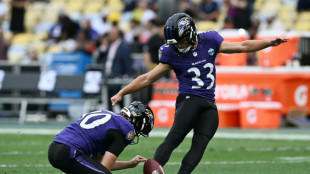 Ravens grab last-second win in Rio as Commanders stop Seahawks

 USA rallies to capture 11th consecutive Presidents Cup
 Phillies clinch, Astros wrap up division on final day of MLB season

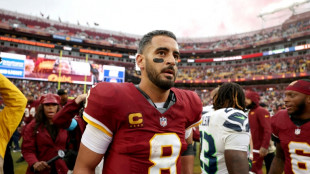 Commanders hand champion Seahawks their first loss

 Dupont scores twice to send Toulouse top of Top 14

 Ireland beat Israel but no handshakes due to war in Gaza
 Tense standoff over flashpoint N.Ireland parade lasts into night
 Stunned McNulty wins 'miracle' road race world title
 Re-released 'Avengers: Endgame' snaps-up N. America box office lead

 American McNulty wins shock road race world title
 Serbia's President Aleksandar Vucic announces resignation
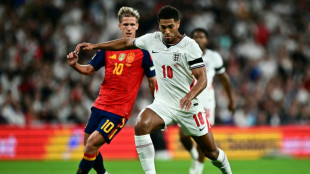 Tuchel urges Bellingham to play with 'rage'
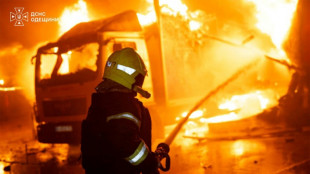 Russian strikes on Ukraine kill 8
 Bavuma, Miller hit centuries as South Africa clinch series
 Spain bring in Le Normand for injured Garcia
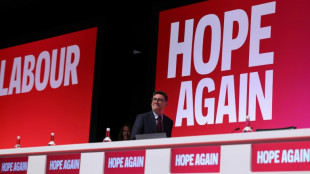 UK Labour party meets buoyed by Burnham but seeking concrete plans
 Nor'easter lashes US east with punishing rain and wind

 UK police arrest five on suspicion of preparing 'terrorist act' near air base
 Washington denounces Iran's truce proposal as 'cynical'

 Armani sprinkles glitter on discreet elegance at Milan show
 UK police arrest five for preparing 'terrorist act' as incident near air base probed
 อเล็กซ์ โบดี และศาสตราจารย์ ดร. ดีเทอร์ ลาซิก ลงนามสัญญาสำหรับ ALPHA WHEY และ BODI เครื่องดื่มให้พลังงาน

A Russian missile smashed a Ukrainian apartment complex, killing dozens. Pro-Russian propagandists offered a slick counter-narrative that shifted the blame away from Moscow -- using pseudo fact-checking as a tool of disinformation.
Since the start of its invasion one year ago, Russia and its supporters have sought to aggressively distort Moscow's role in Ukraine with what experts call a highly potent weapon in its arsenal -- disinformation campaigns.
Global fact-checkers have debunked a blizzard of falsehoods that seek to deflect attention from Russia's potential war crimes or malign its opponent, a task made more complex by fictitious "fact-checks" that risk undermining trust in their own work.
Last month, at least 46 people were killed when a residential building in the city of Dnipro was struck by what Ukrainian officials and experts including the US-based Center for Strategic and International Studies said was a Russian Kh-22 cruise missile.
The battered nine-story building came to epitomize one of the deadliest single attacks in Ukraine since the Russian invasion.
But a website called "War on Fakes" -- which disseminates what experts identify as Russian propaganda -- claimed in an "exclusive" that the building had been destroyed by a Ukrainian air defense missile.
Akin to professional fact-checkers, it used visuals with the word "fake" stamped across them in bold red letters, alongside open-source material including a dashcam video and a graphic that used complex trigonometry to make its case.
"Since Russia's invasion, the 'War On Fakes' initiative has become a powerhouse of spreading false debunks," Roman Osadchuk, from the Atlantic Council's Digital Forensic Research Lab, told AFP.
- 'Effective tool' -
"War On Fakes," whose Telegram channel has hundreds of thousands of subscribers, calls itself "objective" and "unbiased" and claims to combat the "information war launched against Russia."
It does not name its writers and it remains unclear who was behind the project, launched last year soon after the invasion, but among its amplifiers are pro-Kremlin actors including Russian ministries and embassies.
"It is an effective tool of state propaganda and disinformation," said Osadchuk.
"It works primarily because fact-checking usually serves for readers as an 'authoritative' source to seek 'objective information.'"
Similar pseudo fact-checking campaigns have appeared on Russian state television, which runs a segment called "AntiFake," as well as a pro-Moscow Telegram channel called "Fake Cemetery."
They and other pro-Russian agitators have used pseudo-fact-checks to discredit reports by Western media, including AFP, of multiple incidents in the conflict.
Those include killings in the Kyiv suburb of Bucha, where hundreds of bodies were discovered after the Russian army was driven out last March, and shelling of a maternity hospital in the port city of Mariupol that was captured by Moscow after a long siege.
States including Russia have a "long tradition of using fact-checking type techniques as part of propaganda efforts," Martin Innes, director of the Security, Crime and Intelligence Innovation Institute at Cardiff University, told AFP.
"Rather than simply sowing disinformation, these are typically used to try and deny claims being made by an adversary, or to induce doubts about the veracity of claims being made by them."
- 'Undermining trust' -
The hijacking of the fact-checking format has intensified what analysts call the information war around the invasion, raising new challenges for authentic debunkers of disinformation.
"Fake fact-checks risk undermining trust in credible media and legitimate fact-checking institutions," Madeline Roache, from the watchdog NewsGuard, told AFP.
"They can also warp perceptions of Ukraine and the West, and make it seem as though facts about the war are impossible to obtain."
Pro-Russian actors seek to overwhelm the information landscape with multiple, contradictory versions of a story to make it difficult to decipher the exact truth, analysts say.
"War on Fakes" often publishes a series of fact-checks about the same topic, sometimes with multiple and conflicting statements that overwhelm readers.
It publishes "so many false claims that the fact-checks often contradict each other," said the US-based Poynter Institute.
"The aim is to confuse the audience, overload it," Jakub Kalensky, a senior analyst with the European Centre of Excellence for Countering Hybrid Threats, told AFP.
"The ideal result will be a consumer who ends up saying 'there are too many versions of events, it is impossible for me to find out where the truth is,'" Kalensky added.
burs-ac/md/caw/dhc
R.Veloso--PC