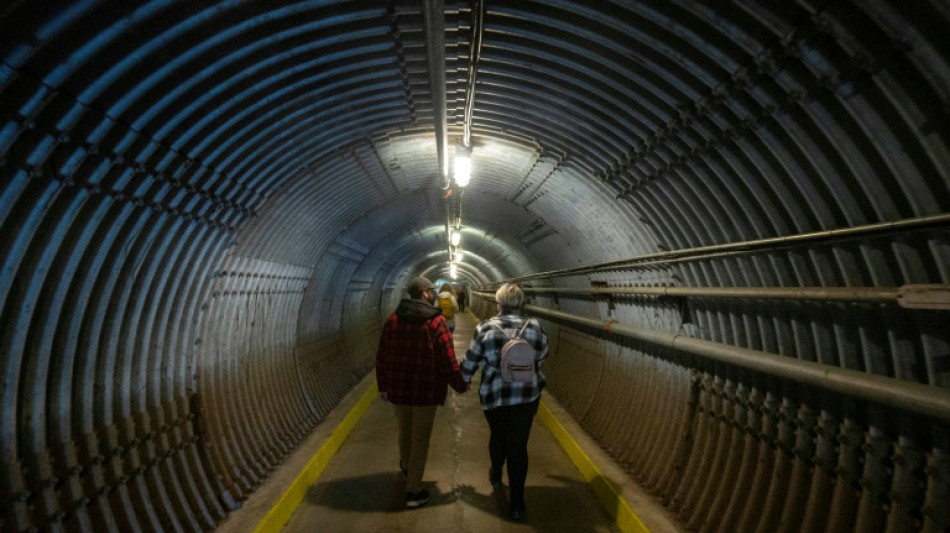
Canadians fearing nuclear apocalypse flock to visit Cold War bunker / Photo: Lars Hagberg - AFP/File

 Oil prices spike after Trump rejects Iran truce offer
 Taylor Swift sets new record at MTV VMAs
 Seoul seeks apology after Ukraine reveals transfer of North Korean POWs

 Messi on target again but Miami downed by Columbus

 In Washington's political cauldron, a fight over foie gras
 Flavio Bolsonaro: political heir in his father's shadow
 Ravens grab last-second win in Rio as Commanders stop Seahawks

 USA rallies to capture 11th consecutive Presidents Cup

 Phillies clinch, Astros wrap up division on final day of MLB season

 Commanders hand champion Seahawks their first loss

 Dupont scores twice to send Toulouse top of Top 14

 Ireland beat Israel but no handshakes due to war in Gaza

 Tense standoff over flashpoint N.Ireland parade lasts into night

 Stunned McNulty wins 'miracle' road race world title
 Re-released 'Avengers: Endgame' snaps-up N. America box office lead
 American McNulty wins shock road race world title
 Serbia's President Aleksandar Vucic announces resignation

 Tuchel urges Bellingham to play with 'rage'

 Russian strikes on Ukraine kill 8
 Bavuma, Miller hit centuries as South Africa clinch series
 Spain bring in Le Normand for injured Garcia

 UK Labour party meets buoyed by Burnham but seeking concrete plans

 Nor'easter lashes US east with punishing rain and wind

 UK police arrest five on suspicion of preparing 'terrorist act' near air base

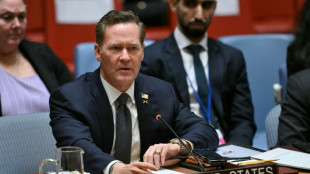 Washington denounces Iran's truce proposal as 'cynical'

A shed on a hillside on the outskirts of Canada's capital hides a Cold War bunker that has been fielding a surge of queries since Russia's invasion of Ukraine, asking if it is operational.
It's now a museum, so the answer of course is no.
Inside, past displays of atomic bombs, a blast tunnel opens up to decontamination showers. There's also a medical clinic, a vault for gold bullion, a radio studio, and a sparse chamber for the prime minister.
Gravel packed around the structure was meant to mitigate shocks from a nuclear strike, while everything inside is secured, including toilets mounted on rubber.
Tour guide Graham Wheatley, 67, vividly recalls fearing nuclear annihilation in his youth.
"There was always a lot of nuclear saber-rattling back in the 60s with (Nikita) Khrushchev and his shoe banging at the UN and 'We will bury you' speech, and then the Cuban Missile Crisis," he says.
"There was a general anxiety," adds visitor Janet Fisher.
That dread has returned, as Moscow steps up its nuclear threats.
"When Russia invaded Ukraine, we had a lot of public inquiries about whether this museum still functions as a fallout shelter," Christine McGuire, its executive director, told AFP.
And the daily barrage of calls has persisted, she said. "That fear is still very real. Anxieties are coming back. We're seeing remnants of the Cold War with the global tensions."
In light of war in Ukraine's impacts -- as well as the growing climate crisis -- the Bulletin of the Atomic Scientists in late January moved their symbolic "Doomsday Clock" to just 90 seconds to midnight -– its closest approach ever to humanity's "self-annihilation."
And on Tuesday, Russian President Vladimir Putin announced his country would suspend its participation in the New START nuclear arms treaty with the United States -- though Moscow's foreign ministry later said it still planned to abide by its regulations.
- Surviving an apocalypse -
The 100,000-square-foot (9,300-square-meter) underground bunker was built between 1959 and 1961 to house more than 500 key civilian, military and government officials to run Canada following a nuclear attack.
After 30 days, when radiation was expected to drop to safer levels, "some lucky person would be chosen to go above ground to see what our post-apocalyptic world looked like and how we were going to rebuild the country," McGuire said.
The top secret outpost, commissioned by then-prime minister John Diefenbaker, was officially called the Central Emergency Government Headquarters or CEGHQ Carp, after the town in which it's located.
Decommissioned in 1991 at the end of the Cold War, it reopened as a museum in 1998 and welcomes close to 70,000 visitors a year.
Speaking in what was the war cabinet room deep inside the four-level facility, McGuire said it remains "an important reminder of how close we all came to global annihilation during the Cold War."
- Fallout from US -
Some 2,000 government and private bunkers in back yards or basements were built across Canada at the onset of the Cold War, far fewer than in the United States or Europe, estimates Andrew Burtch, a Cold War historian at the Canadian War Museum.
"The Cold War brought with it the spectre of nuclear annihilation. And so governments around the world had to think about the best ways in which to prepare for a nuclear attack and how to coordinate the response to it after the fact," he recounted.
"The solution that many countries came to," he said, "was some form of underground (facility) to protect against the main effects of the nuclear bomb, be it the blast, radiation or heat."
Canada planned to deal with radioactive fallout, but was less concerned about threats of direct strikes on its cities.
"The idea was that the Russians would not waste their bombs or missiles on Canada but rather target them at the United States," Burtch explained.
There were several scares between 1947 and 1991. "Nuclear weapons were everywhere during the Cold War, and the threat to use those weapons was periodic and tended to come during periods of high tension," he said.
"Now we find ourself back in the position where we were," he lamented. "So it's quite a disconcerting time."
A.P.Maia--PC