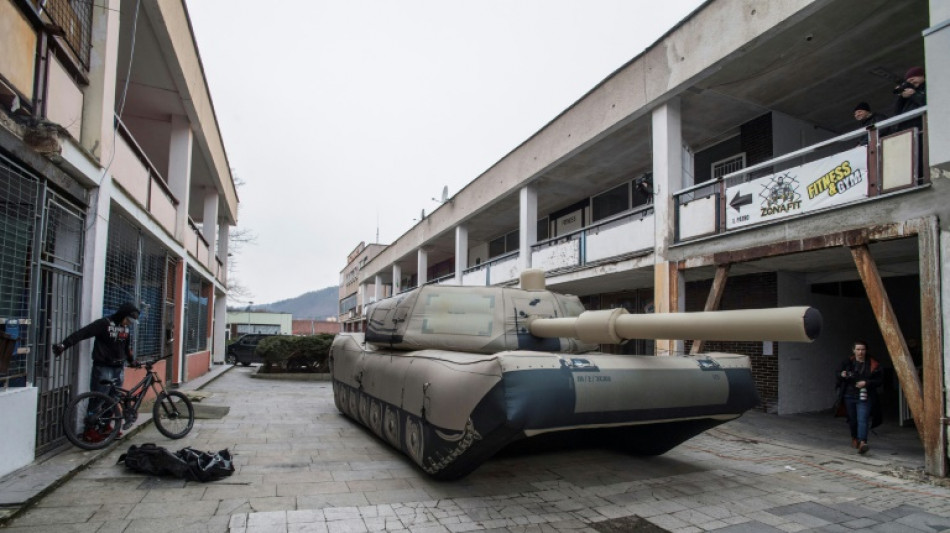
Czech inflatable weapon decoys a hit as Ukraine war rages / Photo: Michal Cizek - AFP

 Burnham Government Announces Neighbourhood Support Teams to Reduce Hospital Admissions

 KFF Health News Readers Weigh In on Healthcare Policy, Ethics, and Workforce Shortages

 16-Year-Old Founder Targets 'Cost Per Kill' With AI Missile Startup

 Elon Musk Promises Steering-Wheel-Free Tesla Model Y Amid Cybercab Sales Launch

 Tosca's 2026 Sustainability Report Makes the Case for Packaging as Critical Supply Chain Infrastructure

 Eisai's Dayvigo Shows Year-Long Efficacy Without Tolerance Ahead of Korean Launch
A Czech company producing inflatable weapon decoys, including Himars rocket launchers and Abrams tanks, said Monday it had seen a spike in demand since the Russian invasion of Ukraine started last year.
The synthetic silk decoys inflated with an electric or petrol blower are used to fool the enemy in the battlefield, making them target the air-filled decoys instead of real weaponry.
The Inflatech company's managers have refused to confirm selling their products to Ukraine, citing military secrecy, but they admitted output had jumped by 100 percent over the past 12 months.
"Definitely we're selling to a lot of governments around the world, not only in Europe," sales and marketing director Poven Kumaresan told reporters.
He added that Inflatech's three dozen employees currently produce 30-40 decoys a month.
These decoys including tanks, armoured vehicles and even jet fighters, weigh between 25 and 90 kilos and take two to four people to handle in the battlefield.
Kumaresan said the company can come up with a new design within 72 hours if it has the exact plans of the original piece of military hardware, while it takes up to two weeks if working "from scratch".
He added it had taken 60 days to ship a replica Himars rocket launcher after the order was placed.
Inflatech has so far rolled out "dozens" of fake Himars rocket launchers while the real weapon is wreaking havoc on Russian invaders in Ukraine.
- Inflated to be blown apart -
Inflatech's products are classified as military materiel and must be approved by government authorities.
The Czech government said last month it had provided Ukraine with military aid worth about half a billion dollars since the invasion started on February 24, 2022.
Inflatech chief executive Vojtech Fresser said key qualities included a look true to the original.
"If I don't have binoculars, looking from a distance of 150-200 metres (yards) I won't be able to tell whether it is a real weapon or a decoy," he said.
The engine used to inflate the weapons also emanates heat that will fool the enemy's infrared sensors.
He said the inflatable decoys cost between $10,000 and $100,000, much less than the rockets used to destroy them.
"If I force the enemy to destroy my product with something that is at least four times as expensive -- but in practice it is even 20 times -- then I win economically," Fresser said.
Kumaresan said the company keeps upgrading its products, looking to make the decoys mobile in the future.
Inflatech, which originally made the decoys for training purposes, used to produce toys or tailor-made models according to customers' wishes.
"We produce according to the customer's specific needs. We're not an e-shop where you could choose," said Fresser.
He added that there is "no limit" on output or product range, and that the company expects rapid growth over the next three years.
"Of course I would prefer to produce toys for children. But first of all we must ensure a safe world for them," Fresser said.
X.Brito--PC


