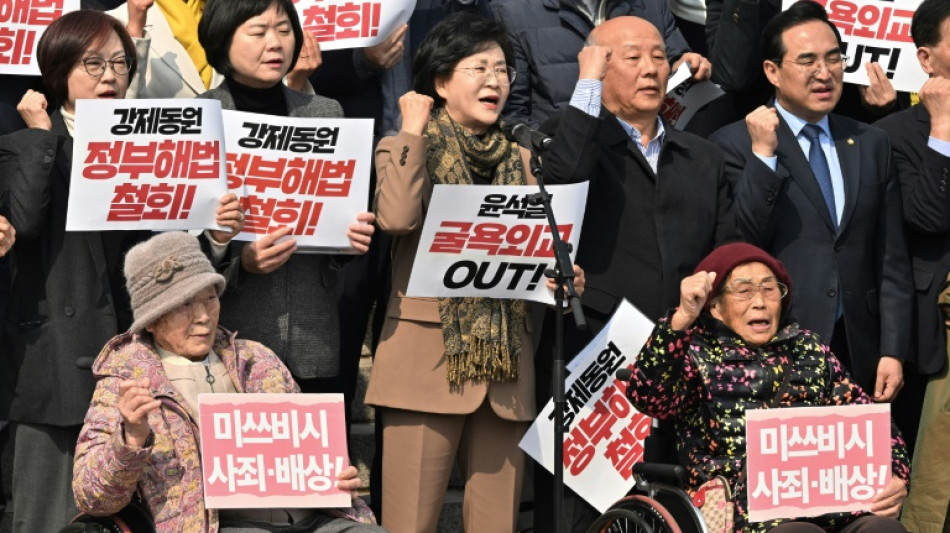
WWII forced labour victims lash out at South Korea's 'dirty money' plan / Photo: Jung Yeon-je - AFP

 Burnham Government Announces Neighbourhood Support Teams to Reduce Hospital Admissions

 KFF Health News Readers Weigh In on Healthcare Policy, Ethics, and Workforce Shortages

 16-Year-Old Founder Targets 'Cost Per Kill' With AI Missile Startup
 Elon Musk Promises Steering-Wheel-Free Tesla Model Y Amid Cybercab Sales Launch

 Tosca's 2026 Sustainability Report Makes the Case for Packaging as Critical Supply Chain Infrastructure

 Eisai's Dayvigo Shows Year-Long Efficacy Without Tolerance Ahead of Korean Launch
South Koreans who were forced to work for Japanese companies during World War II on Tuesday denounced Seoul's new plan to compensate them and end a historic dispute with Tokyo as "dirty money".
Seoul announced plans Monday to pay the victims with money taken from South Korean companies that benefited from a 1965 reparations deal, in a bid to break the "vicious cycle" in its relations with Tokyo.
Japan and the United States immediately welcomed the plan, which does not involve a fresh apology and envisages only voluntary contributions from the Japanese companies involved, such as Mitsubishi and Nippon Steel.
But victims' groups said it fell far short of their demand for a full apology from Japan and direct compensation from the companies involved.
"I am 95 years old and I don't know if I die today or tomorrow. But never in my life have I felt so distressed," Yang Geum-deok, who worked at a Mitsubishi factory during the war, said at a rally in Seoul.
"Even if I die of hunger, I would not accept that dirty money," she yelled, waving a placard that said: "Mitsubishi must apologise and compensate!"
Seoul aims to resolve lingering issues stemming from Japan's brutal 1910-45 occupation of the Korean peninsula as it seeks closer ties with Tokyo in the face of growing threats from North Korea.
Around 780,000 Koreans were conscripted into forced labour by Japan during the colonial period, according to data from Seoul.
That number does not include Korean women forced into sexual slavery by Japanese troops.
"It was the Japanese who dragged us to Japan. Who do we turn to demand an apology?" said victim Kim Sung-joo at the rally, which was also attended by opposition politicians.
South Korea's President Yoon Suk Yeol defended the plan Tuesday, saying it was essential "for freedom, peace and prosperity, not only bilaterally but globally".
The two countries restored diplomatic ties with the signing of the 1965 treaty, which included a reparations package of about $800 million in grants and cheap loans.
Japan has long insisted that the agreement settled all claims relating to the colonial period.
It is unclear whether Japanese companies will make any contributions, with Nippon Steel saying Monday: "Our company's understanding is that this issue has been resolved by the 1965 agreement".
H.Silva--PC