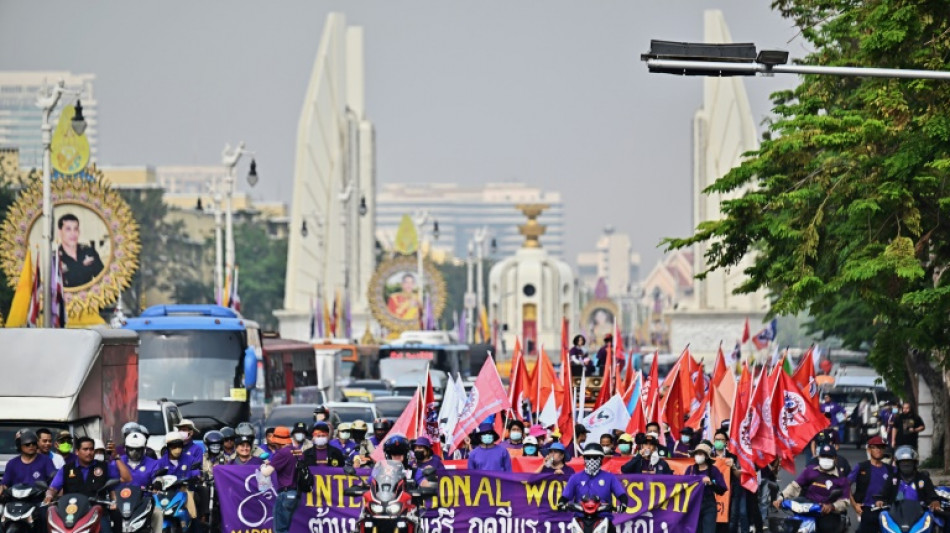
Women march as rights under threat across the globe / Photo: Lillian SUWANRUMPHA - AFP

 2027 Toyota Sienna Gets Sixth-Gen Hybrid System, More Power, and Trim Changes

 Burnham Government Announces Neighbourhood Support Teams to Reduce Hospital Admissions

 KFF Health News Readers Weigh In on Healthcare Policy, Ethics, and Workforce Shortages

 16-Year-Old Founder Targets 'Cost Per Kill' With AI Missile Startup

 Elon Musk Promises Steering-Wheel-Free Tesla Model Y Amid Cybercab Sales Launch

 Tosca's 2026 Sustainability Report Makes the Case for Packaging as Critical Supply Chain Infrastructure

 Eisai's Dayvigo Shows Year-Long Efficacy Without Tolerance Ahead of Korean Launch
Women were beginning to hit the streets en masse across the globe on Wednesday to defend rights that are coming under increasing attack.
To mark International Women's Day, capitals across the world are hosting marches, rallies and demonstrations, including Madrid, where broad tree-lined boulevards are regularly packed with a sea of purple, a colour often associated with women's rights.
Marches took place on Wednesday in Thailand and Indonesia, where a few dozen women gathered in front of the country's parliament to urge lawmakers to pass a long-awaited bill to protect domestic workers and some chanted "long live Indonesian women".
With the Taliban government's banning of women from universities in Afghanistan, Iran's repression of the Mahsa Amini protests, new US restrictions on abortion rights and the Ukraine war's impact on women, there are many reasons to protest.
Global progress on women's rights is "vanishing before our eyes," UN chief Antonio Guterres warned on Monday, saying gender equality would take another three centuries to achieve.
"Women's rights are being abused, threatened, and violated around the world," he added, pointing to Afghanistan, where "women and girls have been erased from public life".
Afghan universities reopened on Monday after a winter break, but only men returned to classes with the Taliban authorities' ban on women in higher education still in force some 18 months after they seized power.
On the eve of International Women's Day, the European Union imposed sanctions on individuals and entities deemed to be responsible for violence and rights abuses against women.
The Taliban's higher education minister Neda Mohammad Nadeem was sanctioned for depriving women from university learning.
The sanctions also targeted officials from five other countries -- Iran, Russia, South Sudan, Myanmar and Syria.
- Mobilising over abortion rights -
In Europe, marches will take place in many countries, including France, where demonstrators will demand "equality both at work and in life" in around 150 towns and cities, a far higher number than in previous years, organisers say.
The protests will focus on the fight against France's deeply-unpopular pension reform which critics say is unfair to women.
In London, the Madame Tussauds museum will mark the day by unveiling a new waxwork of suffragette leader Emmeline Pankhurst, who began an intense struggle 120 years ago that won women's right to vote.
Elsewhere, demonstrations have been banned.
In Pakistan, where marches are criticised for promoting liberal Western values and for not respecting religious and cultural sensitivities, organisers have had to fight multiple court challenges to press ahead with demonstrations.
And in communist-run Cuba, activists seeking permission to demonstrate were arrested earlier this year, with feminist organisations instead urging people to join a "virtual march" on social media to raise awareness about gender violence and femicides.
Wednesday will see feminists mobilising in particular over abortion rights following the US Supreme Court's decision in June to overturn the 1973 Roe v. Wade decision that had guaranteed a woman's constitutional right to terminate a pregnancy.
In Europe, that right has also been undermined recently in Hungary and Poland.
"We are fighting against a patriarchy... that fights ad nauseam against rights -- such as the right to abortion -- that we have won through struggle," read the manifesto of the Madrid march, which is set to begin at 1800 GMT.
burs-mig/mg/hmw/mca
P.Serra--PC