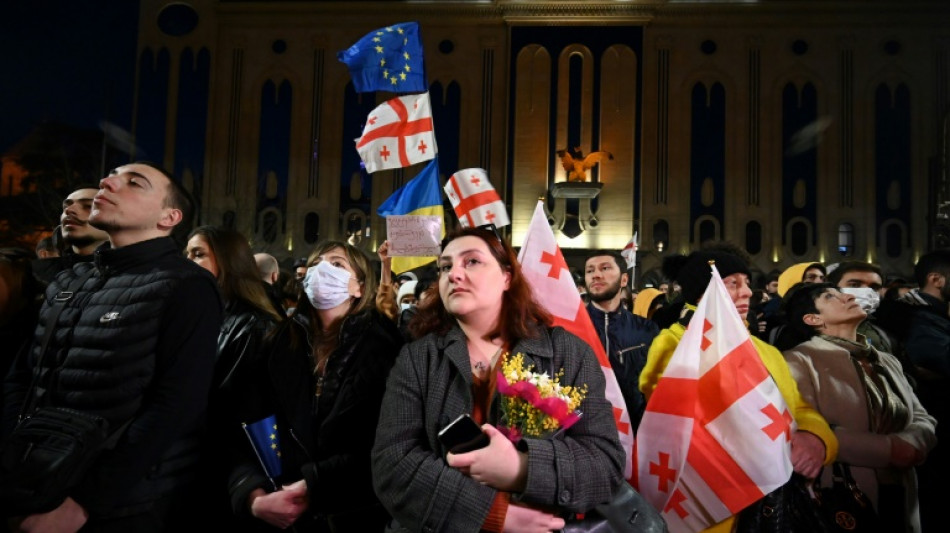
Georgia drops 'foreign agent' bill after mass protests / Photo: Vano SHLAMOV - AFP

 2027 Toyota Sienna Gets Sixth-Gen Hybrid System, More Power, and Trim Changes

 Burnham Government Announces Neighbourhood Support Teams to Reduce Hospital Admissions

 KFF Health News Readers Weigh In on Healthcare Policy, Ethics, and Workforce Shortages

 16-Year-Old Founder Targets 'Cost Per Kill' With AI Missile Startup

 Elon Musk Promises Steering-Wheel-Free Tesla Model Y Amid Cybercab Sales Launch

 Tosca's 2026 Sustainability Report Makes the Case for Packaging as Critical Supply Chain Infrastructure

 Eisai's Dayvigo Shows Year-Long Efficacy Without Tolerance Ahead of Korean Launch
Georgia's ruling party announced on Thursday it was halting plans to introduce a controversial "foreign agent" bill after mass rallies against the legislation seen as reminiscent of Russian legislation used to silence critics.
Concern has been growing that the ex-Soviet nation, which aspires to join the EU and NATO, is taking an authoritarian turn and maintaining links with Moscow.
The announcement came after two days of large-scale protests, including a rally Wednesday that saw Georgian police fire water cannon and tear gas at thousands of demonstrators and issue a dispersal order.
Ruling party Georgian Dream said in a statement the bill had been "represented in a bad light and in a misleading way," adding that it would launch public consultations to "better explain" the law's purpose after announcing its withdrawal.
A European Union delegation in Georgia immediately cheered the halt, saying they "encourage all political leaders in Georgia to resume pro-EU reforms."
Massive crowds had gathered in front of the parliament building in central Tbilisi on Wednesday, holding EU and Georgian flags, and chanting "no to the Russian law".
The protesters demanded authorities drop the bill on "transparency of foreign funding," which critics said mirrors a law used in Russia to force media and dissenting groups to shut down.
Elene Ksovreli, 16, said Georgians did not want to see their future threatened.
"We will not allow them to make Russia define our future," she told AFP. "We, young people, are here to protect our everything."
Another demonstrator, 72-year-old Aza Akhvlediani, called the country's government "stupid".
"I know what's happening in Moscow. They stop every passerby and do whatever they please to them. I think the Georgian government wants the same," she said.
- 'Big moment' -
In response to the unfurling situation, Washington urged the government to show "restraint" and allow peaceful protests, while Ukrainian President Volodymyr Zelensky called for "democratic success" in "friendly Georgia".
Protesters were also out Tuesday after ruling party lawmakers approved the draft law on "foreign agents" in its first reading.
Clashes ensued with police using tear gas and water cannon against the demonstrators.
Police said more than 70 demonstrators had been detained and 50 police officers injured during the protests Tuesday.
Tom de Waal, a senior fellow at Carnegie Europe, said that both the bill and crackdown represented a serious challenge in the politically turbulent country.
"It's a big moment for Georgia, still a democracy, but definitely a struggling one," he said on Twitter.
In Russia, the Kremlin has extensively used the "foreign agent" label against opponents, journalists and human rights activists accused of leading foreign-funded political activities.
Georgian authorities have faced mounting international criticism over a perceived backsliding on democracy, seriously damaging Tbilisi's ties with Brussels.
Georgian Prime Minister Irakli Garibashvili has defended his "balanced" policy as aimed at ensuring "peace and stability".
Russia and Georgia fought a five-day war in 2008.
Georgian President Salome Zourabishvili has expressed support for the demonstrators and vowed to veto the legislation.
- 'Dark day' -
"Today is a dark day for Georgia's democracy," the US embassy in Georgia said after the initial reading of the bill.
According to the ministry, 76 people had been arrested for minor hooliganism and disobeying law enforcement following Tuesday's clashes.
One more person was held for attacking the police, the ministry said.
Georgia applied for EU membership together with Ukraine and Moldova days after Russia invaded Ukraine in February last year.
In June, EU leaders granted formal candidate status to Kyiv and Chisinau but said Tbilisi must implement a number of reforms first.
Plans to join NATO and the EU are enshrined in Georgia's constitution and are supported by at least 80 percent of the population, according to opinion polls.
Late last month, European Union member states issued a formal diplomatic warning to Georgia's leaders over Saakashvili's health.
X.M.Francisco--PC


