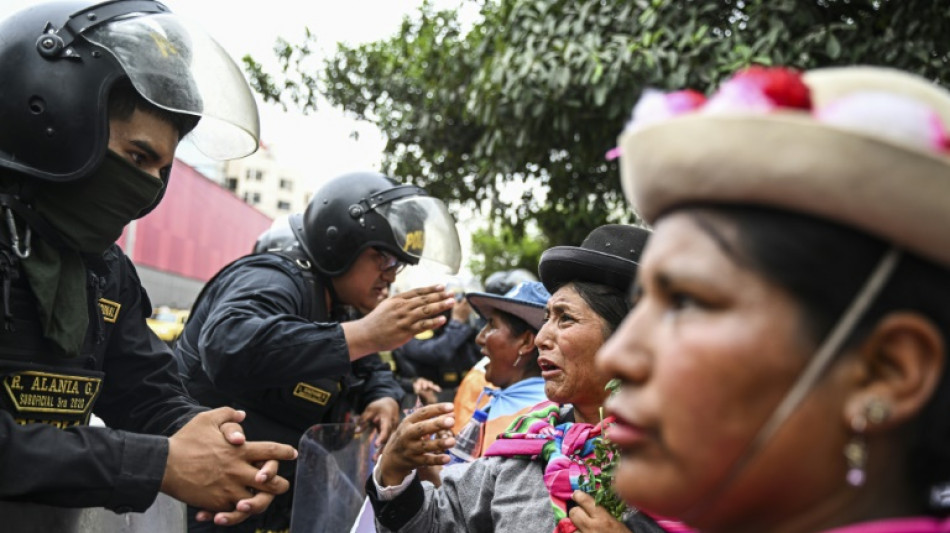
Freedom House downgrades Peru, Burkina Faso but sees bright spots / Photo: Ernesto BENAVIDES - AFP

 2027 Toyota Sienna Gets Sixth-Gen Hybrid System, More Power, and Trim Changes

 Burnham Government Announces Neighbourhood Support Teams to Reduce Hospital Admissions

 KFF Health News Readers Weigh In on Healthcare Policy, Ethics, and Workforce Shortages

 16-Year-Old Founder Targets 'Cost Per Kill' With AI Missile Startup

 Elon Musk Promises Steering-Wheel-Free Tesla Model Y Amid Cybercab Sales Launch

 Tosca's 2026 Sustainability Report Makes the Case for Packaging as Critical Supply Chain Infrastructure

 Eisai's Dayvigo Shows Year-Long Efficacy Without Tolerance Ahead of Korean Launch
Peru and Burkina Faso led a global deterioration in freedom last year but a number of other nations made improvements, giving hope in the fight against authoritarianism, Freedom House said Thursday.
In its 50th annual report, the US democracy research group downgraded both Peru and Burkina Faso on its list of countries' freedom level and also assessed declines in Russia, Nicaragua, El Salvador and Hungary, among others.
Peru, whose political chaos grew last year with the impeachment of president Pedro Castillo after he tried to dissolve congress and rule by decree, was moved from free to partly free, while Burkina Faso, which endured two coups in 2022, went down to not free.
But Colombia and Lesotho were both upgraded to free from partly free. Colombia saw the election of its first left-wing president, Gustavo Pedro, who has vowed to increase democratic inclusion, while Lesotho elected diamond tycoon Sam Matekane on a platform of transparency and economic reforms in the landlocked African nation.
Despite the net decline in freedom around the world, Freedom House also saw improvements in nations including Slovenia, Kosovo, Kenya, Malaysia, the Philippines and Zambia.
The 2022 report "documents a continuation of troubling trends, but it also gives some reason to hope that the freedom recession of the past 17 years may be turning a corner," Freedom House president Michael Abramowitz said in a statement.
Latin America is a key frontline, with the opposite shifts in rankings for Colombia and Peru. The report covers the time before the inauguration in Brazil of President Luiz Inacio Lula da Silva, who defeated the far-right Jair Bolsonaro.
"For years, Latin America was a stable region, there were relatively high levels of freedom and Cuba as an outlier, until authoritarian consolidation took hold in Venezuela and then in Nicaragua," said Amy Slipowitz, a co-author of the report.
In Peru, she pointed to authoritarian steps taken by former president Alberto Fujimori, who ruled from 1990 to 2000, as a harbinger of recent trends in the country, which has seen six presidents in five years.
"One of the trends we found in the broader global research was that both coups and attempted coups can lead to long-term deterioration down the line," she said, pointing to after-effects of the 2014 military takeover in Thailand and the 2016 attempt to oust Turkish President Recep Tayyip Erdogan.
India, which boasts of being the world's largest democracy, was listed as partly free for the third straight year after being downgraded over curbs on civil liberties and freedom of expression under Prime Minister Narendra Modi.
Freedom House is primarily funded by the United States as well as other democratic governments but operates independently.
G.Machado--PC


