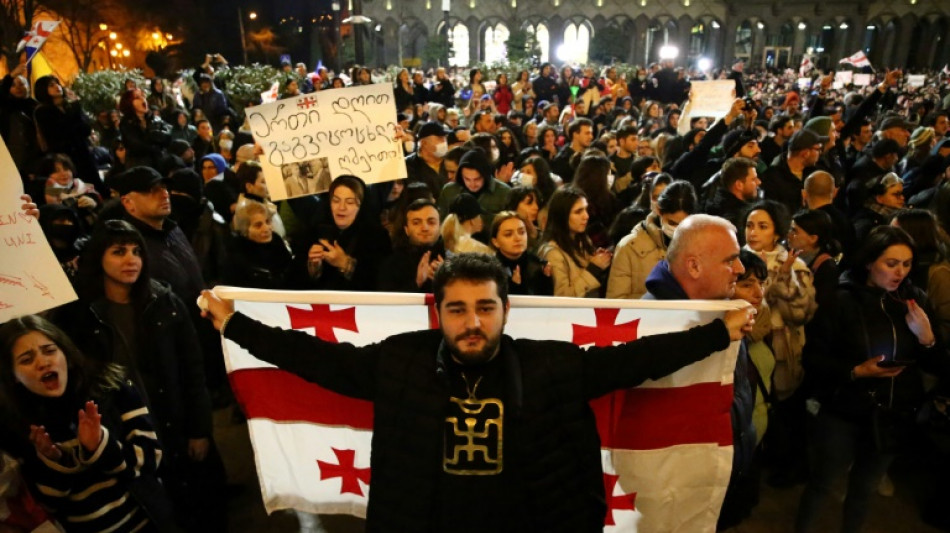
Tens of thousands rally in Georgia despite govt backtracking on controversial bill / Photo: Zurab TSERTSVADZE - AFP

 2027 Toyota Sienna Gets Sixth-Gen Hybrid System, More Power, and Trim Changes

 Burnham Government Announces Neighbourhood Support Teams to Reduce Hospital Admissions

 KFF Health News Readers Weigh In on Healthcare Policy, Ethics, and Workforce Shortages

 16-Year-Old Founder Targets 'Cost Per Kill' With AI Missile Startup

 Elon Musk Promises Steering-Wheel-Free Tesla Model Y Amid Cybercab Sales Launch

 Tosca's 2026 Sustainability Report Makes the Case for Packaging as Critical Supply Chain Infrastructure

 Eisai's Dayvigo Shows Year-Long Efficacy Without Tolerance Ahead of Korean Launch
At least 30,000 protesters took to the streets of Georgia for a third day running Thursday despite the ruling party's promise to drop a controversial "foreign agent" bill reminiscent of Russian legislation used to silence critics.
Waving Georgian, Ukrainian and EU flags, protesters gathered outside the parliament building in the capital Tbilisi, piling pressure on the government accused of flirting with the Kremlin and putting the Black Sea nation on an authoritarian path.
Georgian and Ukrainian anthems as well as the "Ode to Joy", the European Union anthem, were performed at the rally. Protesters also shouted anti-government slogans, with some demonstrators calling on the government to resign.
"Our government is our sole obstacle to joining the EU, which is ready to give us (membership) candidacy," mathematician Eka Kamkamidze, 39, told AFP.
Another protester, 30-year-old painter Mamuka Kiria, said: "Georgians are united in their will to join Europe and the government is isolated -- from its people and internationally."
The protesters wanted "early elections" to push the ruling Georgian Dream party out of power, he said.
- 'First victory' -
Tens of thousands took to the streets this week after lawmakers gave their initial backing to the "foreign agents" bill. On Tuesday and Wednesday Georgian police fired water cannon and tear gas at the demonstrators.
On Thursday morning, the Georgian Dream ruling party backtracked under pressure, announcing it would drop the bill, but the opposition said it would stage more rallies.
On Thursday evening, President Salome Zurabishvili sent a message of support to the protesters in a televised address from New York.
"I want to congratulate society on its first victory. I am proud of the people who made their voices heard," Zurabishvili said.
"There is distrust towards the government as we pursue our European path."
Opposition parties said in a joint statement that the protests would continue, pointing to a lack of guarantees "that Georgia is firmly on a pro-Western course".
They also called for the immediate release of dozens of protesters they said had been detained. The interior ministry said on Thursday evening that all the detained people had been freed.
- 'European future' -
Georgian authorities have faced mounting international criticism over a perceived backsliding on democracy, seriously damaging Tbilisi's ties with Brussels.
Brussels and Washington denounced the plans to introduce a "foreign agent" law as a heavy blow to Georgia's democracy.
The EU delegation in Georgia welcomed the government's announcement that it was withdrawing the draft law, adding that they "encourage all political leaders in Georgia to resume pro-EU reforms".
The US embassy in Tbilisi also welcomed the news.
"The Georgian people have, once again, spoken clearly that the only choice for Georgia is a secure and prosperous European future," said an embassy statement.
"We urge the ruling party to officially retract these bills and not pursue further this type of legislation, which is incompatible with Georgian and European values and the protection of fundamental freedoms."
The Kremlin on Thursday expressed concern at the mass protests in neighbouring Georgia.
Moscow and Tbilisi went to war in 2008 and Russia still controls Georgia's breakaway Abkhazia and South Ossetia regions, although the territories are recognised internationally as part of Georgia.
- 'Big moment' -
Tom de Waal, a senior fellow at Carnegie Europe, said both the bill and the police crackdown on protesters represented a serious challenge in the politically turbulent country.
"It's a big moment for Georgia, still a democracy, but definitely a struggling one," he said on Twitter.
In Russia, the Kremlin has used the "foreign agent" label against opponents, journalists and human rights activists accused of leading foreign-funded political activities.
Since Russia invaded Ukraine, Georgia has hosted an influx of anti-war Russians. But in recent weeks authorities have barred some Kremlin critics from entering the country, and some observers have warned of a drift towards Moscow.
Georgia's treatment of jailed ex-president Mikheil Saakashvili, whose health has drastically deteriorated in prison, has also drawn international condemnation.
The ruling party has insisted it remains committed to Georgia's EU and NATO membership bid, enshrined in the constitution and supported -- according to opinion polls -- by at least 80 percent of the population.
Georgian Prime Minister Irakli Garibashvili has defended his "balanced" policy as aimed at ensuring "peace and stability".
Last June, EU leaders granted formal candidate status to Kyiv and Chisinau but said Tbilisi must implement reforms first.
G.Machado--PC


