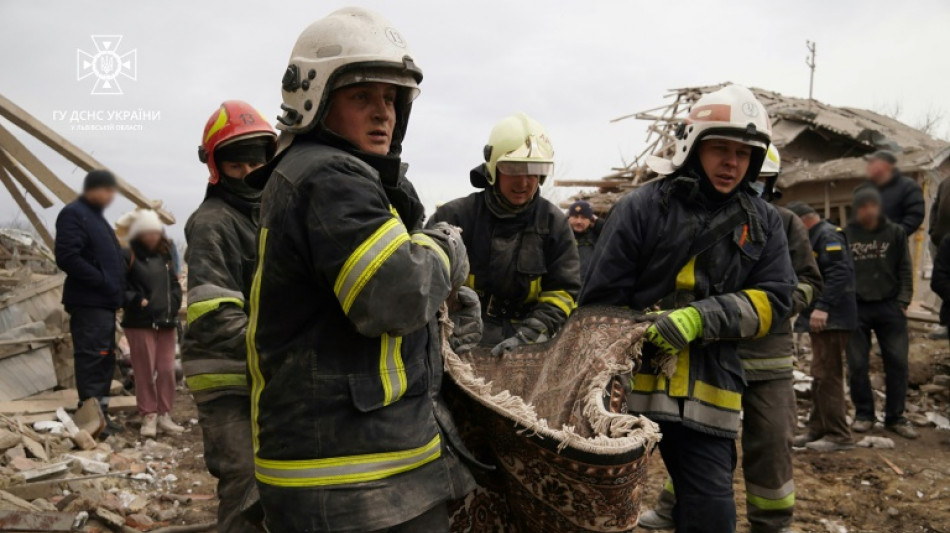
Russia pounds Ukraine with barrage of rare hypersonic missiles / Photo: Handout - UKRAINIAN EMERGENCY SERVICE/AFP

 2027 Toyota Sienna Gets Sixth-Gen Hybrid System, More Power, and Trim Changes

 Burnham Government Announces Neighbourhood Support Teams to Reduce Hospital Admissions

 KFF Health News Readers Weigh In on Healthcare Policy, Ethics, and Workforce Shortages

 16-Year-Old Founder Targets 'Cost Per Kill' With AI Missile Startup

 Elon Musk Promises Steering-Wheel-Free Tesla Model Y Amid Cybercab Sales Launch

 Tosca's 2026 Sustainability Report Makes the Case for Packaging as Critical Supply Chain Infrastructure

 Eisai's Dayvigo Shows Year-Long Efficacy Without Tolerance Ahead of Korean Launch
Nine people were killed across Ukraine on Thursday, as Russia unleashed a barrage of high-precision missile and other attacks that triggered a wave of power cuts, including at Europe's biggest nuclear power plant.
The blackout at the Zaporizhzhia nuclear plant prompted the UN nuclear agency's chief to issue a dire warning that next time "luck will run out", while President Volodymyr Zelensky called on the West to impose sanctions on Russia's atomic industry.
Russia said the strikes, involving rare hypersonic missiles, were retaliation for a border incursion earlier this month.
Moscow also cast doubt over the extension of a vital UN-brokered grain deal which helped ease a global food crisis caused by the invasion, saying it would discuss its renewal with the UN on Monday.
A total of 81 missiles were launched, Zelensky said, killing five people in the western Lviv province, and one person in the eastern city of Dnipro.
At least three other people were killed in a separate shelling attack on a bus stop in the southern city of Kherson, according to Ukrainian officials.
Washington called the missile strikes "brutal and unjustified".
Zelensky said the attacks were "another attempt by a terrorist-state to fight against civilization," and vowed that Ukraine will not be defeated.
"Our state and our people will never be in chains," Zelensky said in his daily address to the nation. "Neither missiles nor atrocities will help Russia achieve this."
In a phone call with European Union chief Ursula von der Leyen, Zelensky called on the West to boost economic pressure on Russia. In his evening statement he also called for sanctions on Russia's nuclear industry following the Zaporizhzhia blackout.
"A terrorist state cannot be left with any opportunity to use any nuclear facilities anywhere in the world for terror," Zelensky said.
- 'We thought we were safe' -
In Velyka Vilshanytsia, a small village not far from the Polish border, villagers searched through the rubble, shocked by the first civilian deaths in the western region considered relatively safe and far from the front lines.
"We thought we were safe here," said Oksana Ostapenko, who lost her sister and two brothers-in-law when the missile struck.
For months Russia has pummelled key infrastructure in Ukraine with missiles and drones -- disrupting water, heating and electricity supplies for millions of people.
Kyiv mayor Vitali Klitschko said two people were wounded on Thursday and 40 percent of the population had been left without power for several hours.
On Prospekt Peremogy, in the west of Kyiv, three cars parked near a high-rise apartment building were charred and the ground was littered with shattered glass from windows, an AFP reporter said.
"I'd seen (the missile) flying towards my block of flats and when I got there I saw a big fire," said resident Igor Yezhov, 60, a car dealer.
"I was very scared."
The Russian missile strikes also left the country's second city of Kharkiv in the northeast without power, water or heating, the regional governor said.
The strikes cut off electricity supplies to the Zaporizhzhia nuclear power plant -- in Russian occupied territory -- forcing it to operate on diesel generators before power was restored later on Thursday, Ukrainian officials said.
It was the sixth time that the facility had been disconnected from the electricity grid since Russian forces captured the plant last year, according to Kyiv.
Electricity is essential to operate pumps that circulate water to cool reactors and pools holding nuclear fuel.
The UN nuclear agency chief Rafael Grossi warned of the danger of the outages, saying "each time we are rolling a dice".
"If we allow this to continue time after time then one day our luck will run out," he warned.
- Transnistria claims -
The Russian army called the strikes "massive retaliation" in response to what it called "terrorist actions" by Kyiv in Russia's western Bryansk province last week. It said Moscow had used Kinzhal hypersonic missiles.
Moscow claims Ukrainian nationalists had crossed into the Bryansk region and killed two civilians, which Kyiv dismissed as a provocation.
Russia also called a vital UN-brokered grain deal -- that ensures supplies to large parts of the developing world -- "complicated" and not properly implemented.
It said it would discuss the renewal of the deal -- which expires on March 18 -- with the UN on Monday in Geneva.
The year-long Russian invasion of Ukraine has revived tensions in the pro-Russian separatist region of Transnistria in Moldova, where Moscow-backed authorities accused Ukraine of plotting a "terror attack".
Ukraine denied the claims as a "provocation orchestrated by the Kremlin."
On the ground, Russia reported gains in the battle for the industrial city of Bakhmut, which has been the focus of months of fierce combat.
A.Motta--PC