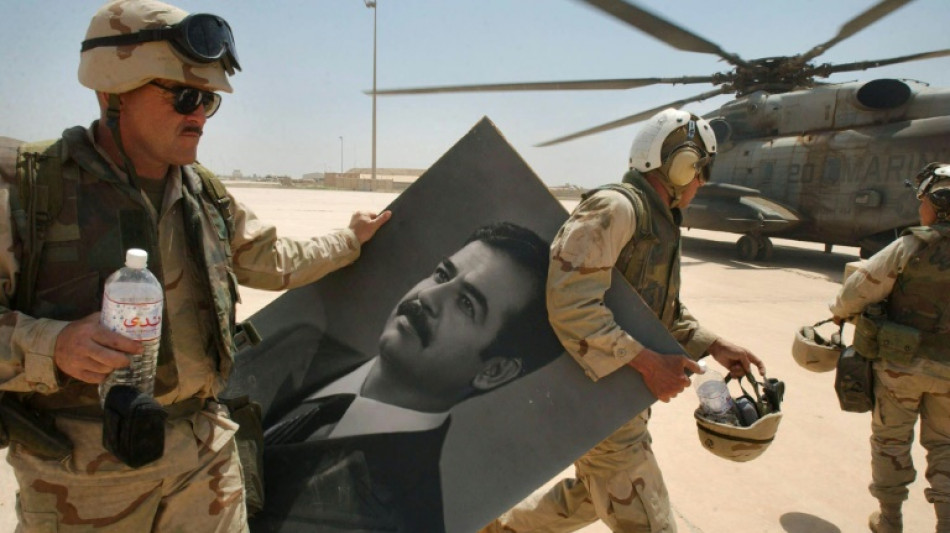
20 years after US invasion, Iraq far from 'liberal democracy' / Photo: ROMEO GACAD - AFP/File

 SpaceX puts Starship megarocket in orbit for first time
 Iran denies link to suspected bomb plot at UK airbase used by US
 Ex-boss Mancini says City charges 'not my concern'
 Berlin Marathon winner Assefa finished race with torn Achilles
 Comedian convicted for Erdogan 'insult' but freed pending appeal

 French prosecutors seek two-year sentence for ex-minister Dati in graft case

 Eala makes fast start as weather and transport woes hit Asian Games
 Hurricane Polo approaches Mexico, threatens severe damage
 Energy markets rally after Trump rejects Iran truce offer
 Japanese convenience store enlists Lady Gaga to bolster recruitment
 Seoul summons Ukraine envoy in row over North Korean POWs

 Ireland 'raised awareness worldwide' in Israel game: Hallgrimsson

 Colombian police capture wife, daughter of Ecuador drug lord
 More Asian Games woes as bus takes Pakistan team to wrong venue

 Radio frequencies vital to Earth observation must be protected: UN
 Comedian on trial for insulting Erdogan in standup show

 Women's Fashion Week kicks off in Paris

 Pope arrives in French border city to speak on united Europe
 The wildfires choking Indonesia, sparking regional haze
 PU Prime Deepens Argentina Presence Through FX Expo Buenos Aires 2026

 Nothing to seal here: NZ police help stranded pup home
 White House releases list of products US, China could tax less
 'Pseudo-journalism': Partisan 'news' sites target US midterms

 'Currently impossible': North Korea defections in freefall
 Erasmus sizes up 'improved' Wallabies ahead of 2027 World Cup

Twenty years after the US-led invasion of Iraq toppled Saddam Hussein, the oil-rich country remains deeply scarred by the conflict and, while closer to the United States, far from the liberal democracy Washington had envisioned.
President George W. Bush's war, launched in the aftermath of the 9/11 attacks, is seared in memory for its "shock and awe" strikes, the toppling of a giant Saddam statue, and the years of bloody sectarian turmoil that followed.
The decision after the March 20, 2003 ground invasion to dismantle Iraq's state, party and military apparatus deepened the chaos that fuelled years of bloodletting, from which the jihadist Islamic State group later emerged.
The US forces, backed mainly by British troops, never found the weapons of mass destruction that had been the justification for the war, and eventually left Iraq, liberated from a dictator but marred by instability and also under the sway of Washington's arch-enemy Iran.
"The US simply did not understand the nature of Iraqi society, the nature of the regime they were overthrowing," said Samuel Helfont, assistant professor of strategy at the Naval Postgraduate School in California.
Bush -- whose father had gone to war with Iraq in 1990-91 after Saddam's attack on Kuwait -- declared he wanted to impose "liberal democracy", but that drive petered out even if Saddam was overthrown quickly, Helfont said.
"Building democracy takes time and building a democracy doesn't create a utopia overnight," said Hamzeh Haddad, a visiting fellow at the European Council on Foreign Relations.
Instead of discovering nuclear, biological or chemical weapons, the assault by the US-led international coalition opened a Pandora's box, traumatised Iraqis, and alienated some traditional US allies.
Major violence flared again in Iraq after the deadly February 2006 bombing of a Muslim Shiite shrine in Samarra north of Baghdad, which sparked a civil war that lasted two years.
By the time the US withdrew under Barack Obama in 2011, more than 100,000 Iraqi civilians had been killed, says the Iraq Body Count group. The United States claimed nearly 4,500 deaths on their side.
- Chaos and corruption -
More horrors came to Iraq when the IS group declared its "caliphate" and in 2014 swept across nearly a third of the country -- a savage reign that only ended in Iraq in 2017 after a gruelling military campaign.
Today some 2,500 US forces are based in Iraq -- not as occupiers, but in an advisory, non-combat role in the international coalition against IS, whose remnant cells continue to launch sporadic bombings and other attacks.
The years of violence have deeply altered society in Iraq, long home to a diverse mix of ethnic and religious groups. The minority Yazidis were targeted in what the UN called a genocidal campaign, and much of the once vibrant Christian community has been driven out.
Tensions also simmer between the Baghdad federal government and the autonomous Kurdish authority of northern Iraq, especially over oil exports.
In October 2019, young Iraqis led a nationwide protest movement that vented frustration at inept governance, endemic corruption and interference by Iran, sparking a bloody crackdown that left hundreds dead.
Despite Iraq's immense oil and gas reserves, about one third of the population of 42 million lives in poverty, while some 35 percent of young people are unemployed, says the UN.
Politics remain chaotic, and parliament took a year, marred by post-election infighting, before it swore in a new government last October.
Prime Minister Mohammed Shia al-Sudani has vowed to fight graft in Iraq, which ranks near the bottom of Transparency International's corruption perceptions index, at 157 out of 180 countries.
"Every Iraqi can tell you that corruption began to thrive ... in the 1990s" when Iraq was under international sanctions, said Haddad, adding that graft is more in focus now "because Iraq is open to the world".
Iraq is battered by other challenges, from its devastated infrastructure and daily power outages to water scarcity and the ravages of climate change.
And yet, said Haddad, today's Iraq is a "democratising state" which needs time to mature because "democracy is messy".
- Iran gains influence -
A major unintended consequence of the US invasion has been a huge rise in the influence its arch foe Iran now wields in Iraq.
Iran and Iraq fought a protracted war in the 1980s, but the neighbours also have close cultural and religious ties as majority Shiite countries.
Iraq became a key economic lifeline for the Islamic republic as it was hit by sanctions over its contested nuclear programme, while Iran provides Iraq with gas and electricity as well as consumer goods.
Politically, Iraq's Shiite parties, freed from the yoke of Sunni dictator Saddam, have become "the most powerful players", says Hamdi Malik, associate fellow at the Washington Institute.
Iran-backed groups have managed to maintain a certain "cohesion" despite infighting after the last elections, he said, adding that "Iran is playing a crucial role" in making sure the cohesion lasts.
By contrast, Iraq's minority "Kurds and Sunnis are not strong players, mainly because they suffer from serious internal schisms", said Malik.
Pro-Iran parties dominate Iraq's parliament, and more than 150,000 fighters of the former Iran-backed Hashed al-Shaabi paramilitary forces have been integrated into the state military.
Baghdad must now manage relations with both Washington and Tehran, says a Western diplomat in Iraq speaking on condition of anonymity.
"It is trying to strike a balance in its relations with Iran, its Sunni neighbours and the West," the diplomat said. "It's a very delicate exercise."
A.Santos--PC