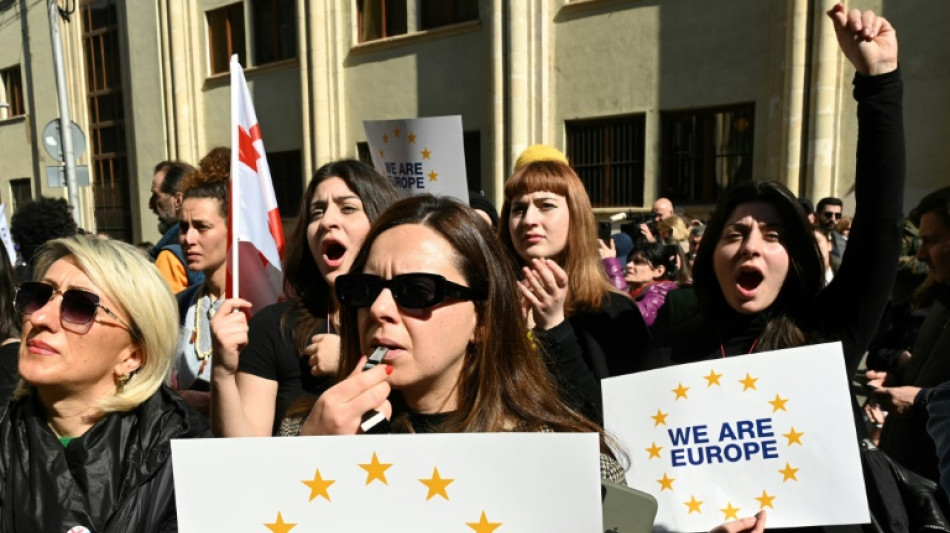
Georgians rally even as parliament scraps 'foreign agent' bill / Photo: Vano SHLAMOV - AFP

 2027 Toyota Sienna Gets Sixth-Gen Hybrid System, More Power, and Trim Changes

 Burnham Government Announces Neighbourhood Support Teams to Reduce Hospital Admissions

 KFF Health News Readers Weigh In on Healthcare Policy, Ethics, and Workforce Shortages

 16-Year-Old Founder Targets 'Cost Per Kill' With AI Missile Startup

 Elon Musk Promises Steering-Wheel-Free Tesla Model Y Amid Cybercab Sales Launch

 Tosca's 2026 Sustainability Report Makes the Case for Packaging as Critical Supply Chain Infrastructure

 Eisai's Dayvigo Shows Year-Long Efficacy Without Tolerance Ahead of Korean Launch
Hundreds of anti-government demonstrators rallied on Friday outside Georgia's parliament as lawmakers formally withdrew legislation reminiscent of Kremlin-designed rules used to hush dissent and which had sparked days of protests.
The mood was festive outside the legislature where the throngs of Georgians against the legislation blew whistles, waved their red and white flag and held signs that read: "We are Europe".
The protests reflect internal turmoil over the geopolitical destiny of Georgia, which aims to join the EU and NATO but also maintain fraught ties with Russia after a 2008 invasion.
Georgian lawmakers voted down the bill in second reading Friday after just one MP out of 36 backed the bill that critics had likened to Russian laws used to pressure civil society.
"This is a victory. We won thanks to our unity," said one of the demonstrators outside parliament, 21-year-old student Irina Shurgaia.
"The whole world saw that Georgians are united in their resolve to be part of the European family," she told AFP.
Protesters had clashed with police on Tuesday and Wednesday and law enforcement fired water cannon and tear gas to disperse the large-scale demonstrations.
The Georgian Dream ruling party buckled under pressure, announcing on Thursday that it would drop the bill.
But opposition parties said their protests would continue anyway, saying there were no guarantees "that Georgia is firmly on a pro-Western course."
Concerns have mounted that the Georgian government is flirting with the Kremlin and putting the Black Sea nation on an authoritarian path.
- 'Anti-Russian' sentiment -
President Salome Zurabishvili sent a message of support to the protesters congratulating them on their "first victory."
"There is distrust towards the government as we pursue our European path," she late Thursday in a televised address from New York.
But the Kremlin on Friday criticised that the president had issued her remarks from the United States and accused a third-party of stoking "anti-Russian" sentiment in the ex-Soviet republic.
"We see where the president of Georgia is addressing her people from," Kremlin spokesman Dmitry Peskov told reporters.
He said that as far as Moscow was concerned the protests were a domestic issue for Georgia and said the divisive law in Georgia actually mirrored US legislation, not Russian.
The European Union, United States and France welcomed the Georgian government's dropping of the bill.
The bloc called on Georgia to implement reforms the EU has put forward as a condition to granting the Black Sea nation a membership candidate status.
French President Emmanuel Macron said that pro-European Georgia "can count" on France.
"Georgians' commitment to democratic values, freedom of the press and freedom of association has been heard," Macron tweeted.
Georgian authorities have faced mounting international criticism over a perceived backsliding on democracy, seriously damaging Tbilisi's ties with Brussels.
Georgia applied for EU membership together with Ukraine and Moldova days after Russia invaded Ukraine in February, 2022.
Last June, EU leaders granted formal candidate status to Kyiv and Chisinau, but said Tbilisi must implement reforms first.
H.Portela--PC


