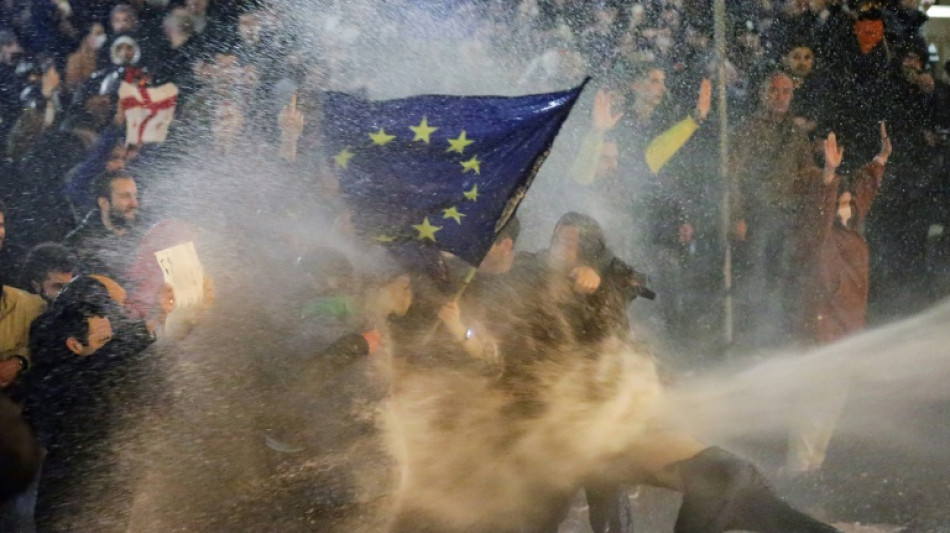
Georgia protesters decry brutal treatment by police / Photo: - - AFP/File

 Geri Halliwell-Horner Embraces Queen Camilla at Commonwealth Writing Competition

 Meta Quest 3 and 3S Gain Access to Over 150 3D Movies

 Sarah Bajada Shares Message on Pregnancy Loss

 ALIX LASERS shareholders remove Michael Sobitsch as managing director in view of the circumstances

 Euroseas Q3 Net Profit Falls to $91.4 Million Amid Fleet Reduction

 Daily Horoscope November 20, 2026: Astrological Predictions for All Signs

 West Midlands Shoppers Urged to Guard Against Black Friday Scams

Standing in the courtyard of his apartment block in Georgia's capital Tbilisi, Zurab Japaridze shows traces of injuries to his head, still visible five days after he was arrested at an anti-government rally.
Tens of thousands of Georgians took to the streets last week after parliament gave its initial backing to a controversial "foreign agent" law reminiscent of Russian legislation used to silence critics.
The bill was dropped under pressure from the youth-led protests that marked a culmination of widespread discontent over the authorities perceived backsliding on democracy and ruling party's covert collaboration with arch-foe Moscow.
More than 140 people were arrested in the aftermath of the demonstrations, with some protesters saying they were violently treated by riot police.
A video of Japaridze's arrest was widely shared on social media, showing the former lawmaker roughly seized by masked law enforcement during a rally outside parliament.
The 47-year-old leader of a small opposition party called Girchi More Freedom said he was taken with two other protesters to the courtyard of a nearby building and brutally beaten.
"Once we were inside and without cameras, they knocked us down and hit us with their feet, their fists, and also truncheons, mainly on the head," he told AFP.
Later transferred to a police station where he spent two nights in detention, he suffered from a "terrible pain in the throat", not knowing until after his release that he had the coronavirus.
"I asked them for medicine but there was none," he said. "Now there will be a court hearing as if it was me who had breached the law."
- 'Hit in the face' -
Several protesters who had been arrested at the demonstrations told AFP they all face similar charges of "hooliganism" and "disobedience", punishable by a fine or up to 15 days behind bars.
One of them, Irakli Noniashvili, said he was arrested on March 8, his second day at the demonstrations during which police used tear gas and water cannon to disperse the crowds.
Equipped with a helmet, ski goggles and a mask, he came face to face with riot police while trying to get rid of a tear gas grenade.
"It was so sudden that I panicked, I didn't know what to do and raised my hands. They grabbed me and took me across the street," the 34-year-old employee of the IT sector told AFP.
He said a policeman suddenly started twisting his fingers. "I swore, so he just hit me in the face really hard," Noniashvili said, pointing to the injury still visible on his nose.
He was held at a police station for three hours before being transferred to the city of Telavi, about 100 kilometres (60 miles) east of Tbilisi, where he spent 14 hours in detention.
- 'Suffocating me' -
The interior ministry said those arrested at the rallies -- which saw clashes erupting sporadically between protesters and police -- behaved aggressively, threw stones at law enforcement and damaged municipal property.
Investigators have announced a probe into numerous cases of police allegedly using "excessive force" against the demonstrators.
Giorgi Mumladze, a figure of Georgia's main opposition force, the United National Movement party founded by the jailed ex-president Mikheil Saakashvili, said the police had "a list of names" of those to be arrested.
"And those they saw on the streets were captured by the police. I was one of them," he told AFP.
"I lost consciousness during the arrest because they were suffocating me," he said, adding that he had a "first-degree burn" on his face from police spraying tear gas into his face multiple times.
Beka Jikurashvili, 30, said he was arrested on March 2 while covering the first day of the demonstrations that saw just a few dozen rally outside parliament.
"It all happened very quickly. Four policemen seized me. Two of them held me by the arms, the other two by the legs and they dragged me, upside down," said the journalist, who works for the Tabula online media platform.
He said 36 people were arrested at the small rally and that he is facing administrative charges even though he was there as a journalist.
"They rushed at people who were standing peacefully. As if someone was resisting them, which was not the case," he said. "There were more police than demonstrators" at the time.
T.Vitorino--PC