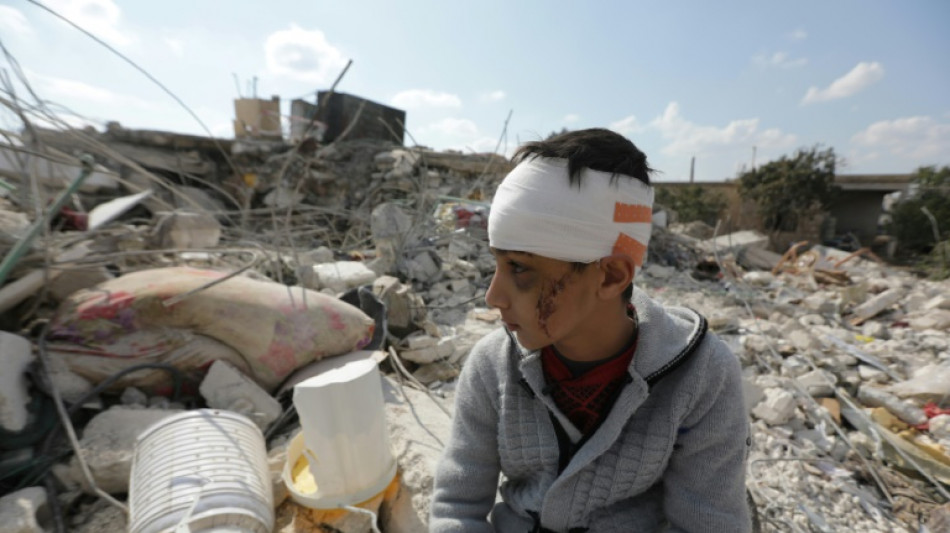
UN investigators slam sluggish Syria quake aid / Photo: Bakr ALKASEM - AFP

 Geri Halliwell-Horner Embraces Queen Camilla at Commonwealth Writing Competition

 Meta Quest 3 and 3S Gain Access to Over 150 3D Movies

 Sarah Bajada Shares Message on Pregnancy Loss

 ALIX LASERS shareholders remove Michael Sobitsch as managing director in view of the circumstances

 Euroseas Q3 Net Profit Falls to $91.4 Million Amid Fleet Reduction

 Daily Horoscope November 20, 2026: Astrological Predictions for All Signs

 West Midlands Shoppers Urged to Guard Against Black Friday Scams

The world failed to act quickly enough in getting life-saving aid to Syrians in desperate need following last month's devastating earthquake, UN investigators said Monday.
The Damascus government, other civil war factions, the international community and the United Nations itself hindered the delivery of urgent assistance to the quake-hit northwest, the UN Commission of Inquiry on Syria said.
They failed to secure an immediate pause in hostilities, or to facilitate life-saving aid through any available route, including for rescue teams in the crucial first week following the February 6 quake, the commission said.
The panel, which investigates and records all international human rights law violations since March 2011 in the country, said they were now probing fresh attacks since the February 6 quake -- which they branded incomprehensible.
"Syrians felt abandoned and neglected by those supposed to protect them, in the most desperate of times," the independent three-member panel said in a statement, calling for a separate investigation into these failings.
President Bashar al-Assad's government took a week to consent to cross-border aid access, said the commission, with member Hanny Megally arguing that international aid should have gone in first, even if it meant skirting around state sovereignty.
- 15.3 million need aid -
Almost 6,000 people were killed in Syria by the 7.8-magnitude tremor that struck the country and neighbouring Turkey.
The UN estimates that five million people need basic shelter and non-food assistance in the quake-hit part of Syria.
Commission chair Paulo Pinheiro said Syria became an "epicentre of neglect", adding that the panel was probing multiple allegations of warring factions "deliberately obstructing humanitarian aid".
He slammed the "wholesale failure by the government and the international community, including the UN, to rapidly direct life-saving support to Syrians in the most dire need".
"Incomprehensibly, due to the cruelty and cynicism of parties to the conflict, we are now investigating fresh attacks even in the very areas devastated by the earthquakes," he added.
Megally said the shelling resumed within two or three days of the quake, and has continued since.
The Syrian conflict started in 2011 with Assad's brutal repression of peaceful protests, and escalated to pull in multiple foreign powers and global jihadists.
Nearly half a million people have been killed, and the conflict has forced around half of Syria's pre-war population from their homes.
- War crime allegations -
The commission issued its latest report Monday, covering violations committed in the second half of 2022.
"More than 13 million people are displaced or refugees at a time when 90 percent of all Syrian civilians live in poverty, and 15.3 million are estimated to require humanitarian assistance to survive -- the highest level of people in need since the start of the conflict," the report said.
It recorded government forces using cluster munitions on a displacement camp, an indiscriminate rocket attack on a market and Russian airstrikes destroying a civilian home -- all with multiple fatalities.
"These atrocities continue a long-established pattern of indiscriminate attacks, which may amount to war crimes," the commission said.
The report said that the Kurdish-led Syrian Democratic Forces in the northeast were still unlawfully holding 56,000 people in camps, mainly women and children, with suspected links to the Islamic State jihadist group.
"The commission has reasonable grounds to believe that the suffering inflicted on them may amount to the war crime of committing outrages on personal dignity, and calls for repatriations to speed up."
X.Matos--PC