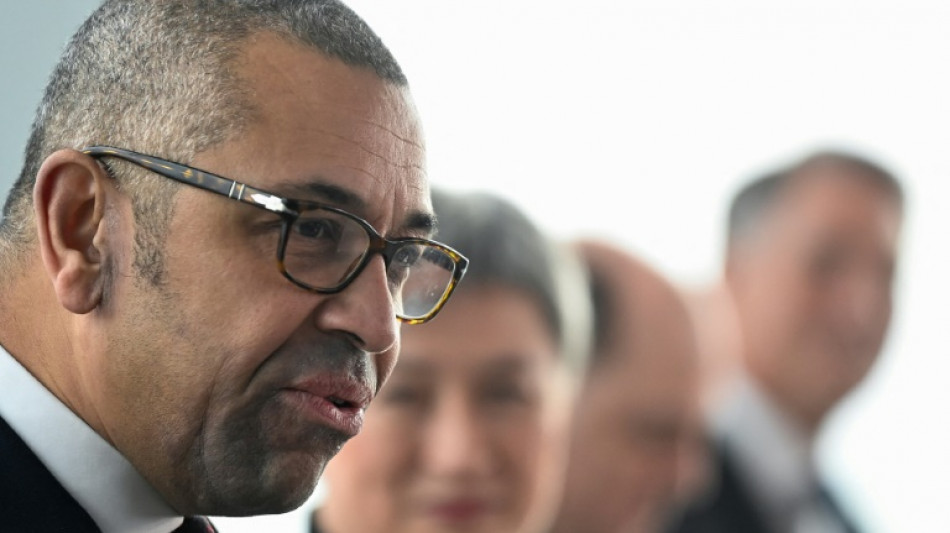
UK boosts security spending against China and Russia threats / Photo: TOBY MELVILLE - POOL/AFP

 Geri Halliwell-Horner Embraces Queen Camilla at Commonwealth Writing Competition

 Meta Quest 3 and 3S Gain Access to Over 150 3D Movies

 Sarah Bajada Shares Message on Pregnancy Loss

 ALIX LASERS shareholders remove Michael Sobitsch as managing director in view of the circumstances

 Euroseas Q3 Net Profit Falls to $91.4 Million Amid Fleet Reduction

 Daily Horoscope November 20, 2026: Astrological Predictions for All Signs

 West Midlands Shoppers Urged to Guard Against Black Friday Scams

Britain on Monday detailed plans to bolster military and security spending to confront the "epoch-defining challenge" posed by China while also countering Russia, as London updated its strategic foreign and defence policy.
In a "refresh" of the so-called Integrated Review, the UK government identified "the threat posed by Russia to European security" as the most pressing short- to medium-term priority.
But the 63-page report -- compiled after months of work across government -- also labelled China a "systemic challenge with implications for almost every area of government policy".
"We cannot be blind to the increasingly aggressive military and economic behaviour of the Chinese Communist Party," Foreign Secretary James Cleverly said, as he unveiled the updated review to parliament.
Britain's top diplomat added Beijing was "stoking tensions" with Taiwan -- the self-governing island which China considers its territory -- and of trying to "strong-arm" other countries.
Responding to the twin threats posed by Beijing and Moscow requires stepped up defence and national security spending, both now and in the future, the review concluded.
It includes plans to spend an extra £5 billion ($6 billion) on defence over the next two years, focused on nuclear resilience and replenishing depleted ammunition stocks.
It also restated an ambition to dedicate 2.5 percent of annual GDP spending to defence, up on the UK's current 2.2 percent spending in the policy area.
- 'Push back' -
London last updated its strategic policy portfolio two years ago, in what was billed as the most comprehensive overhaul since the Cold War era and as part of a recalibration of its post-Brexit world view.
Although it branded Russia the "most acute direct threat to the UK", the report then also announced a much-heralded pivot in focus towards Asia to counter China's growing threat.
Despite the subsequent Russian invasion of Ukraine, the government assessed those fundamentals have not changed, but that the response to them needed to "evolve".
"China poses an epoch-defining challenge to the type of international order we want to see, both in terms of security and values -- and so our approach must evolve," Prime Minister Rishi Sunak wrote in the review's foreword.
He added Britain would work with Beijing on shared priorities such as combating climate change but pledged to "push back" alongside allies against its attempts to "coerce or create dependencies".
"And we are taking new action to protect ourselves, our democracy and our economy at home," Sunak noted.
That will see several existing agencies revamped, including creating a new £1 billion "integrated security fund" and a National Protective Security Authority to improve resilience of critical infrastructure.
Ministers will also double funding on skills and knowledge on China for government staff, including on Mandarin language skills.
The BBC World Service will get a £20 million funding boost to protect its dozens of language services over the next two years, "support English language broadcasting and counter disinformation".
N.Esteves--PC