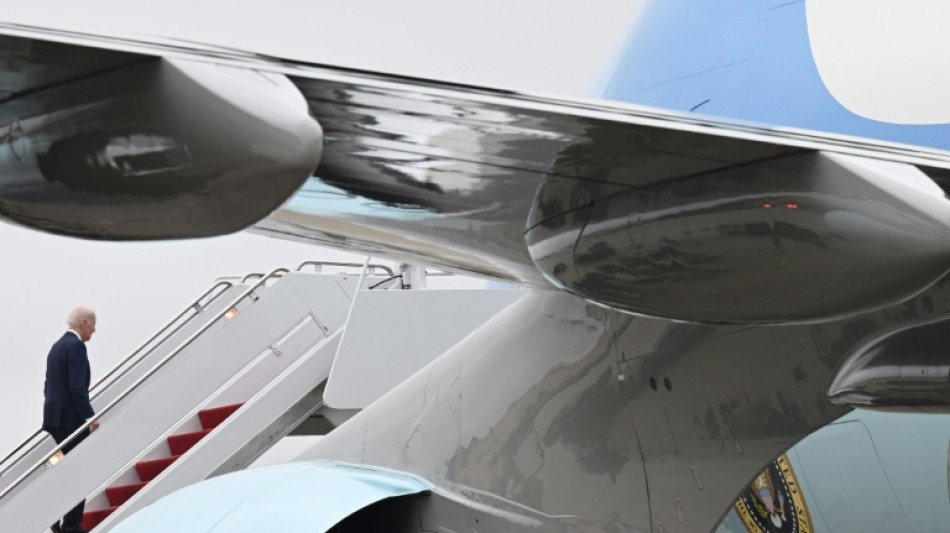
Australia to buy US nuclear subs in ambitious new pact / Photo: SAUL LOEB - AFP

 Geri Halliwell-Horner Embraces Queen Camilla at Commonwealth Writing Competition

 Meta Quest 3 and 3S Gain Access to Over 150 3D Movies

 Sarah Bajada Shares Message on Pregnancy Loss

 ALIX LASERS shareholders remove Michael Sobitsch as managing director in view of the circumstances

 Euroseas Q3 Net Profit Falls to $91.4 Million Amid Fleet Reduction

 Daily Horoscope November 20, 2026: Astrological Predictions for All Signs

 West Midlands Shoppers Urged to Guard Against Black Friday Scams

Australia will buy as many as five US nuclear-powered submarines and later build a new model with US and British technology under an ambitious plan to beef up Western muscle across the Asia-Pacific in the face of a rising China, a US official said Monday.
President Joe Biden was hosting his Australian and British counterparts, Prime Minister Anthony Albanese and Prime Minister Rishi Sunak, on a US naval base in San Diego, California, to announce the plan.
Australia, which joined the newly formed AUKUS group with Washington and London 18 months ago, will not be getting nuclear weapons. However, with nuclear propulsion, the new submarine fleet will add substantial new strength to the Western alliance seeking to push back against China's own military expansion.
Biden's national security advisor, Jake Sullivan, told reporters flying on Air Force One to California that the submarine plan illustrated Washington's long-term commitment to guarding "peace and stability" in the Asia-Pacific region.
The partnership with Australia, which involves sharing secret nuclear technology previously only given to Britain, is "a decades-long, maybe a century-long commitment," Sullivan said.
Three conventionally armed, nuclear-powered Virginia class vessels will be sold "over the course of the 2030s," with the "possibility of going up to five if that is needed," Sullivan said.
The new model, also nuclear-powered and carrying conventional weapons, is a longer-term project and will be dubbed the SSN-AUKUS, he said. It will be built on the base of a British design, with US technology, and "significant investments in all three industrial bases," Sullivan said.
- Defense spending on the rise -
While Australia has ruled out deploying atomic weapons, its submarine plan marks a significant new stage in the US-led attempt to counter growing Chinese military power, including Beijing's construction of a sophisticated naval fleet and turning artificial islands into offshore bases.
In the face of the Chinese challenge -- and Russia's invasion of pro-Western Ukraine -- Britain is also moving to beef up its military capabilities, Sunak's office said Monday.
More than $6 billion additional funding over the next two years will "replenish and bolster vital ammunition stocks, modernize the UK's nuclear enterprise and fund the next phase of the AUKUS submarine program," Downing Street said.
Australia had previously been on track to replace its aging fleet of diesel-powered submarines with a $66 billion package of French vessels, also conventionally powered.
The abrupt announcement by Canberra that it was backing out of that deal and entering the AUKUS project sparked a brief but unusually furious row between all three countries and their close ally France.
Compared to the Collins-class submarines due to be retired by Australia, the Virginia-class is almost twice as long and carries 132 crew, not 48.
China warned that AUKUS risked setting off an arms race and accused the three countries of setting back nuclear nonproliferation efforts.
"We urge the US, the UK and Australia to abandon the Cold War mentality and zero-sum games, honor international obligations in good faith and do more things that are conducive to regional peace and stability," Chinese foreign ministry spokeswoman Mao Ning told reporters in Beijing.
The communist country's leader Xi Jinping made a fiery statement last week accusing the United States of leading a Western effort at "all-round containment, encirclement and suppression of China."
But Washington says Beijing is alarming countries across the Asia-Pacific with its threats to invade the self-governing democracy of Taiwan, as well as highlighting the threat from nuclear-armed North Korea.
H.Silva--PC


