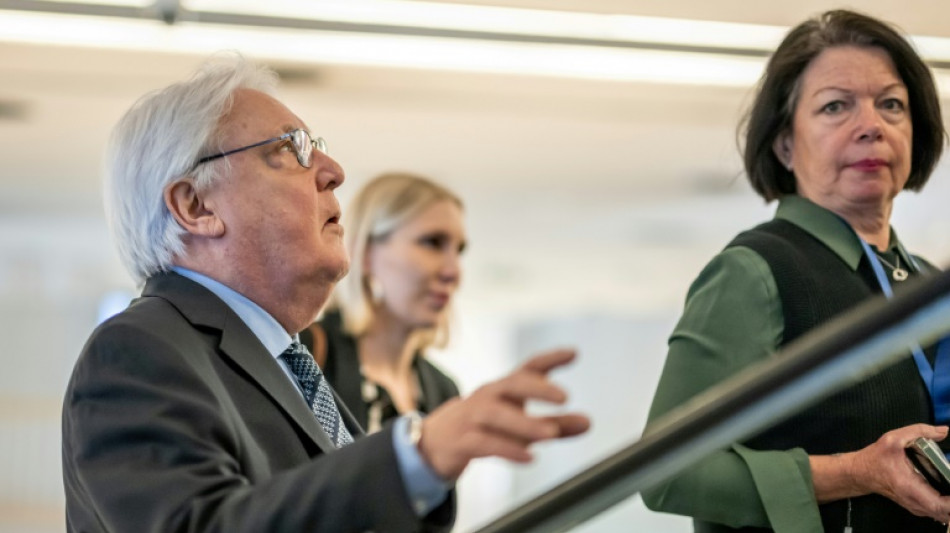
Russia agrees to 60-day Ukraine grain deal extension / Photo: Fabrice COFFRINI - AFP

 Geri Halliwell-Horner Embraces Queen Camilla at Commonwealth Writing Competition

 Meta Quest 3 and 3S Gain Access to Over 150 3D Movies

 Sarah Bajada Shares Message on Pregnancy Loss

 ALIX LASERS shareholders remove Michael Sobitsch as managing director in view of the circumstances

 Euroseas Q3 Net Profit Falls to $91.4 Million Amid Fleet Reduction

 Daily Horoscope November 20, 2026: Astrological Predictions for All Signs

 West Midlands Shoppers Urged to Guard Against Black Friday Scams

Russia agreed Monday to extending the Ukraine grain export deal, but only for a further 60 days, in a proposal criticised by Kyiv.
Following talks with the United Nations in Geneva, Moscow said it would not oppose prolonging the so-called Black Sea Grain Initiative aimed at easing the global food crisis, as had been feared.
But Russia only agreed to extending the deal for half of the 120-day period of the original deal.
Ukraine warned that "contradicts" the original agreement, but did not reject the proposal.
Russia's full-scale invasion of Ukraine in February 2022 saw Ukraine's Black Sea ports blocked by warships, until the deal signed in July allowed for the safe passage of exports of critical grain supplies.
Ukraine was one of the world's top producers and the Black Sea Grain Initiative has helped soothe the global food crunch triggered by the conflict.
More than 24.1 million tonnes have been exported so far under the agreement, according to the UN.
The initial 120-day agreement struck with the UN and Turkey was extended for a further 120 days in November, until March 18.
The Kremlin had cast doubt on whether it would agree to any fresh extension, citing concerns that the twin deal on Russian exports was not being respected.
It said Monday it needed to see "tangible progress" on the parallel agreement on unhindered Russian food and fertiliser exports, claiming Western sanctions exemptions were "essentially inactive".
- Exports 'normalisation' -
Moscow wants to see deeds, not words on upholding this second part of the package, Deputy Foreign Minister Sergey Vershinin said after Monday's talks with top United Nations officials at the Palais des Nations UN headquarters in Geneva.
"The Russian side ... does not object to another extension of the 'Black Sea Initiative' after its second term expiration on March 18, but only for 60 days," Vershinin said in a statement.
"It includes bank payments, transport logistics, insurance, unfreezing of financial activities and ammonia supplies via the Tolyatti-Odessa pipeline."
Ukraine's infrastructure minister said that Russia's stance went against the agreement, but did not reject Moscow's 60-day proposal.
"(The grain) agreement involves at least 120 days of extension, therefore Russia's position to extend the deal only for 60 days contradicts the document signed by Turkey and the UN," Oleksandr Kubrakov said on Twitter.
"We're waiting for the official position of the UN and Turkey as the guarantors of the initiative," he said.
- Sanctions exemptions 'inactive' -
Vershinin led the Russian delegation in the talks, joining with UN humanitarian chief Martin Griffiths and Rebeca Grynspan, head of the UN's trade and development agency UNCTAD.
While the agreement concerns the export of Ukrainian grain, the second agreement, between Moscow and the UN, is intended to facilitate the export of Russian food and fertilisers.
These are exempt from Western sanctions imposed on Moscow.
"The sanctions exemptions for food and fertilisers announced by Washington, Brussels and London are essentially inactive."
Nearly half of the exports shipped so far under the deal are corn and more than a quarter are wheat, according to UN data.
Around 45 percent of the exports went to developed countries. The biggest recipient was China, followed by Spain, Turkey, Italy and the Netherlands.
A.P.Maia--PC


