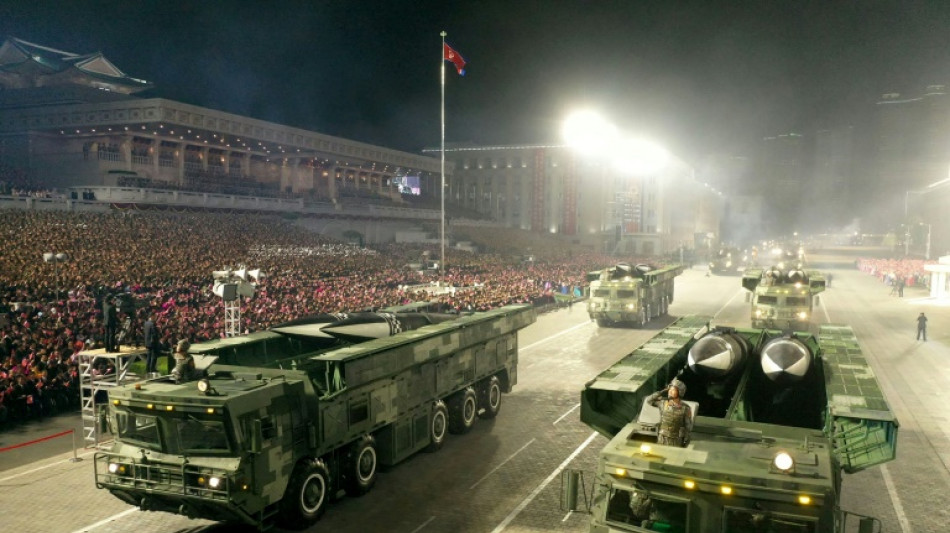
North Korea fires two ballistic missiles, Seoul says / Photo: STR - KCNA VIA KNS/AFP/File

 Geri Halliwell-Horner Embraces Queen Camilla at Commonwealth Writing Competition

 Meta Quest 3 and 3S Gain Access to Over 150 3D Movies

 Sarah Bajada Shares Message on Pregnancy Loss

 ALIX LASERS shareholders remove Michael Sobitsch as managing director in view of the circumstances

 Euroseas Q3 Net Profit Falls to $91.4 Million Amid Fleet Reduction

 Daily Horoscope November 20, 2026: Astrological Predictions for All Signs

 Tosca's 2026 Sustainability Report Makes the Case for Packaging as Critical Supply Chain Infrastructure

North Korea fired two short-range ballistic missiles Tuesday, Seoul said, Pyongyang's second launch in three days and the first since South Korea and the United States began their largest joint military drills in five years.
Washington and Seoul have ramped up defence cooperation in the face of growing military and nuclear threats from the North, which has conducted a series of increasingly provocative banned weapons tests in recent months.
"Our military detected two short-range ballistic missiles fired towards the East Sea from Jangyon area in South Hwanghae province from 0741 (2241 GMT) to 0751," the Joint Chiefs of Staff said in a statement, referring to the body of water also known as the Sea of Japan.
"Our military has strengthened surveillance and vigilance in preparation for additional launches, while maintaining a full readiness posture through close cooperation between South Korea and the United States."
The launch comes just days after Pyongyang fired two "strategic cruise missiles" from a submarine in an apparent protest over the US-South Korea drills.
Known as Freedom Shield, the drills started Monday and will run for 10 days.
In a rare move, Seoul's military this month revealed that the two allies' special forces were staging military exercises dubbed "Teak Knife" -- which involve simulating precision strikes on key facilities in North Korea -- ahead of Freedom Shield.
The Freedom Shield exercises focus on the "changing security environment" due to North Korea's redoubled aggression, the allies have said.
They will "involve wartime procedures to repel potential North Korean attacks and conduct a stabilisation campaign in the North", the South Korean military said previously.
It emphasised that the exercise was a "defensive one based on a combined operational plan".
But North Korea views all such drills as rehearsals for invasion and has repeatedly warned it would take "overwhelming" action in response.
- More to come -
Last year, North Korea declared itself an "irreversible" nuclear power and launched a record-breaking number of missiles.
Leader Kim Jong Un earlier this month ordered his military to intensify drills to prepare for a "real war".
Leif Easley, a professor at Ewha University in Seoul, said while Pyongyang routinely justified its missile tests by pointing to the South's military exercises, they also served a domestic purpose.
"This is largely about the Kim regime not wanting to look weak as it struggles economically at home while South Korea succeeds at strengthening its conventional firepower and security partnerships," he told AFP.
"As a result, further shows of force can be expected from Pyongyang."
Washington has repeatedly restated its "ironclad" commitment to defending South Korea, including using the "full range of its military capabilities, including nuclear".
South Korea, for its part, is eager to reassure its increasingly nervous public about the US commitment to so-called extended deterrence, in which Washington's military assets, including nuclear weapons, serve to prevent attacks on allies.
Analysts previously said North Korea would likely use the drills as an excuse to carry out more missile launches and perhaps even a nuclear test.
"More missile launches with variations in style and scope should be expected, with even a nuclear test. More acts of intimidation from North Korea should not come as a surprise," said Chun In-bum, a retired South Korean army general.
X.M.Francisco--PC


