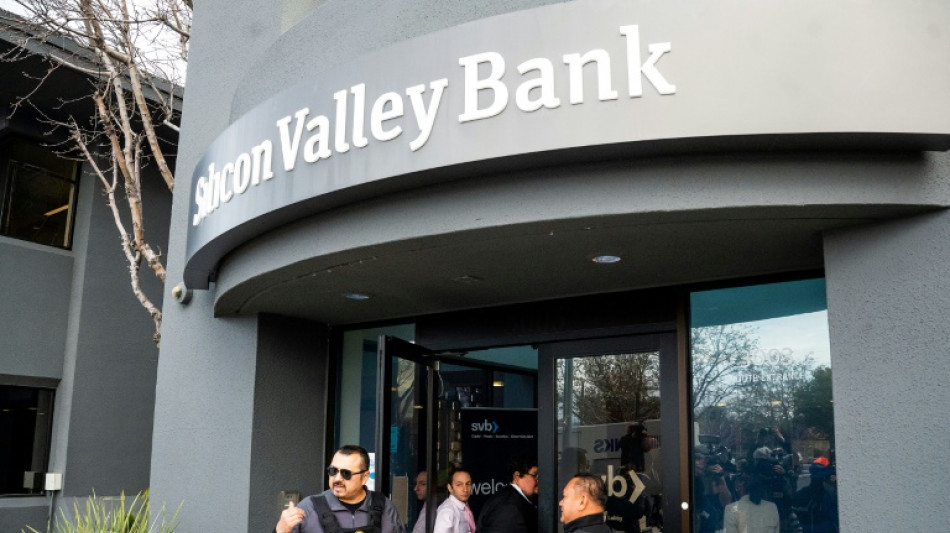
SVB's demise: Why didn't US bank regulators see it coming? / Photo: NOAH BERGER - AFP

 Trump admin finalizes reversal of US fuel economy standards

 US says no China arms sale plans after envoy cites Trump offer

 Dozens kidnapped in two weekend attacks in northern Nigeria
 Next stop the world: Pathirage wins Asian Games javelin gold

 Aster Launches Perpetual Grid Trading 2.0 with Up to 140,000 $ASTER Liquidity Mining Campaign

 Seoul says North Korean mines 'highly suspected' as cause of DMZ blast

 Russia pummels Kyiv in latest deadly daytime attack

 Wartime Ukraine works to keep its railways on track

 Boy among 3 dead in migrant Channel crossing accident: French authorities

 SGFX Creates a Standout Brand Experience at Forex Expo Dubai 2026

 Pope urges Europe to help combat 'deceit and lies' in international ties

 Injured Buttler to miss England ODI series in Pakistan
 Madrid housing protesters vow to maintain pressure on government
 In kayaks or waist-deep in floodwater, shoppers return to Bangkok markets

 UK police probes Iran link to air base bomb scare: media

 Eala blasts into Asian Games quarters in just 55 minutes
 Taiwan gender-row boxer Lin Yu-ting guarantees Asian Games medal

 Comedian on trial for allegedly insulting Erdogan in standup show

 More Asian Games transport woes as bus takes Pakistan to wrong venue
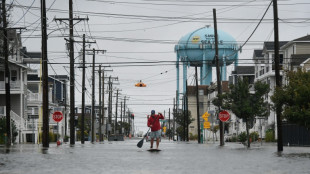
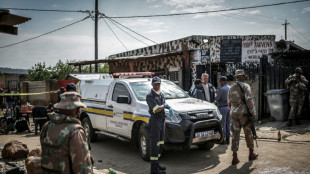 Death toll in South Africa bar shooting rises to 18
 Aide to Venezuelan opposition leader returns from exile

 Messi and Alcaraz love it, now padel takes step closer to Olympics
 Tolls mount in Thailand, Myanmar floods

 Why India's opposition wants top poll official out

 PU Prime Strengthens UAE Momentum with Strong Showing at Forex Expo Dubai 2026

With hindsight, there were warning signs ahead of last week's spectacular collapse of Silicon Valley Bank, missed not only by investors, but by bank regulators.
Just why the oversight failed remained a hot question among banking experts Monday, with some focusing on the weakness of US rules.
The Federal Reserve announced Monday plans for a "thorough, transparent and swift" review of the supervision of SVB that will be publicly released on May 1, effectively acknowledging that it could have done better.
President Joe Biden promised a "full accounting of what happened," adding that he would ask regulators and banking regulators to tighten rules on the sector.
Banking experts have been among those alarmed at the rapid collapse of SVB, the country's 16th biggest bank by assets and how its demise became a harbinger of Sunday's failure of another lender, Signature Bank.
The failures have "exposed the inadequacy of regulatory reforms that have been made since the global financial crisis," said Arthur Wilmarth, a law professor at George Washington University.
A once-over of the bank would have pointed to clear potential red flags in SVB's disproportionate exposure to tech startups, a risky area that can be likened to commercial real estate or emerging markets -- areas that have plagued lenders in the past.
Wilmarth noted that SVB grew very fast between 2020 and 2022 and that its exposure to long-date fixed interest bonds made it especially vulnerable to the a shift in monetary policy by the Fed.
"That's almost a sure proof formula for failure. If the economy turns you begin to have trouble," Wilmarth said.
"None of those would have been a mystery to the regulators."
- No excuses -
Experts pointed as well to the eventual easing of US laws enacted soon after the 2008 crisis.
The original Dodd-Frank law of 2010 imposed higher capital, liquidity and other requirements on banks with at least $50 billion in assets.
In 2018, with support from former President Donald Trump, this requirement was raised to $250 billion, affecting fewer banks.
But that shift in law does not excuse regulators for these failures, according to Anna Gelpern, a law professor at Georgetown University.
"When regulatory requirement are relaxed either by the premise that those institutions don't pose a risk to the system because of their size or that they are easier to supervise, that puts much more pressure on old-fashioned supervision because you don't have the automatic alarm that goes off with the requirements," she said.
"If this was clearly unsafe and unsound behavior," the banks' official designation in the law "does not excuse a failure of supervision," she said.
Michael Ohlrogge, an associate professor of law at New York University, said regulators as a matter of course assign "very little to zero-risk weight" in terms of bank capital requirements for Treasury-linked securities because they are considered safe.
At the same time, regulators are also lenient with banks with regard to depositors with more than $250,000 -- the threshold for federally insured deposits -- believing the bank has a meaningful business relationship with such clients.
"That's probably going to warrant revisiting and thinking more seriously about the run risk of uninsured deposits," Ohlrogge said.
P.Serra--PC