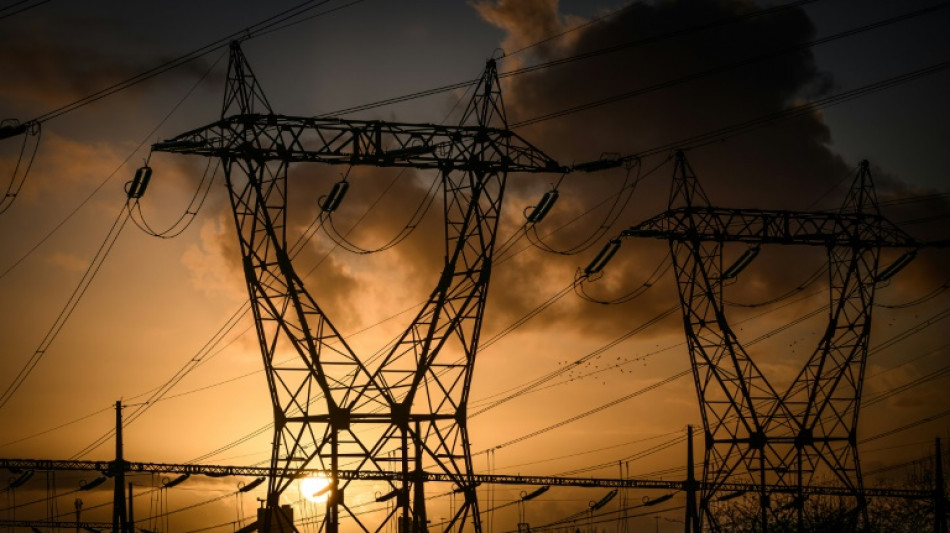
EU unveils electricity reforms to reduce price spike threat / Photo: LOIC VENANCE - AFP/File

 Geri Halliwell-Horner Embraces Queen Camilla at Commonwealth Writing Competition

 Meta Quest 3 and 3S Gain Access to Over 150 3D Movies

 Sarah Bajada Shares Message on Pregnancy Loss

 ALIX LASERS shareholders remove Michael Sobitsch as managing director in view of the circumstances

 Euroseas Q3 Net Profit Falls to $91.4 Million Amid Fleet Reduction

 Daily Horoscope November 20, 2026: Astrological Predictions for All Signs

 Tosca's 2026 Sustainability Report Makes the Case for Packaging as Critical Supply Chain Infrastructure

The EU laid out plans Tuesday to make electricity bills "less dependent" on fossil fuel costs, to limit the risks of price hikes like those seen after Russia invaded Ukraine.
Brussels has been working on reforming its electricity market since Moscow's war sent prices spiralling for individual consumers and businesses last year.
Wholesale energy prices in Europe are set according to the cost of the most expensive sources, usually gas-powered plants, those flexible enough to cover jumps in demand.
Gas prices rocketed after Russian President Vladimir Putin sent in his troops, taking EU electricity costs with them and leaving governments scrambling to compensate consumers.
"For over two decades the electricity market design has served European companies and consumers, letting them enjoy the benefits of a single market," said European energy commissioner Kadri Simson.
"However, the crisis spurred by Russia's attack on Ukraine exposed a number of shortcomings in the current system which needed to be addressed."
Some countries including France and Spain had called for a total overhaul of the system and to decouple the price of electricity from that of gas entirely.
But the measures put forward by the EU's executive arm -- details of which now have to be negotiated between the European parliament and member states -- fall short of those demands.
Instead of a clean break, they aim to reduce the impact of volatile fossil fuel costs by pushing long-term contracts for renewable energy.
For citizens the reforms would introduce new rights to secure long-term fixed-price contracts from their energy supplier, cutting their exposure to sharp rises.
They would also be allowed to have more than one meter and different contracts to more economically serve their varying needs from charging a vehicle, to using heat pumps.
The EU is looking to bolster the use of so-called power purchase agreements that allow companies to benefit more easily from the more stable costs of non-fossil power.
Power producers would be offered security through the more widespread use of government contracts that would see them pay back revenues if the prices spike and get compensation if they fall.
Brussels hopes the moves will bolster investment in non-fossil fuel energy as the EU seeks to meet its climate goals to reach net-zero and keep electricity cost down.
The bloc says it needs to triple the rate at which it is putting up new renewable energy infrastructure if it wants to hit its green targets.
R.Veloso--PC


