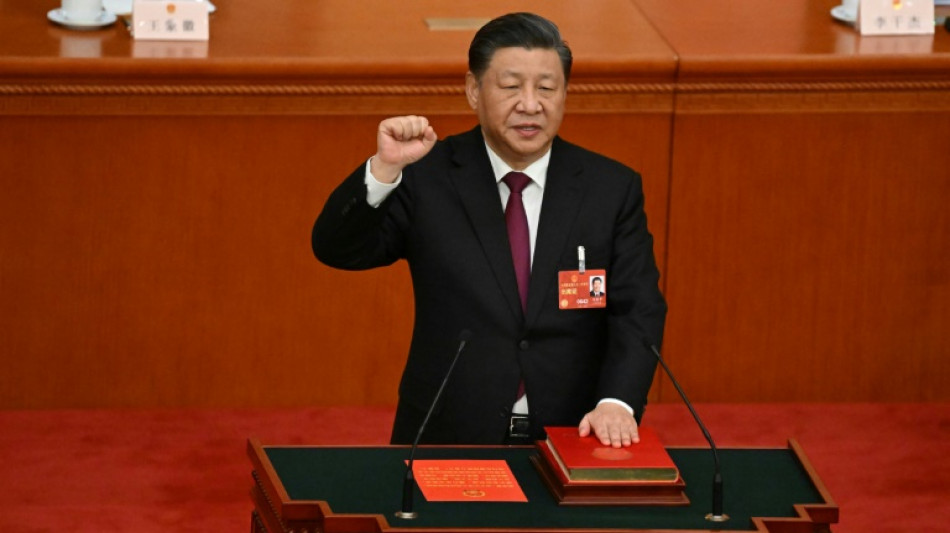
Xi mediation offer spurred Iran deal talks: Saudi official / Photo: NOEL CELIS - AFP/File

 Geri Halliwell-Horner Embraces Queen Camilla at Commonwealth Writing Competition

 Meta Quest 3 and 3S Gain Access to Over 150 3D Movies

 Sarah Bajada Shares Message on Pregnancy Loss

 ALIX LASERS shareholders remove Michael Sobitsch as managing director in view of the circumstances

 Euroseas Q3 Net Profit Falls to $91.4 Million Amid Fleet Reduction

 Daily Horoscope November 20, 2026: Astrological Predictions for All Signs

 Tosca's 2026 Sustainability Report Makes the Case for Packaging as Critical Supply Chain Infrastructure

Chinese leader Xi Jinping approached Saudi Arabia's de facto ruler last year about Beijing serving as a "bridge" between the kingdom and Iran, jump-starting talks that yielded last week's surprise rapprochement, a Saudi official said Wednesday.
The initial conversation between Xi and Crown Prince Mohammed bin Salman took place during bilateral talks at a summit in Riyadh in December, said the official, who spoke on condition of anonymity to describe how the deal -- whose ripple effects could spread across the Middle East -- took shape.
"The Chinese president expressed his desire for China to be a bridge between Saudi Arabia and Iran. His Royal Highness the Crown Prince welcomed this," the official said, later adding that Riyadh sees Beijing as in a "unique" position to wield unmatched "leverage" in the Gulf.
"For Iran in particular, China is either No 1 or No 2 in terms of its international partners. And so the leverage is important in that regard, and you cannot have an alternative that is equal in importance," the official said.
Several other meetings also laid the groundwork for last week's talks in Beijing, according to the official.
They included a brief exchange between the Saudi and Iranian foreign ministers during a regional summit in Jordan in late December; talks between the Saudi foreign minister and Iran's deputy president during the inauguration of Brazilian President Luiz Inacio Lula da Silva in January; and a visit by Iranian President Ebrahim Raisi to Beijing in February.
China's role makes it more likely the terms of the deal will hold, the official said.
"It is a major stakeholder in the security and stability of the Gulf," the official said.
The agreement identifies a two-month window to formally resume diplomatic ties severed seven years ago.
It also includes vows for each side to respect the other's sovereignty and not interfere in the other's "internal affairs".
China's involvement raised eyebrows given Saudi Arabia's historically close partnership with the United States, though that relationship has been strained by issues including human rights and oil production cuts approved last year by the OPEC+ cartel.
"The US and China are both very important partners... We certainly hope not to be ... party to any competition or dispute between the two superpowers," the official said Wednesday.
US officials were briefed before the Saudi delegation travelled to Beijing and before the deal was announced, the official said.
P.Sousa--PC