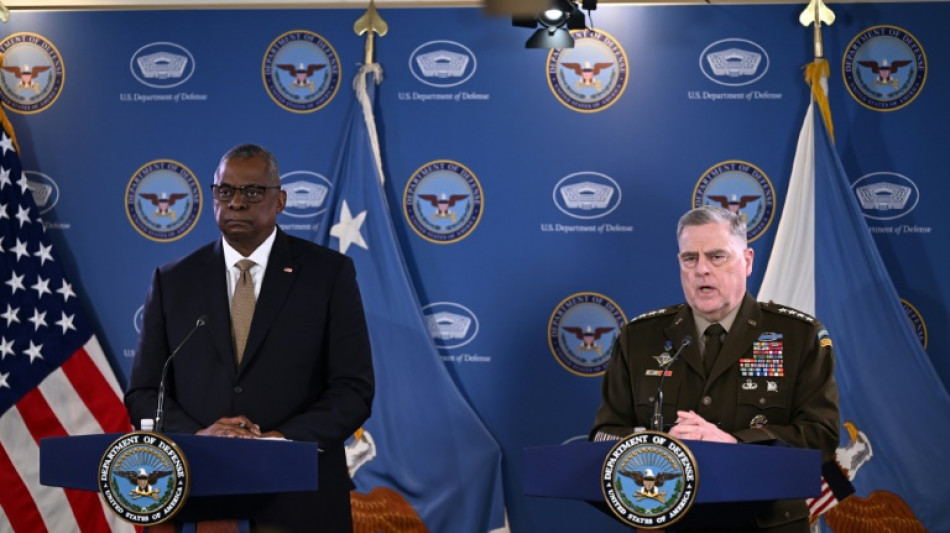
US tells Russia it will fly 'wherever international law allows' / Photo: ANDREW CABALLERO-REYNOLDS - AFP

 Geri Halliwell-Horner Embraces Queen Camilla at Commonwealth Writing Competition

 Meta Quest 3 and 3S Gain Access to Over 150 3D Movies

 Sarah Bajada Shares Message on Pregnancy Loss

 ALIX LASERS shareholders remove Michael Sobitsch as managing director in view of the circumstances

 Euroseas Q3 Net Profit Falls to $91.4 Million Amid Fleet Reduction

 Daily Horoscope November 20, 2026: Astrological Predictions for All Signs

 Tosca's 2026 Sustainability Report Makes the Case for Packaging as Critical Supply Chain Infrastructure

Defense Secretary Lloyd Austin told his Russian counterpart Sergei Shoigu on Wednesday that US aircraft will fly "wherever international law allows" after one of Moscow's jets allegedly caused an American drone to crash.
Washington says a Russian Su-27 clipped an MQ-9, requiring the drone to be brought down in the Black Sea, while Moscow denies responsibility and accuses the United States of conducting "hostile" flights in the region.
Austin spoke with Shoigu "regarding recent unprofessional, dangerous, and reckless behavior by the Russian air force in international airspace over the Black Sea," the Pentagon said in a statement.
He "emphasized that the United States will continue to fly and to operate wherever international law allows," it added.
Russia confirmed the call and said Washington had initiated it.
The US defense chief also told a news conference that it is "incumbent upon Russia to operate its military aircraft in a safe and professional manner."
Austin said maintaining communication with Russia is key, after more than a year of the Ukraine war during which direct contact between top US and Russian defense officials has been rare.
"We take any potential for escalation very seriously and that's why I believe it's important to keep the lines of communication open," he said.
"I think it's really key that we're able to pick up the phone and engage each other. And I think that will help to prevent miscalculation going forward."
- Wreckage 'no longer of value' -
General Mark Milley, the chairman of the US Joint Chiefs of Staff, said alongside Austin that he planned to call his Russian counterpart as well.
The Pentagon is still analyzing video and data from the drone to see exactly what happened.
"Was it intentional or not? Don't know yet," Milley said. "We know that the intercept was intentional. We know that the aggressive behavior was intentional, we also know it was very unprofessional and very unsafe."
But as to the "actual contact of the fixed-wing Russian fighter with our UAV, the physical contact with those two, not sure yet," he said, using an abbreviation for unmanned aerial vehicle.
Moscow said Wednesday that it would try to retrieve the wreckage. Milley did not explicitly rule out a US recovery effort, but said doing so would be difficult.
"We don't have any naval surface vessels in the Black Sea at this time," and the drone likely broke up and sank in an area where the water is 4,000-5,000 feet (1,200-1,500 meters) deep, he said.
Even if Russia was able to recover the wreckage, the United States took "mitigating measures" to protect sensitive information.
"We are quite confident that whatever was of value is no longer of value," Milley said.
The United States uses MQ-9s for both surveillance and strikes and has long operated over the Black Sea, keeping an eye on Russian naval forces.
Several of the drones have been lost in recent years, including one that the US Central Command said was shot down over Yemen with a surface-to-air missile in 2019.
M.Carneiro--PC