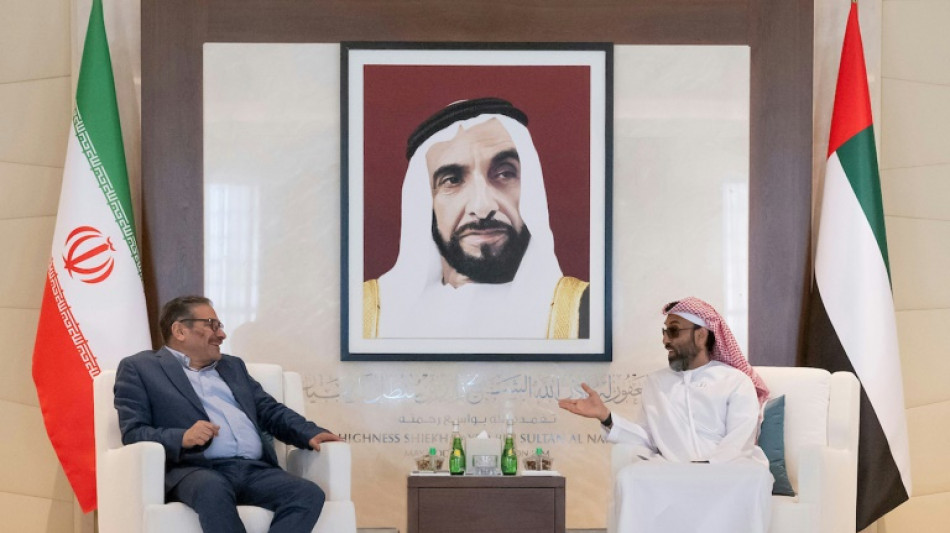
Iran's top security official holds talks in UAE after Riyadh-Tehran deal / Photo: Hamad AL-KAABI - UAE PRESIDENTIAL COURT/AFP

 Geri Halliwell-Horner Embraces Queen Camilla at Commonwealth Writing Competition

 Meta Quest 3 and 3S Gain Access to Over 150 3D Movies

 Sarah Bajada Shares Message on Pregnancy Loss

 ALIX LASERS shareholders remove Michael Sobitsch as managing director in view of the circumstances

 Euroseas Q3 Net Profit Falls to $91.4 Million Amid Fleet Reduction

 Daily Horoscope November 20, 2026: Astrological Predictions for All Signs

 Tosca's 2026 Sustainability Report Makes the Case for Packaging as Critical Supply Chain Infrastructure

Iran's top security official on Thursday held high-level talks in the United Arab Emirates, days after a shock rapprochement between Tehran and Riyadh.
Ali Shamkhani, the secretary of Iran's Supreme National Security Council, met with Emirati president Sheikh Mohamed bin Zayed Al Nahyan in the capital Abu Dhabi to discuss "opportunities for enhancing cooperation," according to the official WAM news agency.
He also held talks with the UAE's national security adviser, Sheikh Tahnoun bin Zayed Al Nahyan, and discussed "bilateral relations," WAM said.
"Iran and the UAE can take great steps on the path of expanding bilateral cooperation and strengthening neighbouring diplomacy," Shamkhani said during his meeting with the UAE president, according to Iran's state news agency IRNA.
"The formation of a stronger region is an attainable ideal that we all must take steps towards."
His trip came after Iran and Saudi Arabia announced a Chinese-brokered deal on Friday to end a seven-year rupture in diplomatic ties.
Shamkhani had travelled to Beijing for intensive negotiations with his Saudi counterpart ahead of the shock announcement.
During talks with his Emirati counterpart on Thursday, Shamkhani called his UAE visit "a meaningful beginning for the two countries to enter a new stage of political, economic and security relations," according to IRNA.
"We should try to increase the security, peace and well-being of the people of the region through dialogue and interaction... while preventing foreigners from playing a non-constructive role," Shamkhani said.
Shiite-majority Iran and the majority-Sunni Kingdom of Saudi Arabia, along with its allies in the six-nation Gulf Cooperation Council, back opposite sides in various armed and political conflicts in the region, most notably in Yemen and Syria.
In 2016, the UAE and other Gulf states scaled back their ties with Tehran after Iranian protesters attacked Saudi Arabia's diplomatic missions in Iran following Riyadh's execution of prominent Shiite Muslim cleric Nimr al-Nimr.
Despite the diplomatic downgrade, the oil-rich UAE maintained strong economic ties with Iran.
Last year, the UAE's ambassador to Tehran resumed his duties after a six year absence, while in September, Iran's top diplomat Hossein Amir-Abdollahian said Tehran wanted to broaden relations with the UAE.
Gregory Brew, Iran analyst at Eurasia Group, said Shamkhani's UAE visit is "significant in that it indicates continued efforts by the Gulf countries to improve relations with Iran".
"The UAE is a major trading partner to Iran, and has also become an important intermediary for Iran's oil exports," he told AFP, adding that Shamkhani may be discussing ways to access Iranian assets frozen overseas through UAE mediation or diplomatic support.
ho/it
A.Motta--PC