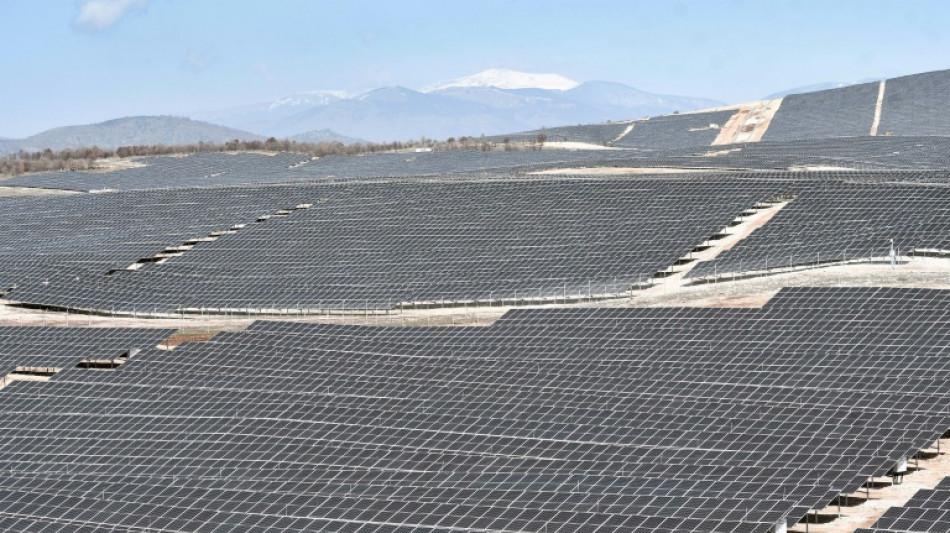
EU races to lead green tech battle against US, China / Photo: Sakis MITROLIDIS - AFP/File

 Geri Halliwell-Horner Embraces Queen Camilla at Commonwealth Writing Competition

 Meta Quest 3 and 3S Gain Access to Over 150 3D Movies

 Sarah Bajada Shares Message on Pregnancy Loss

 ALIX LASERS shareholders remove Michael Sobitsch as managing director in view of the circumstances

 Euroseas Q3 Net Profit Falls to $91.4 Million Amid Fleet Reduction

 Daily Horoscope November 20, 2026: Astrological Predictions for All Signs

 Tosca's 2026 Sustainability Report Makes the Case for Packaging as Critical Supply Chain Infrastructure

The EU on Thursday announced plans to push the bloc's businesses to produce more clean technology in Europe to challenge state-backed competition from the United States and China.
Brussels told European industries producing green technologies, such as solar and wind energy, that obtaining permits and manufacturing will be made easier under plans accused by some as protectionism.
The European Commission, the EU's executive arm, wants at least 40 percent of green tech to be produced in the EU by 2030.
The target featured in plans for a Net Zero Industry Act published on Thursday to support the EU's bid to become a "climate neutral" economy with zero greenhouse gas emissions by 2050.
The commission hopes to achieve its objectives by ensuring businesses obtain permits faster, and says public tenders would be considered based on green criteria that could favour European companies.
"We will continue to trade with our partners. Not everything will be made in Europe but more should be made in Europe," commission vice president Frans Timmermans told reporters in Brussels.
The Net Zero Industry Act proposal was to be made public Tuesday, but a standoff within the commission over whether to include nuclear power, a low-carbon energy, delayed the announcement.
In the end, nuclear featured in the text but the provisions only apply to fourth generation reactors that do not yet exist but would make it possible to reduce waste to almost zero, as well as small reactors in development.
Another landmark draft regulation unveiled Thursday aims to secure supplies of critical raw materials needed to make the most of the electrical products consumers use today, including smartphones.
- 'Very open act' -
Green technology production took on greater urgency after the United States unveiled a $370-billion "buy American" subsidy programme for tax credits and clean energy subsidies.
European businesses have warned that lavish subsidies elsewhere alongside lower energy bills could tempt the continent's firms to Asia or North America, and EU officials have complained that the IRA will discriminate against Europe's industry.
Part of the EU's response to the IRA has included controversially loosening state aid rules for green technology and last week the commission allowed members to match subsidies offered in other countries.
The clean technology sector is expected to be worth 600 billion euros ($630 billion) worldwide by 2030, more than three times current levels.
Some have questioned the bloc's "protectionist" objectives.
"The purpose of this law and how the draft was written is not to achieve faster decarbonisation, but it's basically to reshore production and that is a protectionist goal," said Niclas Poitiers, research fellow at the Brussels-based Bruegel think tank.
"This is about making sure that batteries and solar panels are produced in the EU."
European Commission President Ursula von der Leyen, however, this week dismissed such claims and insisted the proposal was in fact "a very open act".
- Too much reliance -
The EU also wants to meet the rapidly growing need for raw materials, much of which it currently imports from China, to avoid relying on one country for a specific product.
China currently dominates in many sectors including semiconductors, critical minerals, batteries and solar panels.
When Moscow invaded Ukraine in 2022, the EU scrambled to find fossil fuels elsewhere instead of Russia after years of relying on Russian energy.
Thursday's Critical Raw Materials Act draft said the EU wants the bloc to meet 10 percent of the demand for mining and extraction of raw materials.
"We have resources in Europe. We must find the means to extract them," the EU's internal market commissioner Thierry Breton said.
The text says the EU should not rely on one single country for more than 65 percent of imports for any strategic raw material by 2030.
But there would be wiggle room if Brussels has a "strategic partnership on raw materials" with a non-EU country.
Both proposals must be approved by member states and European Parliament deputies, with revisions likely to be made.
L.E.Campos--PC


