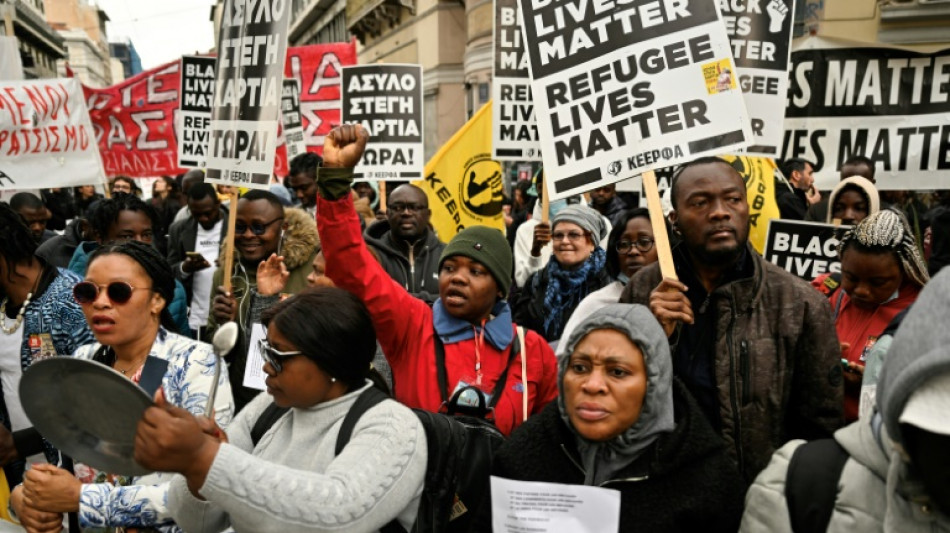
Refugees protest tough Greek migration policy / Photo: Louisa GOULIAMAKI - AFP

 San Ġiljan Defeat Paredes 20-12 in Challenger Cup Opener

 2027 Toyota Sienna Gets Sixth-Gen Hybrid System, More Power, and Trim Changes

 Burnham Government Announces Neighbourhood Support Teams to Reduce Hospital Admissions

 KFF Health News Readers Weigh In on Healthcare Policy, Ethics, and Workforce Shortages

 16-Year-Old Founder Targets 'Cost Per Kill' With AI Missile Startup

 Elon Musk Promises Steering-Wheel-Free Tesla Model Y Amid Cybercab Sales Launch

 APEX FTE Expo 2026 Unites Aviation Leaders in Singapore and Honors Passenger Experience Excellence

 West Midlands Shoppers Urged to Guard Against Black Friday Scams
Hundreds of refugees protested against Greece's tough migration policies in Athens on Saturday, accusing the conservative government of "murdering" asylum seekers through illegal pushbacks.
"Stop pushbacks, down with the government of murderers," read one of the banners at the rally in front of parliament. Another read "The blood of the innocent cries out for justice."
Some protesters carried signs with the dates of migrant boat sinkings in the Aegean Sea.
Other demonstrators drew a link between migrant deaths at sea and the February 28 train tragedy that left 57 dead and has been blamed on the government of Prime Minister Kyriakos Mitsotakis.
"Mitsotakis, you have blood on your hands -- dead kids at sea, dead kids on trains," they chanted.
Since taking office four years ago, Greece's conservative government has reinforced its land and sea borders with Turkey in a bid to stem illegal arrivals.
Police minister Takis Theodorikakos this week said a contract to build a planned 35-kilometre (22-mile) extension to the country's steel fence on the border with Turkey would be signed "in coming days".
In the latest incident in Greek waters, a woman and a man died earlier in March after a speedboat with nearly 30 people on board sank near the island of Kos.
A month earlier, a woman and a man drowned when a dinghy carrying 41 asylum seekers crashed onto a rocky coast at Lesbos island.
The European Union has said it is working with the United Nations and the African Union to organise voluntary returns to countries of origin, and to take refugees to camps before being resettled in the EU or elsewhere.
In January, European Commission chief Ursula von der Leyen said the EU planned to put in place migration deals with countries such as Bangladesh, Pakistan, Egypt, Morocco, Tunisia and Nigeria "to improve returns... and to prevent departures".
Greece has repatriated more than 8,000 people over the last two years in cooperation with the International Organization for Migration, Migration Minister Notis Mitarachi said this week.
The Greek government has consistently denied the accusations of pushbacks, despite claims to the contrary from alleged victims, rights groups and even the UN's special rapporteur on the human rights of migrants.
"In Greece, pushbacks at land and sea borders have become de facto general policy," the UN's special rapporteur on the human rights of migrants, Felipe Gonzalez Morales, said last year.
A.P.Maia--PC


