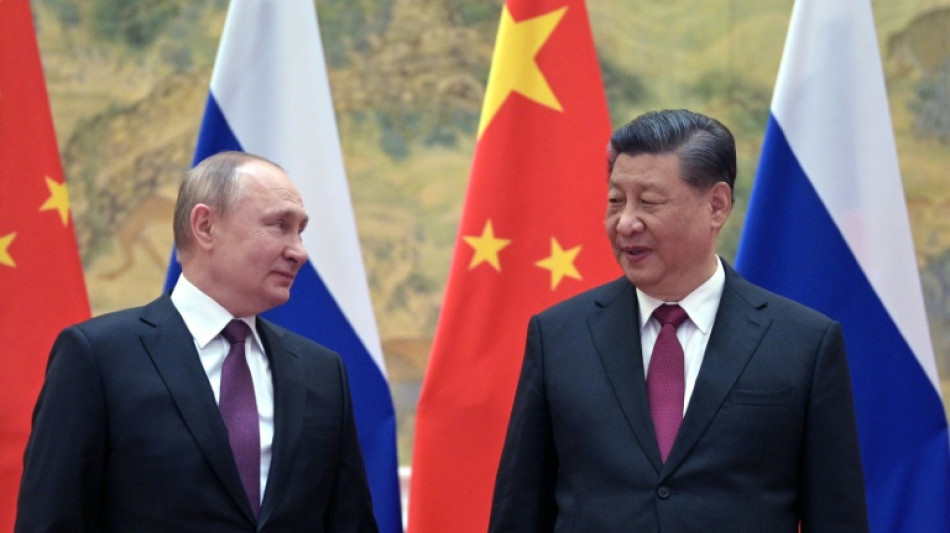
'No other option': Russia's unequal economic marriage with China / Photo: Alexei Druzhinin - Sputnik/AFP/File

 San Ġiljan Defeat Paredes 20-12 in Challenger Cup Opener

 2027 Toyota Sienna Gets Sixth-Gen Hybrid System, More Power, and Trim Changes

 Burnham Government Announces Neighbourhood Support Teams to Reduce Hospital Admissions

 KFF Health News Readers Weigh In on Healthcare Policy, Ethics, and Workforce Shortages

 16-Year-Old Founder Targets 'Cost Per Kill' With AI Missile Startup

 Elon Musk Promises Steering-Wheel-Free Tesla Model Y Amid Cybercab Sales Launch

 APEX FTE Expo 2026 Unites Aviation Leaders in Singapore and Honors Passenger Experience Excellence

 West Midlands Shoppers Urged to Guard Against Black Friday Scams
Russia has found itself in an unequal relationship with China since intensifying its pivot toward Beijing after the assault on Ukraine.
Since Western countries imposed sanctions on Moscow, bilateral trade between the two neighbours has reached a record $190 billion and the proportion of Russian foreign trade carried out in yuan has gone from 0.5 percent to 16 percent.
"It's absolutely critical for Russia to be close to China, because Russia doesn't have many trade friends," Elina Ribakova, deputy chief economist at the Institute of International Finance, told AFP.
Russian President Vladimir Putin is now preparing to host Chinese leader Xi Jinping next week.
The two last met when Putin visited Beijing three weeks before launching his campaign in Ukraine.
Ties between the two countries are particularly strong in the energy sector, which has been heavily targeted by Western sanctions.
"China and India have replaced the European Union as Russia's most important export market" for oil, said a group of economists from the Institute of International Finance.
- 'Another tool' -
Along with Turkey, China and India accounted for two-thirds of Russia's crude oil exports in the fourth quarter last year.
"Chinese companies took over the niches that were freed by Western companies that exited Russia," said Sergey Tsyplakov, an expert at the Moscow Higher School of Economics.
That was a view shared by Anna Kireeva, a research fellow at the prestigious MGIMO University in Russia.
"It was necessary to find alternative sources of import as well, especially in machinery, electronics, various parts and components, automobiles and other vehicles," Kireeva told AFP.
She said however most big Chinese companies that are well-integrated into Western markets opted to pause their activities in Russia for fear of potential sanctions.
Time will tell if the alliance of convenience will turn into a long-term sustainable partnership.
"Putin wants an even relationship with China, like with a twin brother, but it's not the case," analyst Timothy Ash told AFP.
"Russia has no other option" than to turn to China, he said.
Temur Umarov, a fellow at the Carnegie Endowment for International Peace, said Russia's economic stability "depends on China".
"It gives Beijing another tool, another instrument to influence Russia from domestically," he said.
The Kremlin however denies any disparity.
"There is neither a leader nor a follower in relations between Russia and China, because both parties trust each other equally," Russian presidential aide Yuri Ushakov told journalists.
- Competitors -
Some logistical problems hinder trade development between Beijing and Moscow.
Railway routes in Russia's Far East are saturated, Kireeva said, and their upgrade will take some time.
Infrastructure in Far Eastern regions, including the main oil port of Kozmino in the Sea of Japan, are also congested.
Besides, Russia has had to sell its oil at cheaper prices than usual to China or India to maintain sales volumes.
Its budget is already feeling the consequences of the forced discounts.
Oil export revenue sank by 42 percent year-on-year in February, the International Energy Agency said.
Having fewer partners leaves Russia in a vulnerable position compared to China, which remains a competitor, Ash said.
"Beijing has an interest in keeping Russia as an ally that is independent to the West, while it also likes Russia to be weakened so it can exploit it."
Russia's economic dependency on China is still in its early stages, Umarov said.
"But in years or decades this economic leverage could turn into some bigger political leverage," he added.
E.Paulino--PC


