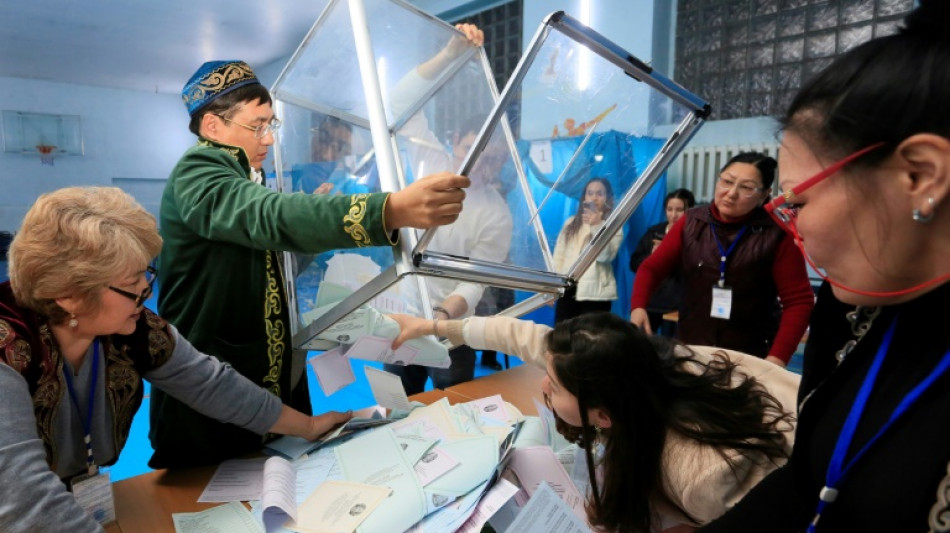
OSCE urges more democratic reforms after Kazakh elections / Photo: Ruslan PRYANIKOV - AFP

 Texas Sports Betting Status: No Legal Options Amid Legislative Push for 2027 Referendum

 Geri Halliwell-Horner Embraces Queen Camilla at Commonwealth Writing Competition

 Meta Quest 3 and 3S Gain Access to Over 150 3D Movies

 Sarah Bajada Shares Message on Pregnancy Loss

 ALIX LASERS shareholders remove Michael Sobitsch as managing director in view of the circumstances

 Euroseas Q3 Net Profit Falls to $91.4 Million Amid Fleet Reduction

 Daily Horoscope November 20, 2026: Astrological Predictions for All Signs

 Tosca's 2026 Sustainability Report Makes the Case for Packaging as Critical Supply Chain Infrastructure
International observers on Monday welcomed progress in Kazakhstan's parliamentary elections but said more democratic reforms were needed as the country hopes to turn the page after a brutal crackdown.
Sunday's elections in the oil-rich Central Asian country were called by President Kassym-Jomart Tokayev as part of a "modernisation" drive after protests against fuel prices last year.
The demonstrations were brutally crushed and 238 people died, according to the official toll.
The Organisation for Security and Co-operation in Europe (OSCE) said that several of its recommendations had been implemented and there was therefore "increased choice for voters".
"But further changes to the legal framework are needed to provide a sufficient basis for conducting democratic elections," the OSCE observers said.
Turnout was 54.19 percent among the 12 million eligible voters in the ex-Soviet country, wedged between China and its former master Russia.
Results are expected later Monday.
- 'Changing for the better' -
A new system has been introduced for this election, with 69 deputies -– out of the 98 in the Majilis, the lower house of parliament -– elected by proportional representation.
Exit polls broadcast on state television showed the ruling Amanat party in the lead with 53 percent of the vote, and five to six parties are expected to enter parliament, compared to three currently.
The 29 deputies elected by the first-past-the-post system were not yet known.
Tokayev, a former diplomat, was hand-picked in 2019 by his predecessor and mentor Nursultan Nazarbayev to take the helm after a nearly three-decade rule.
But Tokayev purged the vestiges of that era after the demonstrations.
Both Tokayev and 82-year-old Nazarbayev were seen casting their vote on Sunday.
"As independent candidates are admitted, I think the electoral system is changing for the better," nurse Irina Reshetnik, 58, told AFP at a polling station in the capital Astana.
- 'Irregularities' -
Ernest Serikov, an 81-year-old retired professor in Kazakhstan's largest city Almaty, said he supported the president and called the elections "experimental".
Independent candidates were allowed to run for parliament for the first time in nearly 20 years, the previous lower house having been made up of three pro-government parties.
The threshold to enter the 98-seat legislature was also lowered to five percent and a 30-percent quota was introduced for women, young people and people with disabilities.
But the OSCE report pointed out that "limits on the exercise of constitutionally guaranteed fundamental freedoms remain and some political groups continue to be prevented from participating as political parties in elections".
The observers noted that the voting "was organised in a smooth manner overall" but that "significant procedural irregularities were observed".
On reforms yet to be undertaken, they said that "priority recommendations related to fundamental freedoms of peaceful assembly, expression and media are yet to be implemented".
M.Gameiro--PC