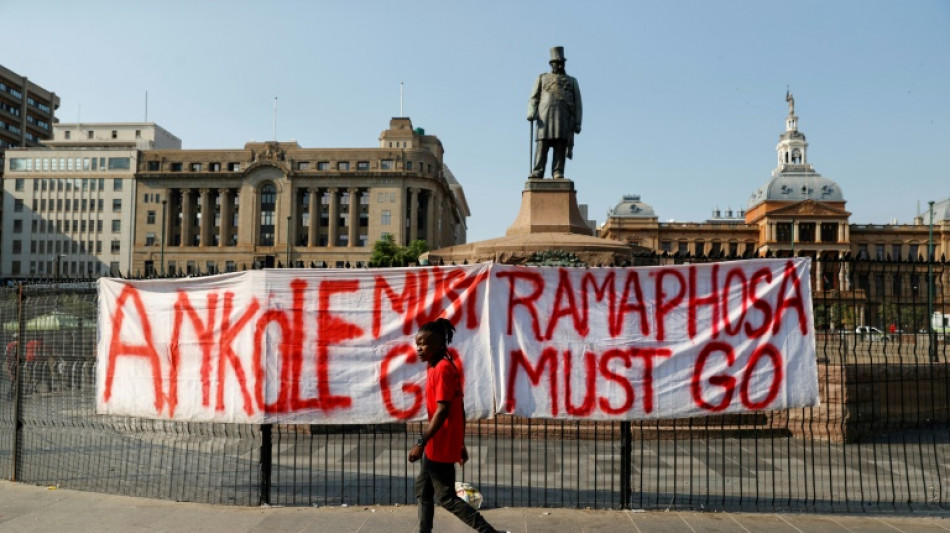
South African protesters march to demand Ramaphosa steps down / Photo: PHILL MAGAKOE - AFP

 Texas Sports Betting Status: No Legal Options Amid Legislative Push for 2027 Referendum

 Geri Halliwell-Horner Embraces Queen Camilla at Commonwealth Writing Competition

 Meta Quest 3 and 3S Gain Access to Over 150 3D Movies

 Sarah Bajada Shares Message on Pregnancy Loss

 ALIX LASERS shareholders remove Michael Sobitsch as managing director in view of the circumstances

 Euroseas Q3 Net Profit Falls to $91.4 Million Amid Fleet Reduction

 Daily Horoscope November 20, 2026: Astrological Predictions for All Signs

 Tosca's 2026 Sustainability Report Makes the Case for Packaging as Critical Supply Chain Infrastructure
South Africa's opposition held rallies under tight security on Monday in a bid to force out President Cyril Ramaphosa over his handling of the country's sickly economy and crippling energy crisis.
But turnout was low and calls for strikes went unheeded as the government mobilised thousands of police, backed by troops, to stifle any unrest.
The leftwing Economic Freedom Fighters (EFF), the country's third-largest party, had called for a "national shutdown," sparking fears of a repeat of bloody clashes and looting just under two years ago.
Under close escort and with a police helicopter overhead, several thousand protesters marched in the capital Pretoria to Ramaphosa's official residence, passing the seat of government, the Union Buildings.
"Our demands are simple, we want Ramaphosa to leave this house, to leave this house with immediate effect," EFF's firebrand leader Julius Malema told protesters.
"We are here to demand the end of load shedding (electricity outages), to demand Ramaphosa to step down and if he doesn't… we will force him to step down," he said.
In other parts of the country, protesters gathered in groups varying in size from dozens to hundreds.
- High security -
The protest call rekindled memories of clashes in July 2021 that saw the worst violence since the end of apartheid and advent of democracy in 1994.
At least 350 people were killed when protests sparked by the jailing of ex-president Jacob Zuma spiralled into riots and looting.
As the protests loomed, the authorities mobilised nearly 3,500 troops to assist police and warned they would deal firmly with any unrest.
"The mayhem and anarchy that was threatened did not materialise due to the strong presence and visibility of law enforcement authorities," Ramaphosa's spokesman, Vincent Magwenya, told AFP in a text message.
"Citizens who were not party to any demonstration were able to carry on with their normal daily activities," he said.
"There was no shutdown. Some businesses closed down due to intimidation and fear of violence."
The EFF told followers their actions "must be militant and radical" but to behave peacefully and watch out for provocateurs.
Eighty-seven protesters were arrested for violence-related offences overnight, according to the police, who gave no details of the offences.
- Crisis-ridden -
Ramaphosa, a former union boss who became a business tycoon after apartheid, stepped into the president's job in February 2018.
Supporters acclaimed him a clean pair of hands after the graft-tainted era of President Jacob Zuma.
Today, his popularity ranking has slumped, battered by his handling of the economy, chronic electricity shortages and joblessness.
These crises have combined with a personal scandal about a cash heist at a luxury farm owned by Ramaphosa.
The president hit back at the EFF over its "shutdown" call, accusing it of instrumentalising the nation's problems ahead of general elections next year.
His party, the African National Congress (ANC), described the protest as "extremist and regressive."
There was "no place or tolerance for vigilantism and forceful removal of an incumbent government" in South Africa, it warned.
For the first time since January 2, the country on Sunday -- and most of Monday -- was spared scheduled power cuts, something that the EFF claimed was due to the pressure of the strike call.
In Pretoria, EFF member Gift Boquopane, 42, joined the protest with his wife and children.
He carried a sign reading "Down with loadshedding," a reference to the deeply unpopular outages.
The power cuts have fanned resentment in a country struggling with soaring inflation and unemployment, which has reached stratospheric levels among the young.
In the last three months of 2022, economic growth tumbled below pre-pandemic levels.
"The damage that the Ramaphosa government is causing is so terrible that we cannot tolerate it any longer. They must go now," said Carl Niehaus, a former ANC official official who joined the rally.
V.F.Barreira--PC

