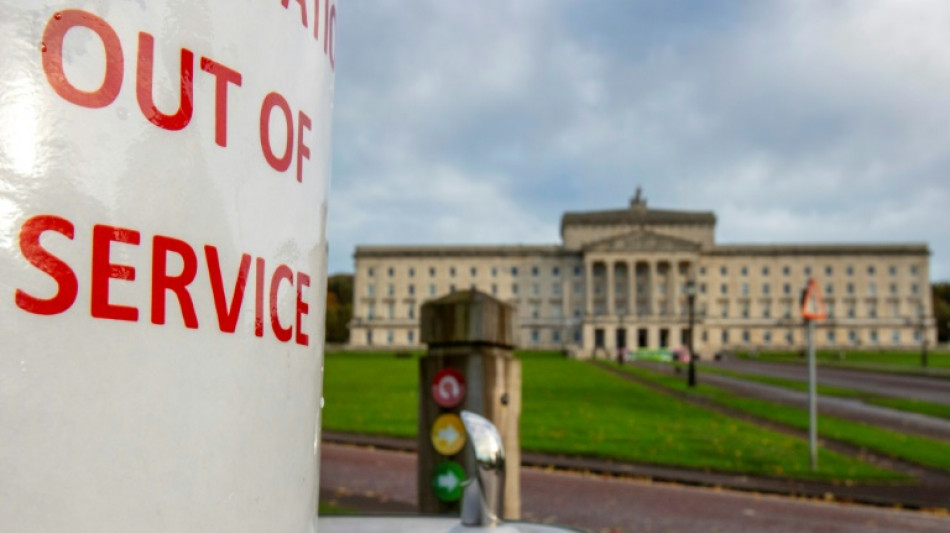
N.Ireland unionists oppose key part of Brexit trade deal / Photo: Paul Faith - AFP

 Texas Sports Betting Status: No Legal Options Amid Legislative Push for 2027 Referendum

 Geri Halliwell-Horner Embraces Queen Camilla at Commonwealth Writing Competition

 Meta Quest 3 and 3S Gain Access to Over 150 3D Movies

 Sarah Bajada Shares Message on Pregnancy Loss

 ALIX LASERS shareholders remove Michael Sobitsch as managing director in view of the circumstances

 Euroseas Q3 Net Profit Falls to $91.4 Million Amid Fleet Reduction

 Daily Horoscope November 20, 2026: Astrological Predictions for All Signs

 Tosca's 2026 Sustainability Report Makes the Case for Packaging as Critical Supply Chain Infrastructure
Northern Ireland's largest pro-UK party said Monday they oppose a crucial part of a new post-Brexit trade pact for the British province agreed by London and the European Union.
A vote in Britain's parliament on parts of the pact -- which would give Northern Irish lawmakers an effective veto over new EU rules being imposed on the UK province -- is due to take place on Wednesday.
Democratic Unionist Party (DUP) leader Jeffrey Donaldson welcomed progress on the issue but said "the imposition of EU law" on Northern Ireland had not been resolved.
The mechanism -- referred to as the "Stormont brake" -- was a key element in a landmark compromise announced by London and Brussels last month, following months of negotiations.
Wrangling over post-Brexit trade soured relations between London and Brussels and unsettled Northern Ireland, nearly 25 years on from a peace deal that ended three decades of armed conflict.
It had been hoped the new agreement, dubbed the Windsor Framework, would be accepted by all sides and help lead to the restoration of power-sharing in the province.
The DUP collapsed the devolved government last year over its opposition to the post-Brexit arrangements, which it claimed put Northern Ireland's place in the wider UK at risk.
However, Donaldson said DUP lawmakers and officials had "unanimously agreed... that our members of parliament would vote against the draft statutory instrument on Wednesday".
- 'Best deal' -
The brake would allow Northern Ireland's devolved assembly to potentially block the application of new EU laws if a group of lawmakers in Northern Ireland's devolved assembly formally petition over an objection.
It was designed to address concerns voiced by unionists, and Donaldson's party in particular, over what they had referred to as a "democratic deficit" in existing trade rules.
Under the "Northern Ireland Protocol" sealed in 2020, the province is subject to some EU rules that do not apply elsewhere in the UK.
That protocol was aimed at avoiding the creation of a hard land border between Northern Ireland and the Republic of Ireland, which remains an EU member.
But it has angered pro-UK unionists who argue it keeps Northern Ireland under EU rules despite the UK having left, and makes a united Ireland more likely.
The DUP's apparent opposition to the new proposals raises the prospect that the Stormont assembly will not be sitting during events in April to mark the 25th anniversary of 1998 peace accords, when US President Joe Biden is set to attend.
UK Prime Minister Rishi Sunak's spokesman told reporters the vote will still proceed on Wednesday and he was "confident" it would be passed.
"We continue to believe this is the best deal for the people and businesses of Northern Ireland," he said.
The spokesman denied DUP claims about the "Stormont Brake", saying the EU has "no role" in deciding if it is used or not.
"The treaty is clear that's for the people of the UK alone," he added.
X.Matos--PC

