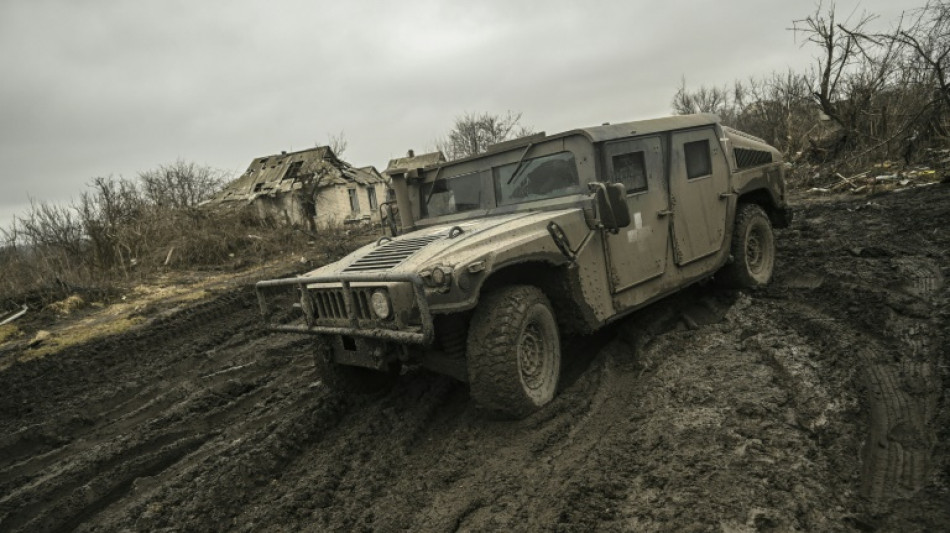
Mud: The common enemy in eastern Ukraine / Photo: Aris Messinis - AFP/File

 Texas Sports Betting Status: No Legal Options Amid Legislative Push for 2027 Referendum

 Geri Halliwell-Horner Embraces Queen Camilla at Commonwealth Writing Competition

 Meta Quest 3 and 3S Gain Access to Over 150 3D Movies

 Sarah Bajada Shares Message on Pregnancy Loss

 ALIX LASERS shareholders remove Michael Sobitsch as managing director in view of the circumstances
 Euroseas Q3 Net Profit Falls to $91.4 Million Amid Fleet Reduction

 Daily Horoscope November 20, 2026: Astrological Predictions for All Signs

 Tosca's 2026 Sustainability Report Makes the Case for Packaging as Critical Supply Chain Infrastructure
Gripping the steering wheel of his truck, Grygoriy expertly made his way along a muddy route to take personnel and ammunition to an artillery position near Ukraine's front line.
"The hardest part is going uphill," the 39-year-old soldier said as the truck in turns slipped and then found its grip on a twisting, churned-up path through some fields.
Grygoriy, who has been driving the Soviet-designed Zil-131 for the past six months, said the 6x6 truck "saves us every time" in treacherous driving conditions.
On some parts of the route, the muddy black traces left by tyres or tank tracks form a series of parallel lines a dozen metres wide.
After a cold and snowy winter, the arrival of spring rains and milder temperatures has brought back mud to the Donbas battlefields.
Videos shared on social media show soldiers wading through trenches and vehicles destroyed after getting stuck in the mud.
After some days of dry weather, the rain came back to Donbas on Sunday, particularly around Bakhmut, where the fighting between Russian and Ukrainian forces has raged for months.
Near the city, the driver of a Ukrainian T-64 tank said the Soviet model "has no problem going through the mud -- its tracks were designed so that they get stuck very rarely".
Newer models such as the T-72 or the T-90 are "worse", said the soldier, who asked not to be named.
- Major offensive 'impossible' -
The roads in this part of Ukraine are frequently covered in the country's famous black soil -- one of the most fertile in the world because it is rich in humus.
Brought in from the fields by tank tracks, it becomes a greasy mud in the rain.
The conditions make it difficult for either side to shift a front line that has remained relatively unchanged since November.
"Both sides are waiting for weather conditions to improve," Ruslan, the head of Grygoriy's artillery unit, told AFP.
"Any major offensives are impossible or at least very problematic. Time is on the side of those defending," he said.
The mud can also slow down evacuations.
"Of course it's a problem but we have always been able to find an appropriate vehicle for an injured soldier to be transported to hospital," a member of a medical unit in a small village near the front line said, speaking on condition of anonymity.
"For the more serious cases, we transport them with the vehicles that we have here, even though we cannot move quickly.
"You've seen the conditions here," said the medical worker, pointing to a crater-pocked road covered in thick, slippery mud.
A lieutenant in an infantry unit near Bakhmut said the rain was "a major problem".
"Our boys stay in the trenches, in the mud and they have to defend the position."
"Tracked vehicles are also blocked at the moment -- both on our side and on theirs.
"If the weather dries up and stays that way for three or four weeks there will definitely be a large-scale attack," he said.
A.Motta--PC