Ukraine's Hungarians stuck between Kyiv and 'pro-Putin' Orban / Photo: ATTILA KISBENEDEK - AFP

 Justice Alito steps aside from major US climate case
 Willis happy with England exile after retains Top 14 player award
 Spain housing protests keep heat on government as PM seeks new law
 Wissa spoils Zimbabwe homecoming as DR Congo win AFCON qualifier
 UK police release on bail five men held over airbase incident
 Ex-All Black Plummer 'sure' New Zealand will find Super Rugby solution
 Shein sees 1% revenue growth in first half of 2026
 Netherlands regrets Israel retaliation in settlements row
 Moscow seizes Russian assets of German food retailer Metro
 Bulgarian spirits inflamed by new rakia rules

 Documentary turns camera on architect Peter Zumthor
 UK police say releasing on bail five men held over airbase incident
 Trump admin finalizes reversal of US fuel economy standards
 US says no China arms sale plans after envoy cites Trump offer
 Dozens kidnapped in two weekend attacks in northern Nigeria
 Next stop the world: Pathirage wins Asian Games javelin gold
 Aster Launches Perpetual Grid Trading 2.0 with Up to 140,000 $ASTER Liquidity Mining Campaign
 Seoul says North Korean mines 'highly suspected' as cause of DMZ blast
 Russia pummels Kyiv in latest deadly daytime attack
 Wartime Ukraine works to keep its railways on track
 Boy among 3 dead in migrant Channel crossing accident: French authorities
 SGFX Creates a Standout Brand Experience at Forex Expo Dubai 2026
 Pope urges Europe to help combat 'deceit and lies' in international ties
 Injured Buttler to miss England ODI series in Pakistan
 Madrid housing protesters vow to maintain pressure on government
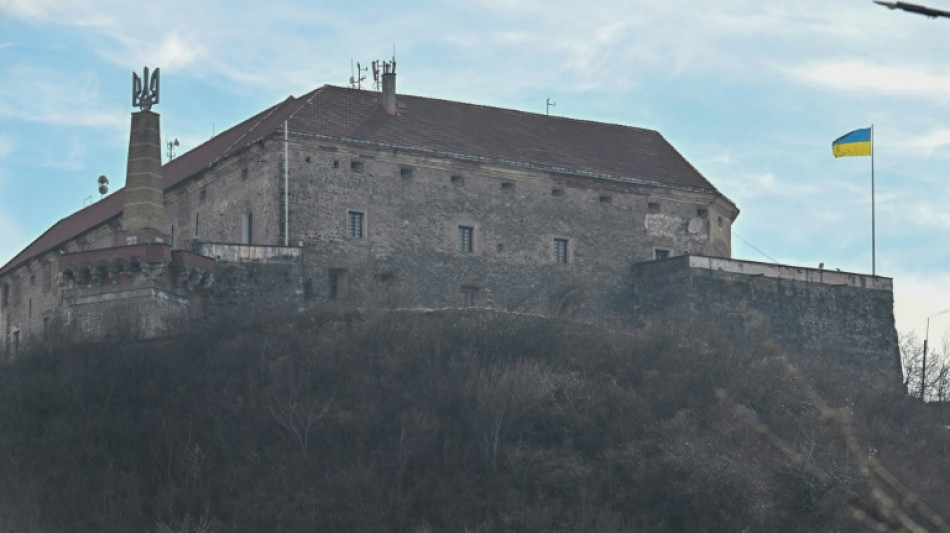
Until October, the medieval castle on the hill above Mukacheve in Ukraine's westernmost region sported a statue of Hungary's national symbol, the "turul" bird.
It has since been replaced with Ukraine's trident after the city's mayor ordered the mythical creature's replacement, unsettling Transcarpathia's large Hungarian community and sparking protests from Budapest.
Closer to Budapest than Kyiv and part of the Austro-Hungarian empire until World War I, multi-ethnic Transcarpathia borders Poland, Slovakia, Hungary and Romania, and is home to over 100,000 Magyars -- its biggest minority group.
But the turul "is a chauvinistic symbol of imperial-era Hungary and belongs in a museum," Mukacheve's mayor Andriy Baloha told AFP.
"Only the trident should be on the castle," he said.
"The same goes for flags on municipality-owned buildings," said the 34-year-old, referring to another recent local decree that prohibits the flying of Hungarian flags.
- Worsening relations -
The measures are the latest to unnerve Transcarpathian Hungarians, many of whom fled to Hungary to avoid military service after Russia invaded Ukraine.
Relations between Kyiv and Hungary, an EU and NATO member, already sour because of a rift over minority language education rights, have worsened in the past year.
Hungary's nationalist premier Viktor Orban has being obstructing tightening NATO links with Ukraine over the language spat, giving Kyiv only lukewarm support during the war.
Orban has also claimed that ethnic Hungarians are being forced into military service and dying in large numbers at the front, without providing details.
Although Hungary has sent aid and hosted refugees, Orban -- close to Russian President Vladimir Putin before the war -- refuses to send weapons to Kyiv, opposes sanctions against Russia, and has urged peace talks instead.
The approach has prompted Ukrainians like Baloha to describe Orban as "pro-Russian" and suspect that Budapest wants to annex Transcarpathia.
"It's important to show that Transcarpathia is, was, and will be an integral part of Ukraine," he said in defence of his controversial decrees.
- 'Tension and worry' -
According to Karolina Darcsi, spokesperson for the local Hungarian political party KMKSZ, Budapest's "no weapons" policy has led to "negative portrayals" of Hungarians in Ukrainian media.
"In comments under articles, some Ukrainians say that 'if Hungarians are like that they should be deported to Budapest,'" she told AFP.
Such anti-Hungarian sentiment and curbs on teaching their mother tongue cause the minority "tension and worry", said Pal Popovics, a teacher at a high school in Mukacheve.
Legislation aimed at protecting the Ukrainian language adopted by Kyiv since 2017 means that schoolchildren can no longer sit final or university entrance exams in Hungarian.
From September, at least 20 percent of classes must be taught in Ukrainian.
The school, whose corridors are lined with pictures of Hungarian historical figures, is one of around 100 in Transcarpathia where classes are currently taught only in Hungarian. Like many in the region, it was renovated with state funds from Budapest.
"Mother-tongue schooling is vital for preserving our identity -- restricting it makes us feel like second-class citizens," Popovics said.
"We just want respect -- we pay our taxes and fight like our fellow citizens against the Russian invasion," he told AFP in the school cellar during an air raid alarm.
- 'Pure provocation' -
Zsolt Ladanyi, an ethnic Hungarian who has fought for Ukraine, said he "didn't think twice" about volunteering for the army.
"I told my Ukrainian comrades that I was born here and never thought of leaving," the 50-year-old baker told AFP in Uzhhorod, Transcarpathia's largest city.
"But I don't understand why Hungary doesn't send weapons," he added as he showed his phone footage from frontline trenches.
Sandor Spenik, dean of Uzhhorod university's Ukrainian-Hungarian faculty, told AFP that the friction was being "pushed a bit from Kyiv".
The turul removal in Mukacheve was a "pure provocation" designed to incite peoples and countries against each other during wartime, he said, while in everyday life there is "no tension between people".
"Persecuting our ethnic Hungarian citizens over a stance of the Hungarian government, which we dislike, is completely wrong," said Volodymyr Chubirko, head of the regional council.
Tension in Transcarpathia is "an inflated myth", he said. "We will preserve ethnic peace."
A.Santos--PC