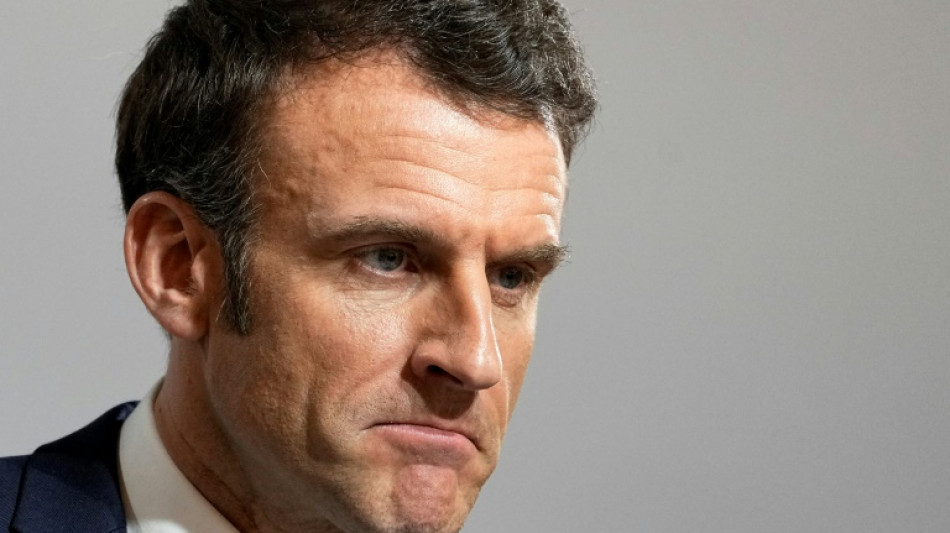
Macron to speak as anger smoulders over French pension reform / Photo: Michel Euler - POOL/AFP

 Texas Sports Betting Status: No Legal Options Amid Legislative Push for 2027 Referendum

 Geri Halliwell-Horner Embraces Queen Camilla at Commonwealth Writing Competition

 Meta Quest 3 and 3S Gain Access to Over 150 3D Movies

 Sarah Bajada Shares Message on Pregnancy Loss

 ALIX LASERS shareholders remove Michael Sobitsch as managing director in view of the circumstances

 Euroseas Q3 Net Profit Falls to $91.4 Million Amid Fleet Reduction

 Daily Horoscope November 20, 2026: Astrological Predictions for All Signs

 Tosca's 2026 Sustainability Report Makes the Case for Packaging as Critical Supply Chain Infrastructure
French President Emmanuel Macron is set to give a televised interview on Wednesday, with the 45-year-old seeking to calm public anger over his pension reform and tamp down spiralling protests and strikes.
Police arrested another 234 people in Paris on Monday night during tense standoffs between protesters and security forces, a police source said, with several groups burning trash bins, bikes and other objects.
The latest unrest comes after Macron's centrist government narrowly survived two no-confidence motions in parliament on Monday, meaning the legislation to raise the retirement age from 62 to 64 looks almost certain to enter force.
Anger over the government's decision to invoke a notorious constitutional power to ram the reform through parliament without a vote last week has dismayed many of his political allies and caused fury on the streets.
"The reform is adopted but it is not seen as legitimate in the eyes of French people," political scientist Jerome Jaffre told France Inter radio on Tuesday. "That's a source of problems, of bitterness, and it's far from being resolved."
Violent protests also took place in eastern cities Dijon and Strasbourg overnight, while protesters blocked a motorway in southeast France on Tuesday and continued to disrupt traffic around the northern port of Le Havre.
Macron's office said he would go live to answer questions by journalists from broadcasters TF1 and France 2 at 1:00 pm (1200 GMT) on Wednesday.
The former investment banker, who made pension reform a central theme of his re-election campaign last April, has so far avoided commenting on the legislation, leaving Prime Minister Elisabeth Borne as the public face of the change.
"The president needs to speak, the earlier the better," Bruno Millienne, a member of parliament from the Macron-allied MoDem party, told AFP on Monday. "We need to bring the nation back together."
A survey on Sunday showed the president's personal rating at its lowest level since the height of a the anti-government Yellow Vest protest movement in 2019, with only 28 percent of respondents having a positive view of him.
- Strikes ahead -
The government survived two no-confidence motions on Monday lodged by opposition groups, with one failing by just nine votes in the 577-seat National Assembly.
The far-right National Rally party of Marine Le Pen is set to lodge an appeal against the pensions law at the Constitutional Council on Tuesday, but it is seen as unlikely to succeed.
"One of the difficulties at the moment, after the no-confidence votes, is that there are no obvious solutions (to the political crisis), or they are difficult to find," Vincent Martigny, a politics professor from the University of Nice, told the France 5 channel.
Under-fire Borne has refused to bow to calls to resign, telling AFP that she was "determined to continue to carry out the necessary transformations in our country with my ministers".
As well as the political crisis sparked by the law, the government is also contending with growing public order problems and the risk of economic disruption.
Spontaneous protests by young people have seen clashes with police nightly since last week, while strikes and blockades at oil refineries risk creating fuel shortages.
Shortages in the southern port of Marseille saw long queues of drivers forming at petrol stations.
"I've been to most stations," 18-year-old high school student Christos Chatts told AFP as he looked for petrol in the city centre ahead of his end-of-year exams. "They're either closed, or there's no fuel, or there are monster queues."
The government said Tuesday that it would requisition workers at a fuel depot in Fos-sur-Mer near Marseille, forcing them back to work on pain of prosecution.
The streets of Paris also remain strewn with uncollected rubbish after a two-week strike by garbage workers, causing public health worries.
"The key word for the days to come is 'pacification'," former president Francois Hollande, a frequent critic of Macron, told the LCI channel on Tuesday.
Government insiders and observers have raised fears that France is again heading for a bout of sustained violent protests, only a few years after the Yellow Vest" movement shook the country from 2018 to 2019.
Another round of strikes and protests organised by trade unions have been called on Thursday and are expected to again bring public transport to a standstill.
"Nothing will weaken the determination of the workers," the hard-line CGT union has said.
burs-adp/ah/jmm
E.Borba--PC

