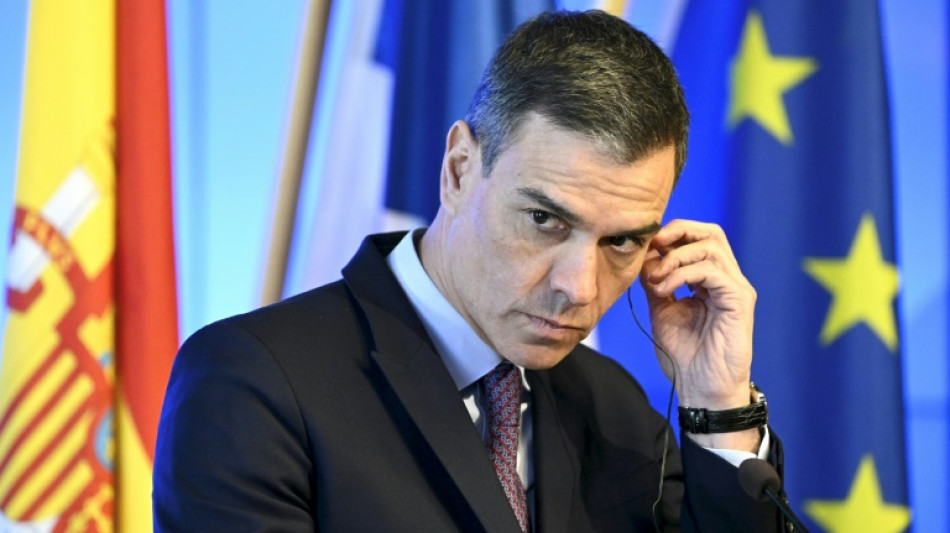
Spain govt faces no-confidence vote by far-right Vox / Photo: Heikki Saukkomaa - Lehtikuva/AFP

 Texas Sports Betting Status: No Legal Options Amid Legislative Push for 2027 Referendum

 Geri Halliwell-Horner Embraces Queen Camilla at Commonwealth Writing Competition

 Meta Quest 3 and 3S Gain Access to Over 150 3D Movies

 Sarah Bajada Shares Message on Pregnancy Loss

 ALIX LASERS shareholders remove Michael Sobitsch as managing director in view of the circumstances

 Euroseas Q3 Net Profit Falls to $91.4 Million Amid Fleet Reduction

 Daily Horoscope November 20, 2026: Astrological Predictions for All Signs

 Tosca's 2026 Sustainability Report Makes the Case for Packaging as Critical Supply Chain Infrastructure
Spanish lawmakers on Tuesday began debating a no-confidence motion targeting Socialist Prime Minister Pedro Sanchez brought by the far-right Vox party and fronted by an 89-year-old former communist.
The initiative, which comes before local and regional elections on May 28 and an end-of-year general election, will be put to the vote on Wednesday.
But it has no chance of success, given the move is only likely to win support from Vox's 52 MPs in the 350-seat chamber.
The main right-wing opposition Popular Party (PP) has said it will abstain.
It is the second such motion against Sanchez brought by Vox, with a previous attempt failing in September 2020.
This time, the no-confidence move is being defended by an external figure who does not belong to the party, Ramon Tamames.
Jailed for opposing the Franco regime, Tamames was a leader of the Communist Party during Spain's democratic transition after the dictator's death in 1975, but in the ensuing years this economics professor turned to the right.
Addressing lawmakers from the floor rather than from the speaker's box, a visibly frail Tamames justified his stance by the need to defend the Spanish "nation" against a left-wing government supported by Catalan and Basque independence groups.
Accusing the executive of "not respecting the division of powers", he also said it was guilty of a "widespread misuse of public spending for electoral purposes".
Vox leader Santiago Abascal, who opened the debate, called Sanchez's administration the "worst Spanish government in decades".
In response, Sanchez accused Vox of "hiding behind a candidate of convenience" in order to stage a "parliamentary show".
"Vox is the flavour-enhancer of the right, which simply enhances the taste of radical extremism," he said, while also criticising the PP over its plans to abstain in Wednesday's vote.
Vox became Spain's third-largest party when it entered parliament in 2019, and last year won its first share of power in one of Spain's regional governments alongside the PP.
It is a model the party is hoping to repeat, given that polls suggest the PP would win December's general election but would need Vox's support to govern.
But its ultra-conservative stances, notably over abortion in recent months, have embarrassed the PP which is trying to keep its distance from the far-right faction.
O.Salvador--PC