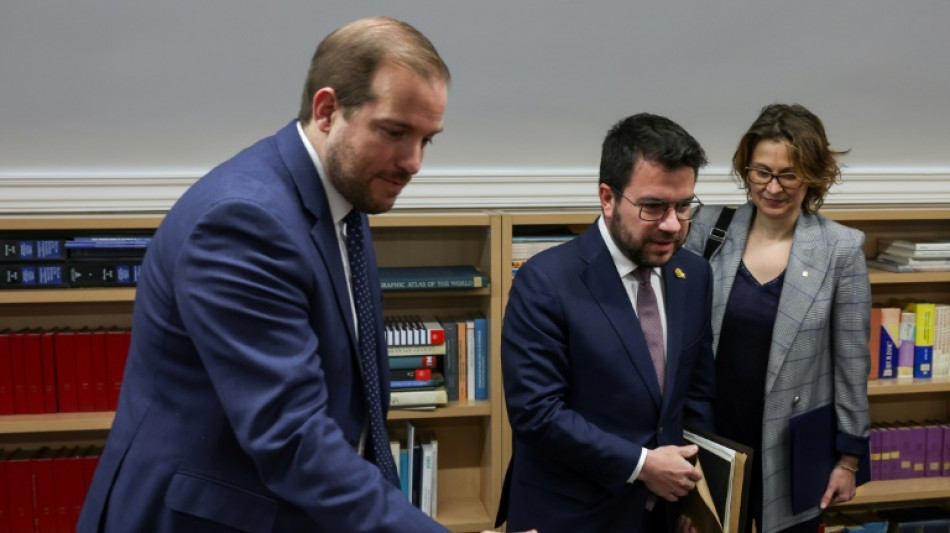
Spain needs more transparency over Pegasus: EU lawmakers / Photo: Pierre-Philippe Marcou - AFP

 Texas Sports Betting Status: No Legal Options Amid Legislative Push for 2027 Referendum

 Geri Halliwell-Horner Embraces Queen Camilla at Commonwealth Writing Competition

 Meta Quest 3 and 3S Gain Access to Over 150 3D Movies

 Sarah Bajada Shares Message on Pregnancy Loss

 ALIX LASERS shareholders remove Michael Sobitsch as managing director in view of the circumstances

 Euroseas Q3 Net Profit Falls to $91.4 Million Amid Fleet Reduction

 Daily Horoscope November 20, 2026: Astrological Predictions for All Signs

 Tosca's 2026 Sustainability Report Makes the Case for Packaging as Critical Supply Chain Infrastructure
Spain needs more transparency over the Pegasus spyware hacking scandal, a European Parliament committee said Tuesday at the end of a two-day fact-finding mission to Madrid.
The cross-party European committee, which investigates the illegal use of spyware in EU states, has been looking into espionage allegations involving Pegasus software which can turn smartphones into pocket spying devices.
"We urge the authorities to expeditiously cooperate with the courts to allow the maximum transparency" in these cases, committee chair Jeroen Lenaers, a Dutch MEP, told reporters.
"Victims of spyware deserve more information and transparency," he said, while acknowledging that the legal framework in Spain was "in line with fundamental rights protection".
The delegation of 10 MEPs from six countries has previously visited Israel, Poland, Greece, Cyprus and Hungary as it pursues its probe into the Israeli-made software which can read a phone's messages, track its location and secretly turn on the camera and microphone.
Last year, Catalonia's regional leadership accused Spain's intelligence services of using Pegasus software to hack the mobile phones of dozens of separatist politicians, sparking a crisis that prompted the government to sack its spy chief.
The accusations emerged after Canada's cybersecurity watchdog Citizen Lab published a report in April saying the phones of at least 65 Catalan separatists had been tapped following the failed 2017 independence bid.
Several weeks later, spy chief Paz Esteban told a parliamentary committee 18 Catalan separatists, including Catalan regional leader Pere Aragones, had been spied with Pegasus software but always with court approval.
She was later sacked.
- Morocco 'a plausible candidate' -
Around the same time, the government admitted the phones of Prime Minister Pedro Sanchez and two other top ministers had also been hacked by the same spyware, blaming it on "an external attack" which the press blamed on Morocco.
Although Lenaers admitted the committee lacked "proof" that Morocco was behind it, he said it was "a plausible candidate".
"We even have interlocutors of our mission today and yesterday who even refused to comment on the potential links to Morocco out of fear of retaliation by the Moroccan authorities. That for me already makes it plausible," he said.
Both cases of spying involving the ministers and the Catalan separatists are currently before the courts.
Aragones met the committee in Madrid on Tuesday morning, describing the espionage as "a new chapter in the dirty war against those of us who defend the independence of Catalonia".
"Democratic institutions and representatives of Catalan citizens have been treated like criminals," he said.
An interim report published by the European Parliament in November found that Pegasus spyware had been used "illegitimately" to conduct surveillance in at least four EU countries -- Greece, Spain, Poland and Hungary -- and called for a moratorium on the sale, acquisition, transfer and use of spyware in the EU.
F.Cardoso--PC