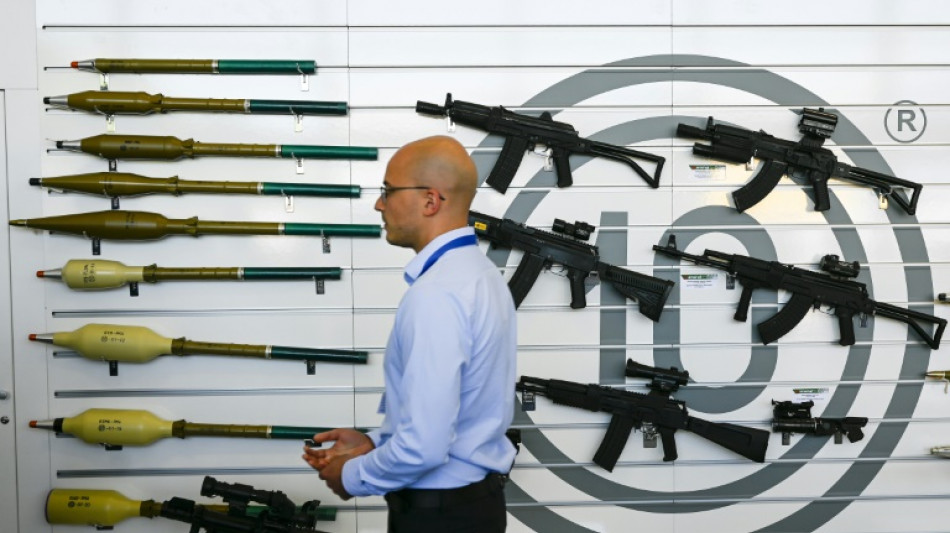
'Guns and Roses': Bulgaria arms trade booms on Ukraine war / Photo: Nikolay DOYCHINOV - AFP

 Texas Sports Betting Status: No Legal Options Amid Legislative Push for 2027 Referendum
 Geri Halliwell-Horner Embraces Queen Camilla at Commonwealth Writing Competition

 Meta Quest 3 and 3S Gain Access to Over 150 3D Movies

 Sarah Bajada Shares Message on Pregnancy Loss

 ALIX LASERS shareholders remove Michael Sobitsch as managing director in view of the circumstances

 Euroseas Q3 Net Profit Falls to $91.4 Million Amid Fleet Reduction

 Daily Horoscope November 20, 2026: Astrological Predictions for All Signs

 Tosca's 2026 Sustainability Report Makes the Case for Packaging as Critical Supply Chain Infrastructure
With its huge munitions factories and endless rose fields, Kazanlak in central Bulgaria has been really living up to its "Guns and Roses" nickname since Moscow invaded Ukraine.
Bulgaria's booming arms industry has never had it so good, with exports estimated at $4.3 billion last year (about four billion euros) -- three times its previous record.
The country's oldest arms maker Arsenal, which already employs 7,000 workers in its Kazanlak plant, is offering seaside holidays and other incentives to attract staff.
It has even been tempting back Bulgarians who left the Balkan country to find work abroad.
"When they hired us they said there's orders to keep us busy for at least five years," one of the newly hired workers told AFP at the factory gates.
"I have only been here a week myself, but I already have three new colleagues," said the woman, who would not give her name.
- Historic Russia links -
While you might think it would be trumpeting its success from the rooftops, the company did not reply to AFP requests for an interview.
Although Bulgaria itself has largely not sent arms to Ukraine because of the EU member's historic ties with Moscow, that is where Kazanlak's burgeoning production is mostly destined.
Its arms and munitions are instead being bought up by neighbouring Romania and Poland before being funnelled to Kyiv.
Kazanlak and the "Valley of the Roses" around it, which is also famous for its rosewater, suffered badly when its arms makers lost their markets when the Soviet bloc collapsed in 1989, though conflicts in the Middle East revived demand for their cheap and sturdy weapons, like the AR-M1, the "Bulgarian Kalashnikov" rifle, in the 2010s.
Arsenal's upturn "benefits the whole town", Yordan Ignatov, deputy chair of the local chamber of commerce, said.
"Last year, Kazanlak had the lowest unemployment rate in the country after Sofia," he added, half the national average.
Investment is also booming.
"Everything that is built is bought," real estate agent Teodor Tenev told AFP.
Bulgaria specialises in ammunition for Soviet-era weapons -- those most used by Kyiv -- though it wants to modernise its ageing production facilities with European money to start churning out NATO-standard shells and other ammo.
And there was more good news on that front Monday when European Union foreign ministers agreed on a two-billion-euro plan that included jointly purchasing desperately needed artillery shells for Ukraine.
Even though it stands to vastly benefit from the deal, Sofia sought to save its diplomatic blushes by not signing the joint declaration.
Nor did its reticence stop EU Internal Market Commissioner Thierry Breton from starting a tour last week of European arms makers in Bulgaria.
Up the road from Kazanlak in Sopot, Breton visited the country's biggest arms maker, VMZ.
The state-owned plant has a new production line for the 155 mm artillery shells that Ukraine's army needs. Breton's visit was not open to the media.
- 'Not a political pawn' -
Supplying arms to Ukraine is an extremely sensitive issue in Bulgaria.
The Socialists -- the successors to the old communist party -- and the ever-rising ultra-nationalists are firmly against as the country gears up for the fifth election in two years next month.
Parliament so far has authorised only one shipment of light arms and ammunition to Kyiv.
Shortly after the invasion began, pro-European then-premier Kiril Petkov walked a tightrope to try to help Kyiv.
"We estimate that one-third of the ammunition needed by Ukraine in the first phase of the war came from Bulgaria," Petkov told the German daily Die Welt.
Even after the fall of Petkov's short-lived cabinet last June, indirect arms sales continued.
Retired Bulgarian army colonel Vladimir Milenski regrets that Bulgaria has refused to openly arm Kyiv.
"This would have sent a strong political signal showing that we are not a political pawn in Russia's hands," he said.
"To belong to the EU and NATO family and behave in such a way as not to infringe on the interests of Russia, an aggressor, is in the end tantamount to supporting it."
H.Portela--PC

