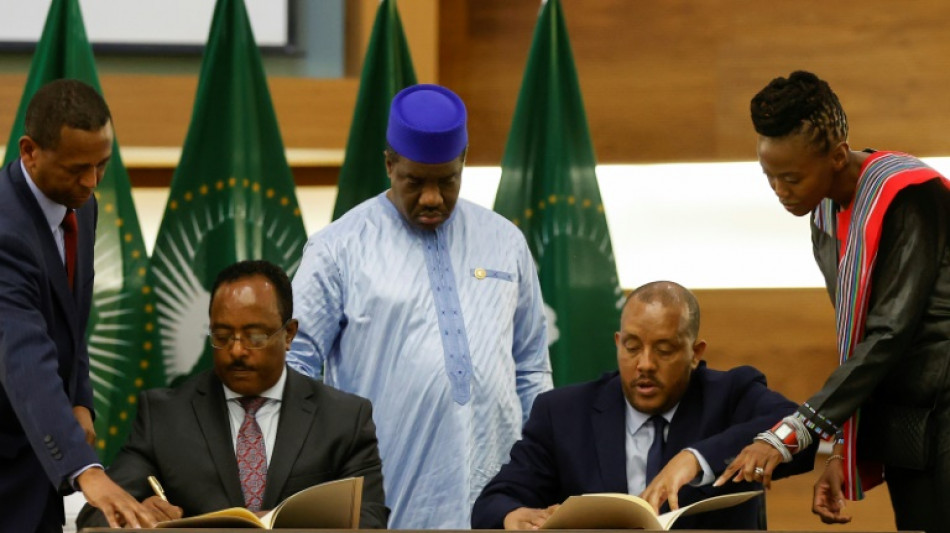
Ethiopia parliament removes rebel Tigray party from terror list / Photo: PHILL MAGAKOE - AFP/File

 Texas Sports Betting Status: No Legal Options Amid Legislative Push for 2027 Referendum

 Geri Halliwell-Horner Embraces Queen Camilla at Commonwealth Writing Competition

 Meta Quest 3 and 3S Gain Access to Over 150 3D Movies

 Sarah Bajada Shares Message on Pregnancy Loss

 ALIX LASERS shareholders remove Michael Sobitsch as managing director in view of the circumstances

 Euroseas Q3 Net Profit Falls to $91.4 Million Amid Fleet Reduction

 Daily Horoscope November 20, 2026: Astrological Predictions for All Signs

 Tosca's 2026 Sustainability Report Makes the Case for Packaging as Critical Supply Chain Infrastructure
Ethiopia's parliament on Wednesday removed the rebel Tigray People's Liberation Front (TPLF) from an official list of terrorist groups, a key step in the peace process following the two-year conflict in the country's north.
"The house has approved the decision to lift the TPLF's terrorist designation with a majority vote," the parliament said on Facebook.
The move will strengthen the November 2022 peace deal between the TPLF and the federal government, it said.
"It was remarked during the discussion of the draft decision that lifting TPLF's terrorist designation is indispensable to uphold the peace agreement held between the federal government and TPLF," it said.
The TPLF, which once dominated Ethiopian politics, was officially designated a terrorist organisation in May 2021, six months after the war erupted.
During the brutal conflict, the TPLF briefly came close to marching on the capital but was beaten back by forces loyal to Prime Minister Abiy Ahmed.
Under the terms of the peace deal signed in South Africa's capital Pretoria, the TPLF agreed to disarm in return for the restoration of access to Tigray, which was largely cut off from the outside world during the war.
Since the deal, there has been some resumption of basic services and aid deliveries to Tigray, which has faced dire shortages of food, fuel, cash and medicines.
Access to the region of six million people remains restricted, and it is impossible to verify independently the situation on the ground.
The fighting has killed untold numbers of civilians, displaced more than two million and left millions more in need of humanitarian aid.
Estimates of casualties vary widely, with the United States saying that as many as half a million people have died while Olusegun Obasanjo, the African Union's envoy to the region, has said it could be up to 600,000.
- War crimes -
The war tarnished the reputation of Abiy, a Nobel Peace laureate, with the United States accusing troops from Ethiopia and its ally Eritrea of committing crimes against humanity during the conflict.
Washington on Monday accused all parties to the conflict of committing war crimes but singled out Ethiopian, Eritrean and regional Amhara forces for crimes against humanity, without mentioning the TPLF.
Ethiopia's foreign ministry in turn accused the US -- which has long regarded Addis Ababa as one of its major partners in Africa -- of adopting a "partisan and divisive approach".
Since the peace deal, communications, banking and electricity are slowly being restored to Tigray, with national carrier Ethiopian Airlines resuming commercial flights between Addis Ababa and Tigray's capital Mekele in December.
The conflict broke out when the TPLF attacked military installations, setting off a major offensive by Abiy's government with backing from Eritrea.
P.Queiroz--PC