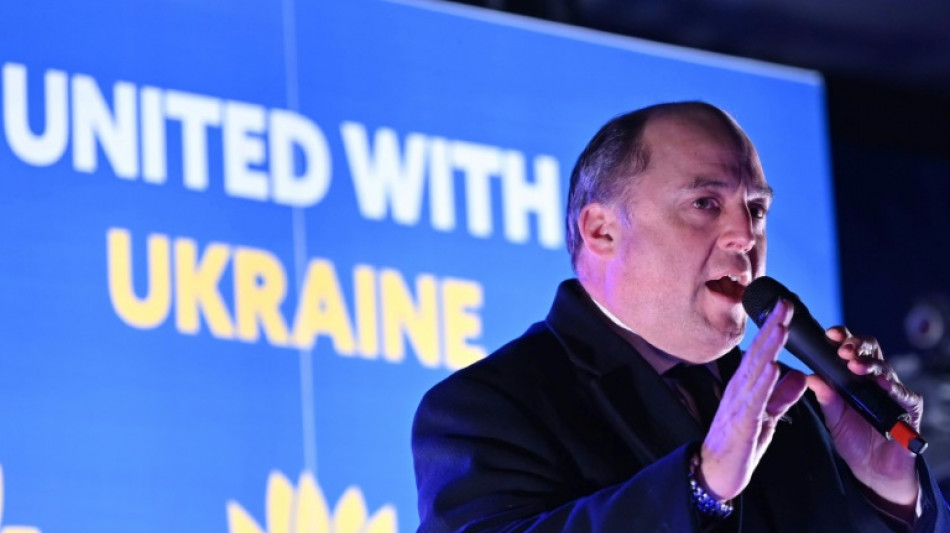
UK defence minister would 'love' to draw on expert reservists / Photo: JUSTIN TALLIS - AFP/File

 Texas Sports Betting Status: No Legal Options Amid Legislative Push for 2027 Referendum

 Geri Halliwell-Horner Embraces Queen Camilla at Commonwealth Writing Competition

 Meta Quest 3 and 3S Gain Access to Over 150 3D Movies

 Sarah Bajada Shares Message on Pregnancy Loss

 ALIX LASERS shareholders remove Michael Sobitsch as managing director in view of the circumstances

 Euroseas Q3 Net Profit Falls to $91.4 Million Amid Fleet Reduction
UK Defence Secretary Ben Wallace said Wednesday he would "love" to see Britain emulate the model of military reservists used by Finland and Sweden.
The two Nordic countries have a large pool of reservists drawn from the compulsory military service undertaken by young adults.
Wallace, briefing reporters in London alongside Swedish Defence Minister Pal Jonson, said that "conscription and reserve(s) often go hand in hand".
"So I definitely think we're all envious of how they use their reserves. And you know, I would like, love to have a model like that," the former British Army officer said.
Britain scrapped national service for all young men in 1960, and occasional calls for its return have been confined to right-wing politicians and media.
The Ministry of Defence denied that Wallace was himself calling for a return of national service, but was underscoring the "positive impact" of reservists in Finland and Sweden.
"He praised the reservist models in those countries and did not in any way state he wanted to introduce conscription in the UK," a ministry spokesperson said.
Following talks with Jonson, Wallace was giving an update on Sweden and Finland's bids to join NATO after Russia invaded Ukraine.
He noted that "a different cultural thing" was at play after both Nordic countries persisted with conscription in the decades since World War II, albeit with a seven-year break for Sweden.
Wallace said reservists were especially important given the reliance of modern armed forces on specialists, for example in cyberwarfare, who could be activated in time of need.
"And I think we've got to recognise that again the lesson of Ukraine is how do we work on our resilience, and part of that is about reserves," he said.
F.Ferraz--PC