Ukraine war sends Western anxiety soaring on back of pandemic

 US ambassador denounces settler siege as Israel dispatches troops
 Hasan takes 6-55 as Bangladesh claim opening day of Australia Test

 Taiwan says AI agents used in cyberattacks targeting island

 Japan protests Putin's first visit to disputed islands

 Kiss wants fit-again Wallabies playmaker Gordon to 'open up' Japan

 British eccentrics push humble garden shed to new heights

 Zambia votes with president's economic record on the line

 Germany's dry rivers spark battle on engineering vs restoration
 Senators demand inquiry into conditions aboard USS Abraham Lincoln

 All Blacks' Proctor out of South Africa series, Mo'unga called up

 Bangladesh quick Hasan reduces Australia to 74-4 at lunch

 Seoul tech leads Asian stock gains as traders cheer US inflation

 Farage and Count Binface go head-to-head in snap UK poll

 Afghan students divided over smartphone ban at universities
 Japan go back to school for second Australia Test
 Matthew McConaughey on his sweet return to the big screen

 President's economic record on the line as Zambia votes

 Grieving Messi available for Miami in Leagues Cup clash

 Colombia enters 'final phase' of quake search as toll hits 265

 Father-figure Christie helps guide Kounta to European silver

 McIlroy returns to St. Jude to launch marathon PGA playoff push

 Guimaraes makes Arsenal debut in Como friendly

 Travis Kelce says wedding to Taylor Swift was 'best night of my life'

 US stocks mostly up after data shows slightly lower inflation in July

 Caracas protest denounces secrecy of Venezuela transition talks

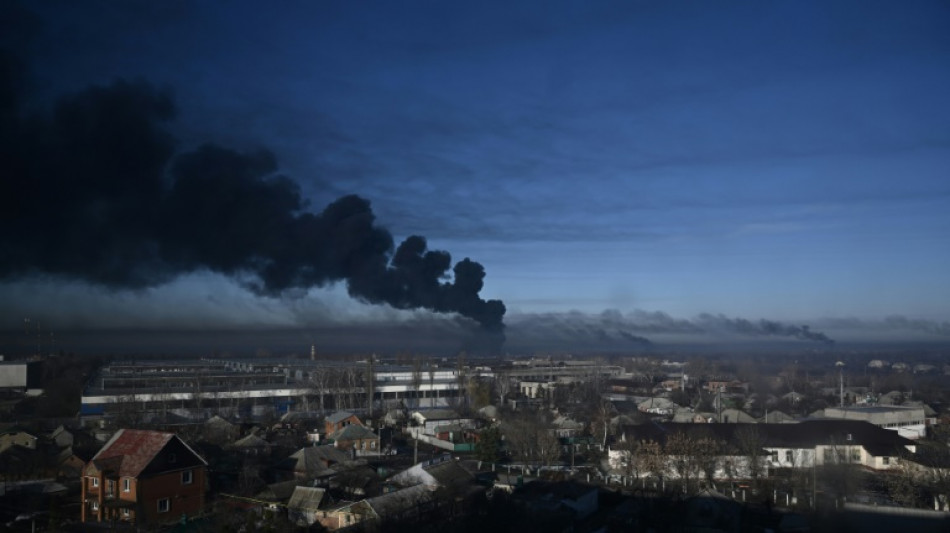
Just as millions of people dared to hope a two-year pandemic was receding, war broke out in Ukraine, triggering a new surge of anxiety in Western Europe and fears about wider conflict -- or worse.
As the West faces a possible new Cold War and warnings about heightened nuclear threats fill social media and the airwaves, many people are struggling with the sudden new world order, even if they are living thousands of miles away from the frontlines in Ukraine.
Chogwu Enape, a 29-year-old policy researcher based in Paris, said she hadn't been able to sleep properly since Russia invaded Ukraine last week.
"I'm worried about innocent people dying needlessly and I am worried that this crisis will morph into World War III," Enape told AFP.
"Every single scroll on social media brings news or images of the invasion. The racism that Africans are facing while trying to flee brought it home for me," she said.
"That could be me."
Psychologists have voiced particular concern about the effect of the latest global crisis on children and young people, even those living in relative comfort in peaceful countries.
"Children are constantly absorbing things they read, see and hear and it's completely natural for them to be picking up on the situation in Ukraine and feeling anxious," explained Vivian Hill, a psychology professor at University College London.
Some therapists and counsellors have reported distress among their clients.
"Almost every person I have encountered has been affected" by the war, said psychotherapist Nilufar Ahmed, who is also a psychologist at Britain's University of Bristol.
Others have turned to charity for help.
"We've heard from a number of people who are distressed by what they are seeing and hearing about the war in Ukraine, and who want to share their feelings with us," a spokesman for British mental health charity Mind, which runs a helpline, told AFP.
Anxiety and depression already rose by "a massive 25 percent" during the first year of the coronavirus pandemic, the World Health Organization said on Tuesday, adding that young people were the worst hit.
- 'Accumulation of crises' -
Michelle Nealon, president of the Chicago School of Professional Psychology, said that as many countries loosened Covid restrictions, "there was some light at the end of this gruelling tunnel".
"Then war broke out, violent images of missile attacks and deceased soldiers lying on the streets flooded our social media and TV screens, threat of nuclear attacks hung in the air, and we watched economies scramble in the aftermath," she said.
"There is a feeling of there is only so much that one can handle."
Antoine Pelissolo, a psychiatrist at France's Henri-Mondor University Hospital, said some people felt "a sense of despair in the face of an accumulation of crises, with the impression they will never be able to get out of them".
"For younger generations in particular, this brutal confrontation with the reality of war, and therefore possible death... is a shock that can cause anxiety and a strong feeling of insecurity."
Ahmed pointed out that many in the West are responding differently to the Ukraine war than to conflicts in the Middle East or Africa.
"The current war is resonating more in Europe because the Ukrainians look like other Europeans more than the refugees that have dominated the public psyche, who tend to be racialised and constructed as different," Ahmed said.
- How to help -
What can we do to manage our mental health in a time of crisis?
For children, British psychotherapist Noel McDermott advised "keeping life 'normal' with structure and routine" and stressed the importance of school in helping them overcome frightening events.
Hill advised against avoiding the issue with children.
"Listen to their worries and provide honest answers to their questions (while trying) to give details at an age-appropriate level."
For adults, Pelissolo recommended relaxation, meditation and physical activity to cope with rising anxiety.
Nealon said "sleeping well, eating a healthy diet and getting daily exercise are essential for keeping us physically and emotionally strong".
Donating to a charity "would make a real difference and will make you feel better too", Ahmed said.
All the experts advised children and adults to limit exposure to news about the war.
"Don't just switch off the news -- do something nourishing for yourself. Phone a loved one, go for a walk with a friend," Ahmed recommended.
"Whenever you do look at the news, try to stick to reliable, trusted news sources that don't engage in 'What ifs?'", the Mind spokesman advised.
"Try to regularly ask yourself, 'Is this helping me or am I doom scrolling?'"
G.Machado--PC