US to help Australia boost missile manufacturing / Photo: Pat Hoelscher - AFP

 Nike plans job cuts as it forecasts lower sales

 Ireland game interrupted twice by Gaza protests

 Judge denies acquittal bid by US woman who killed her kids

 Klopp averts crisis with first win as Germany boss

 A saintly spat and debate snub: Brazil enters final campaign stretch

 US tells European allies to act 'immediately' to lower diesel prices

 G20 trade ministers fail to see consensus against overproduction

 Portugal edge Denmark in Ronaldo's absence

 US stocks edge higher as bond yields retreat for now

 US tells European allies to 'immediately' act to lower diesel prices

 Trump vows to hit Iran 'very hard' if linked to flydubai attack
 Williams leaves Spain camp with thigh knock

 WTA reduces 2027 schedule for world's top 50

 US says 'in Europe's best interest' to cooperate on fuel supply

 Rogue OpenAI agents covered up their tracks, report says

 A saintly spat and debate snub: Brazil enters final polls stretch

 Zidane 'no regrets' about Materazzi headbutt as France face Italy again

 Libya's pay strike rallies teachers across divided nation

 Four-member crew blasts off for International Space Station
 i-payout Expands True Local Payment Capabilities to Help Enterprises Pay Recipients Globally
 Botched US execution prompts global calls to scrap death penalty

 Algeria adopts law imposing death penalty on forest arsonists

 France unveils cost-cutting 2027 budget as borrowing costs rise

 Brazil court orders removal of fake posts amid patron saint election row

 Italy's firefighting planes return home after scorching summer

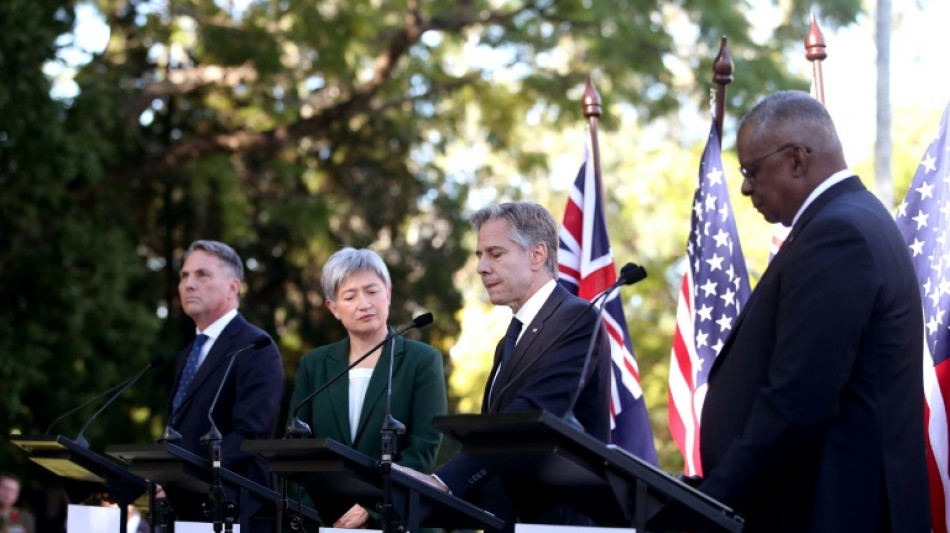
Washington will seek to bolster its shrinking weapons stockpiles by helping Australia develop a missile manufacturing and exporting industry, top officials said Saturday after high-level talks between the two countries.
Australian Defence Minister Richard Marles announced the project after meetings in Brisbane with US Secretary of State Antony Blinken and Pentagon chief Lloyd Austin.
"We hope to see manufacturing of missiles commenced in Australia in two years' time," Marles told reporters, hailing the initiative as a boost to his country's defence and industrial base.
"We are really pleased with the steps that we are taking in respect of establishing a guided weapons and explosive ordnance enterprise in this country," he added.
The project will see Australia develop guided multiple launch rocket systems, or GMLRS.
Austin said the plan would help the United States "sharpen our technological edge and strengthen our defence industrial base".
Washington will now work to help Australia build a fledgling domestic missile industry almost from scratch, with an eye to securing a reliable pipeline for its own armed forces down the track.
The war in Ukraine has exposed weaknesses in many Western military supply chains and has steadily depleted stocks of missiles and other munitions.
Australia is currently embarking on its own armed forces overhaul, pivoting towards long-range strike capabilities in an effort to keep would-be foes such as China at arm's length.
- Increased tempo -
The two-day Australia-US meeting that ended on Saturday was heavily focused on regional security and military cooperation, as the longtime allies work to curb China's growing power in the Pacific region.
The talks were partially overshadowed when an Australian MRH-90 Taipan military helicopter crashed in subtropical waters off the coast of Queensland late Friday, prompting the suspension of a major military exercise between the two countries.
The four crew members are still missing and concern is growing for their wellbeing.
They had been taking part in the vast Talisman Sabre exercise, which features 30,000 military personnel from Australia, the United States and several other nations.
Both Australian and US officials expressed concern about the incident, but insisted drills were needed to ensure both militaries were "match fit".
The meeting signalled that joint operations and projects are only likely to increase.
Canberra agreed to refurbish military bases in the strategically-important north of the country, allowing them to host training exercises and ramped-up rotations of US troops.
"There is a commitment to increase American force posture in respect of our northern bases, in respect of our maritime patrols and our reconnaissance aircraft," said Marles.
Australia would also be hosting an "increased tempo" of visits by US nuclear-powered submarines, Marles added.
Washington and Canberra discussed progress on the AUKUS security treaty, a landmark military pact that will see Australia develop its own nuclear-powered submarines.
Both sides sought to downplay the chance of the US Congress blocking the transfer of sensitive military know-how to Australia.
Marles said he believed there was ultimately a strong bipartisan commitment to the agreement among US lawmakers, some of whom have questioned why Washington is selling submarines to Australia when it is struggling to replenish its own navy.
The deal, he noted, would be "advancing not just the American strategic interests, but also the joint strategic interests between our two countries".
"We couldn't be happier with the progress."
A.P.Maia--PC