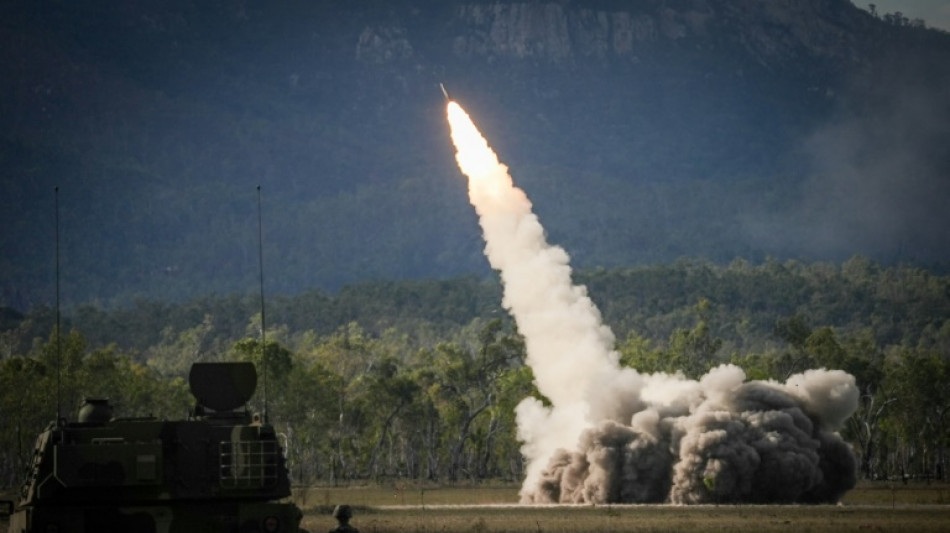
Pentagon eyes missile testing role for Australia / Photo: ANDREW LEESON - AFP/File

 Japan Olympic chief says 'lot more' athletes at Games than expected
 Asian carmakers besting US rivals at home, China poised to strike

 Widgets & Web Offers All-Inclusive Investor Relations Websites for Public Companies, IPOs and SPACs

 Adams named new US captain to 2030 World Cup

 China a better influence in Latin America than US: poll

 Judge pauses construction of border project in Texas national park

 Belgium's De Bruyne fires double to sink Turkey, France held by Italy

 US jobs data boosts stocks as oil prices dip

 US Supreme Court to hear high-stakes climate case

 Trump expected to name intel chief Clayton as AI czar: reports
 Argentina unveils passports-for-investment scheme

 Brazil election debate chaos sparks censorship row
 England's Carse charged by cricket body over nightclub incident

 Amazon vows $1 bn for data center towns, decries 'myths'
 Oil prices drop on G7 fuel release, US jobs data boosts stocks

 G7 agrees deal to ease global energy supply concerns

 Spain's government dealt blow as lawmakers reject housing bills
 Food, medicine shortages deepen in Russian-occupied Oleshky

 Man City whistleblower Rui Pinto facing 'dire consequences' - lawyers

 Russia 'tearing Kyiv apart', mayor says, as strikes paralyse traffic

 Taiwan boxer Lin wins Games gold as Japan edge North Korea on penalties

 Japan tame North Korea to win Games gold after shootout drama

 US posts weak job growth data in September
 Ethiopia's conflict: the regional dimension

 Life expectancy almost back to pre-Covid levels, says WHO

Australia could be a testing ground for US hypersonic and other long-range precision weapons under the AUKUS pact, a top Pentagon official told AFP on Wednesday.
US Secretary of the Army Christine Wormuth said Australia's contribution to the three-way AUKUS agreement, which includes Britain, "doesn't always have to be dollars".
The pact was signed in late 2021 and is seen as a way of countering China's growing clout in the Asia-Pacific region.
Work under AUKUS has so far focused on supplying Australia with nuclear-powered submarines, a fleet capable of travelling stealthily over vast distances and striking foes at long range.
But the pact is increasingly focused on developing advanced capabilities such as long-range precision firing, artificial intelligence and hypersonic weapons.
Wormuth said Australia could be a proving ground for these weapons.
"One thing Australia has in spades is long distances and relatively unpopulated land," she told AFP in a telephone interview from Washington.
"A challenge for us in the United States when it comes to hypersonics or even some of our things like the precision strike missile -- which is not a hypersonic weapon but has very long ranges in some of its increments -- for us to find open spaces in the United States where we can actually test these weapons, it's a challenge.
"Australia obviously has a tremendous amount of territory where that testing is a little bit more doable -- so I think that's a unique thing, as an example, that the Australians bring to the table."
China has denounced the AUKUS pact as undermining peace in the region -- a charge that Washington, Canberra and London reject.
But critics have also asked whether it is truly cooperative, or whether the United States, because of its size and overwhelming military power, will dominate.
Wormuth said she expected the two smaller partners to pitch in and "have skin in this game -- and they do".
"The sense I got certainly from talking to senior Australian officials is they're not doing this to make us happy, they're not doing this just for fun," said the Pentagon official, who visited Australia last week for the Talisman Sabre multinational military exercise.
"They're doing this because they see it as in their own national interest in terms of being able to meet the different challenges that they see in the theatre."
- 'Prohibitively expensive' -
Facing Russia's war in Europe, threats from North Korea and a more bellicose China, the United States has sought to bolster its defence alliances and put more advanced capabilities into the hands of allies like Australia, Ukraine and Taiwan.
For much of the Cold War, it was Washington's policy to be able to fight two major wars at once.
Wormuth admitted that today, budget constraints, US public opinion and the relative strength of Russia and China make such a doctrine impossible.
"I think there is a recognition that when you look at the size of our military, when you look at the size of the defence budget that the American taxpayer is willing to pay for, we... don't plan to fight more than one major war at a time," she said.
Instead, the United States hopes its alliance and nuclear arsenal will "discourage opportunistic aggression".
"Given the sophistication of the Russian military and the Chinese military today, to try to size our military to hypothetically handle two wars at a time would be prohibitively expensive".
V.Fontes--PC