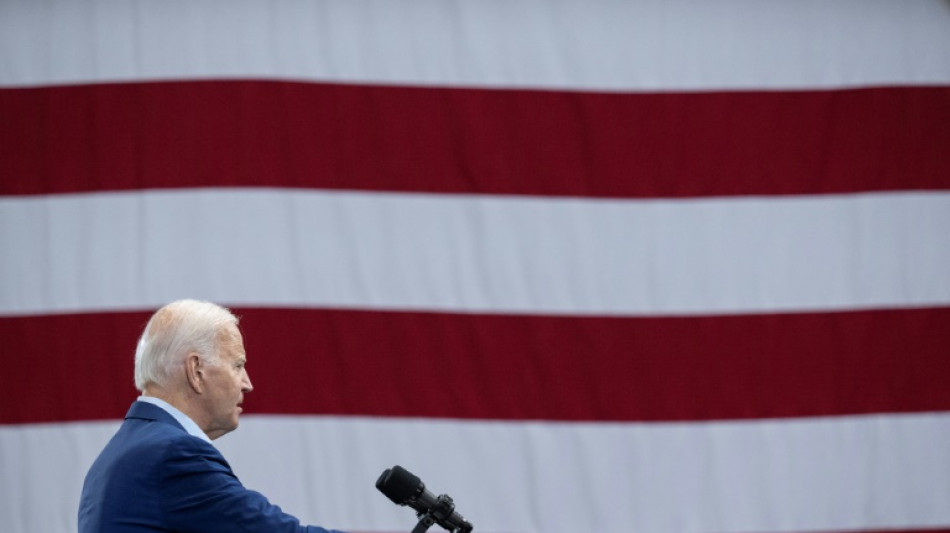
Biden announces curbs on US investments in China / Photo: Jim WATSON - AFP

 Japan Olympic chief says 'lot more' athletes at Games than expected
 Asian carmakers besting US rivals at home, China poised to strike

 Widgets & Web Offers All-Inclusive Investor Relations Websites for Public Companies, IPOs and SPACs

 Adams named new US captain to 2030 World Cup

 China a better influence in Latin America than US: poll

 Judge pauses construction of border project in Texas national park

 Belgium's De Bruyne fires double to sink Turkey, France held by Italy

 US jobs data boosts stocks as oil prices dip

 US Supreme Court to hear high-stakes climate case

 Trump expected to name intel chief Clayton as AI czar: reports

 Argentina unveils passports-for-investment scheme

 Brazil election debate chaos sparks censorship row
 England's Carse charged by cricket body over nightclub incident

 Amazon vows $1 bn for data center towns, decries 'myths'

 Oil prices drop on G7 fuel release, US jobs data boosts stocks

 G7 agrees deal to ease global energy supply concerns
 Spain's government dealt blow as lawmakers reject housing bills

 Food, medicine shortages deepen in Russian-occupied Oleshky

 Man City whistleblower Rui Pinto facing 'dire consequences' - lawyers

 Russia 'tearing Kyiv apart', mayor says, as strikes paralyse traffic
 Taiwan boxer Lin wins Games gold as Japan edge North Korea on penalties

 Japan tame North Korea to win Games gold after shootout drama

 US posts weak job growth data in September

 Ethiopia's conflict: the regional dimension

 Life expectancy almost back to pre-Covid levels, says WHO

US President Joe Biden on Wednesday issued an executive order aimed at restricting certain American investments in sensitive high-tech areas in China -- a move that could further strain ties between the world's top two economies.
The long-anticipated rules, expected to be implemented next year, target sectors like semiconductors and artificial intelligence, as Washington seeks to limit access to key technologies.
"The commitment of the United States to open investment is a cornerstone of our economic policy and provides the United States with substantial benefits," Biden said in a letter to Congressional leaders announcing the executive order.
"However, certain United States investments may accelerate and increase the success of the development of sensitive technologies and products in countries that develop them to counter United States and allied capabilities."
The program is set to prohibit new private equity, venture capital and joint ventures investments in advanced semiconductors and some quantum information technologies in China, according to the Treasury Department.
"The outbound investment program will fill a critical gap in the United States' national security toolkit," a senior government official said on condition of anonymity.
"What we're talking about is a narrow and thoughtful approach as we seek to prevent (China) from obtaining and using the most advanced technologies to promote military modernization and undermining US national security."
The Treasury is considering a notification requirement for US investments in Chinese entities involved in less advanced semiconductors, and activities relating to certain types of artificial intelligence.
China could exploit US investments to further its ability to produce sensitive technologies critical to military modernization, the Treasury Department said.
But it anticipates creating an exception for certain US investments into publicly traded securities and transfers from US parents to subsidiaries.
- Chilling effect? -
While the volume of dollars or numbers of transactions covered by a ban or notification regime are likely to be quite small, it does not necessarily mean the overall impact will be limited, said Emily Benson, director of the Project on Trade and Technology at the Center for Strategic and International Studies (CSIS).
"It's possible that while they're not directly subject to bans, companies will rethink the nature of their investments and that could have a chilling effect on bilateral investment over time," Benson told AFP.
The latest restrictions come shortly after visits by several high-level US officials to China as Washington and Beijing aim to stabilize ties.
During Treasury Secretary Janet Yellen's trip to the Chinese capital last month, officials from both sides talked about what such curbs might look like, and she told reporters that any new moves would be implemented in a transparent way.
"I emphasized that it would be highly targeted and clearly directed narrowly at a few sectors where we have specific national security concerns," Yellen said at the time.
She added that she wanted to allay fears that Washington would implement measures with broad-based impacts on the Chinese economy.
Nicholas Lardy, nonresident senior fellow at the Peterson Institute for International Economics (PIIE), noted that "the share of investment in China that's been financed by foreign capital in recent years is about one to two percent."
"If you want to have an impact, you've got to get other countries that are making these kinds of investments in China to have a similar regime," he said.
On Wednesday, a senior government official said key allies and partners have recognized the importance of this issue and "some are seeking to align" their policy approaches.
Outbound investment curbs would not represent an all-out effort to prevent Washington and Beijing from cooperating more deeply, Benson noted.
But "the administration has been trying to land high-level meetings with Chinese officials and it will fall on the US to really demonstrate through targeted language that this is not going to cause huge disruption in investment," she said.
P.Serra--PC