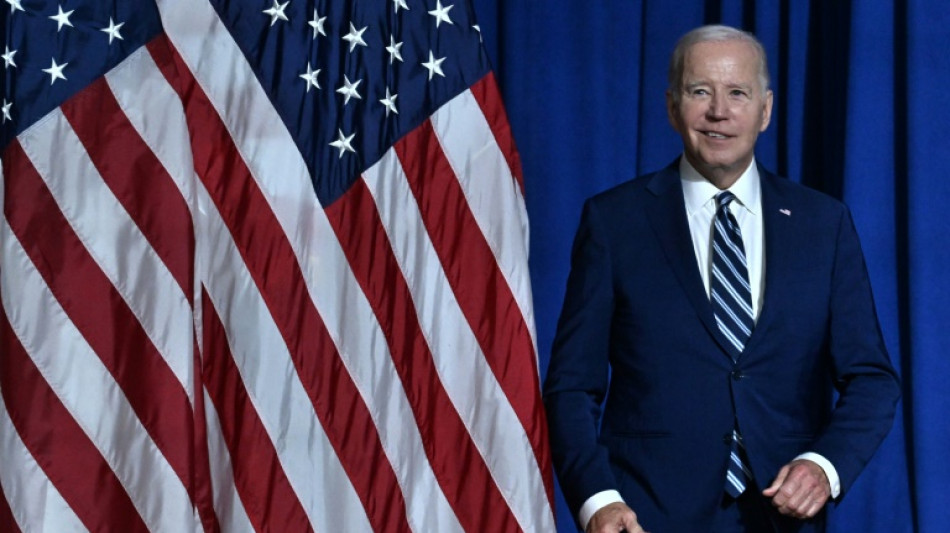
One year on: How has US climate plan affected trade ties? / Photo: Jim WATSON - AFP/File

 Japan Olympic chief says 'lot more' athletes at Games than expected

 Asian carmakers besting US rivals at home, China poised to strike

 Widgets & Web Offers All-Inclusive Investor Relations Websites for Public Companies, IPOs and SPACs

 Adams named new US captain to 2030 World Cup

 China a better influence in Latin America than US: poll

 Judge pauses construction of border project in Texas national park

 Belgium's De Bruyne fires double to sink Turkey, France held by Italy

 US jobs data boosts stocks as oil prices dip

 US Supreme Court to hear high-stakes climate case

 Trump expected to name intel chief Clayton as AI czar: reports

 Argentina unveils passports-for-investment scheme

 Brazil election debate chaos sparks censorship row

 England's Carse charged by cricket body over nightclub incident

 Amazon vows $1 bn for data center towns, decries 'myths'

 Oil prices drop on G7 fuel release, US jobs data boosts stocks

 G7 agrees deal to ease global energy supply concerns
 Spain's government dealt blow as lawmakers reject housing bills
 Food, medicine shortages deepen in Russian-occupied Oleshky

 Man City whistleblower Rui Pinto facing 'dire consequences' - lawyers

 Russia 'tearing Kyiv apart', mayor says, as strikes paralyse traffic
 Taiwan boxer Lin wins Games gold as Japan edge North Korea on penalties

 Japan tame North Korea to win Games gold after shootout drama

 US posts weak job growth data in September

 Ethiopia's conflict: the regional dimension

 Life expectancy almost back to pre-Covid levels, says WHO

US President Joe Biden's landmark climate action plan may have been trailed by billions of dollars in clean energy investment, but its potential to reshape trade lines has strained ties with allies.
The Inflation Reduction Act (IRA), signed into law on August 16 last year, directs some $370 billion in subsidies toward America's energy transition, including tax breaks for US-made electric vehicles and batteries.
But the incentives, which boost American manufacturing after years of offshoring, have triggered fears that they could draw businesses out of other countries.
"This was really the United States coming into the game in a big way," said Joshua Meltzer, senior fellow at the Brookings Institution.
Europe had been subsidizing the development of clean technologies since before the IRA, as had China and others, Meltzer noted.
But Washington's entry "meant that for these subsidies to remain competitive they had to be continued or raised," he told AFP.
- 'Unintended consequences' -
The legislation had some "unintended consequences" in constraining trade with key US allies, said Jeffrey Schott, senior fellow at the Peterson Institute for International Economics.
A sticking point was a consumer tax credit of up to $7,500 for the purchase of electric vehicles (EVs) assembled in North America.
To qualify for the full credit, vehicle batteries should also have a percentage of critical minerals sourced from America or countries with which it has free-trade pacts, leaving the European Union and, initially, Japan in the cold.
This drew ire from those countries, and US officials eventually expanded access to the clean vehicle subsidies, noting in March that the free trade agreement requirement could also include newly negotiated critical minerals deals.
This includes one that Japan had inked with the United States just shortly earlier -- opening doors to benefits from some subsidies.
"Part of the initial friction was because... the last revisions of the IRA were done in haste and in secret," said Schott.
There appeared to be a "lack of understanding that US allies were not all US free-trade partners," he added, leading to some "creative accounting" by the Treasury Department in defining how the law would be implemented.
Meltzer said that the United States "quite quickly tried to respond to these concerns by negotiating these kind of bilateral deals," referring to Japan's pact and the EU's efforts toward a similar accord.
This alleviated many concerns, he said.
- Partnerships and relocations -
Canada, which warned about the risks of a subsidy war, has since responded by matching certain IRA incentives with those of its own.
In April, it announced up to 13.2 billion Canadian dollars ($9.8 billion) in subsidies over 10 years for Volkswagen's first overseas battery plant in Ontario.
Elsewhere, South Korea's largest automaker Hyundai is hoping to produce US-assembled electric cars eligible for subsidies at a site under construction in Georgia.
Other South Korean companies have forged partnerships with US ones to build assembly lines meeting IRA requirements, such as battery maker Samsung SDI's joint venture with General Motors to build an EV battery plant in the US.
"The IRA would benefit the US through additional output and lower strategic dependence vis-a-vis China," said an analysis by three European Central Bank economists in July.
"The US would gain from positive relocation effects, increasing production by six percent to 30 percent in electrical and optical equipment," the economists said in a column on the Centre for Economic Policy Research's policy portal.
This comes mainly at China's expense, and to a smaller degree the EU's, the economists said.
While the relocation involves a relatively small share of total output, losses in specific sectors can be more substantial.
Since the climate law was signed, at least $75 billion in new manufacturing investments has been announced, according to policy analyst Jack Conness of think tank Energy Innovation: Policy and Technology.
IRA green subsidies may be "of similar size" to those available in the EU, but the US clean-tech subsidies are "simpler and less fragmented," said European think tank Bruegel in a report this year.
Such factors could make the US subsidies more attractive to businesses, at a time when Europe also faces rising energy costs following Russia's invasion of Ukraine.
"If you're in an energy-intensive sector such as chemicals... the US looks increasingly attractive," Meltzer said.
"It's a broader set of factors, I think, that are creating competitive challenges in Europe," he said. "The IRA is a part of that... but it's not everything."
L.Torres--PC