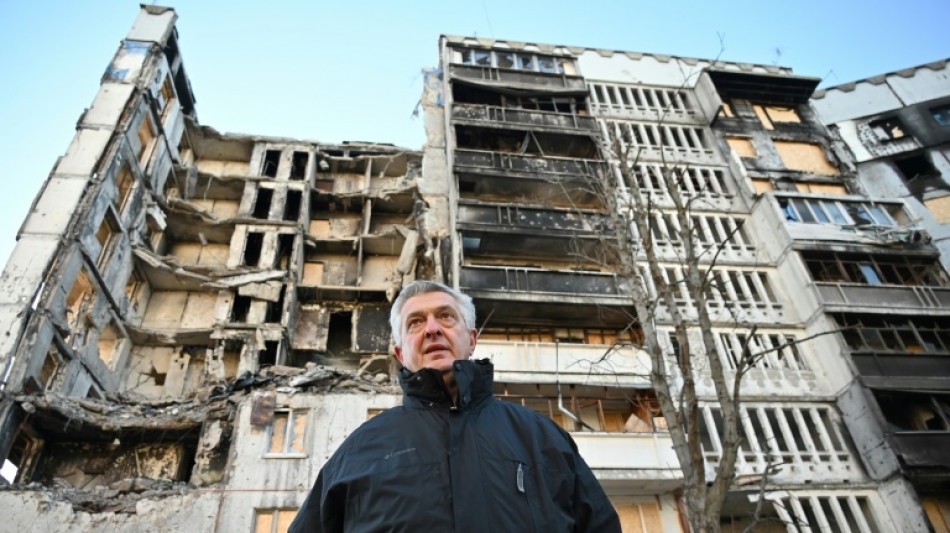
UN refugee chief seeks inclusion, not quick fixes, as needs grow / Photo: SERGEY BOBOK - AFP/File

 Malaysia Sues Google for $146m Over Harmful Content

 Black Wind Turbine Blades Reduce Bird Deaths by 74% in Spain Study

 Brazil’s Landless Movement Partners with China to Build Affordable Tractors for Family Farms

 Raheem Sterling Receives Suspended Sentence After Lamborghini Crash

 Luxembourg Pay Rise Delayed as Regional and World Headlines Develop

 Audience to Choose the Set List at Luxembourg's First FAMIL Jukebox Night

 Twickenham Grounds Team Prepares Pitch for Six Matches in Three Days

 Black Friday Discounts Cut Prices on Two Top-Rated Wiper Blades

 Arizona Gun Regulation Battle Intensifies Under New Democratic Legislative Majority
As the world faces an unprecedented number of refugees and a backlash grows in Europe, a top UN official is warning against the political push for quick fixes.
Filippo Grandi, the UN high commissioner for refugees, said a model comes from what may be an unlikely source -- the war in Ukraine, which set off an exodus of refugees who were largely welcomed in Europe.
Despite some dire warnings of the impact of Ukrainian refugees, the choices by European nations -- giving them access to schools, health care and employment and allowing freedom of movement -- "actually helped with social cohesion," Grandi told AFP.
"It's a good lesson that inclusion, as opposed to exclusion, is a very good tool to sustain these responses," he said as world leaders met in New York for the UN General Assembly.
Italy's southernmost island of Lampedusa has seen a major influx of migrants with some 8,500 people arriving between Monday and Wednesday last week.
The European Union vowed action and Italian Deputy Prime Minister Matteo Salvini has called the arrivals an "act of war."
Grandi, who is Italian, said: "There has been so much politicization of this."
"Politicians need short fixes, they need slogans to say we are on top of it.
"It doesn't work like that. We have to explain to public opinion that these are complex issues that require time, resources and different solutions," he said.
"There is no 'invasion.' There is no 'catastrophe.' It is possible to do it, but countries have to work together," he said of addressing migration.
- Finding long-term solutions -
The surge of migration to Lampedusa is coming largely from Africans traveling through Tunisia, where the economy has descended into tumult and racist violence has escalated as President Kais Saied rails against people from sub-Saharan Africa.
The European Union, with strong backing from Italy, has pushed through a package of hundreds of millions of euros to Tunisia in return for stemming migration.
But Grandi said that solutions lay "upstream" and that by the time people are "at the shores of Europe, it's almost too late."
In addition to addressing root causes, Grandi called for more "safe, orderly channels" for migrants to enter Europe.
"Many times they go and ask for asylum, even if they're not refugees, and this has created chaos and mismanagement," he said.
Grandi also called for a more efficient Europe-wide system to rescue people at sea.
"Many will disagree and maybe they will not listen to me," he said. "That's a basic duty of humanity -- to rescue people at sea."
- Talks planned in Geneva -
The UN High Commissioner for Refugees says that a record of more than 110 million people are displaced around the world.
People are fleeing not just into wealthy countries. Hundreds of thousands of Sudanese have fled fighting in recent months to Chad, one of the world's poorest countries, which Grandi visited this month.
Despite rising needs, humanitarian aid budgets have been falling. The International Committee of the Red Cross and Red Crescent recently announced new job cuts due to shrinking funding.
In December, Grandi will join French President Emmanuel Macron in leading the Global Refugee Forum in Geneva, a once-in-four-years event that aims to encourage good practices and cooperation.
Grandi acknowledged that the talks came as countries were increasingly divided, including between the West and developing nations over the Ukraine war.
But he said of the forum: "I think there's a lot of interest. But of course there are risks. The world is very polarized."
"I'm hoping that this forum will be a moment of unity, not of division."
A.Aguiar--PC

