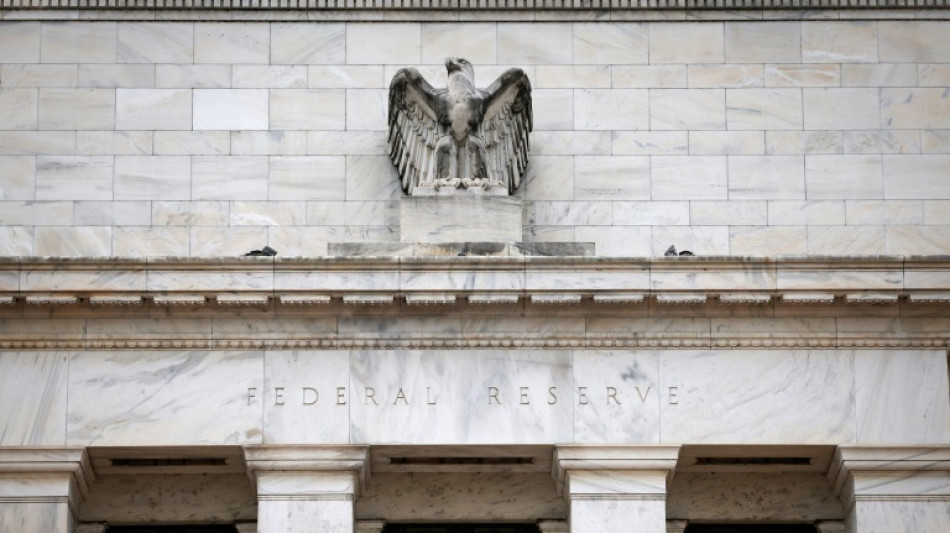
OECD sees 'sub-par' global growth as high rates bite / Photo: WIN MCNAMEE - GETTY IMAGES NORTH AMERICA/AFP/File

 Malaysia Sues Google for $146m Over Harmful Content

 Black Wind Turbine Blades Reduce Bird Deaths by 74% in Spain Study

 Brazil’s Landless Movement Partners with China to Build Affordable Tractors for Family Farms

 Raheem Sterling Receives Suspended Sentence After Lamborghini Crash

 Luxembourg Pay Rise Delayed as Regional and World Headlines Develop

 Audience to Choose the Set List at Luxembourg's First FAMIL Jukebox Night

 Twickenham Grounds Team Prepares Pitch for Six Matches in Three Days

 Black Friday Discounts Cut Prices on Two Top-Rated Wiper Blades

 Arizona Gun Regulation Battle Intensifies Under New Democratic Legislative Majority

The OECD raised its global economic outlook for 2023 on Tuesday but cut the growth forecast for next year as interest-rate hikes aimed at curbing inflation take their toll.
The world economy is now expected to grow 3.0 percent this year, up from the 2.7 percent forecast in the June outlook of the Organisation for Economic Co-operation and Development.
But it said global growth was projected to remain "sub-par", slowing to 2.7 percent next year -- down from 2.9 percent in the previous forecast.
"After a stronger-than-expected start to 2023, helped by lower energy prices and the reopening of China, global growth is expected to moderate," the OECD said.
"The impact of tighter monetary policy is becoming increasingly visible, business and consumer confidence have turned down, and the rebound in China has faded."
Central banks worldwide have sharply raised borrowing costs in an effort to tame consumer prices which soared in the wake of Russia's invasion of Ukraine last year.
"Inflation is projected to moderate gradually over 2023 and 2024 but to remain above central bank objectives in most economies," the OECD said.
The European Central Bank raised a key interest rate to a record high last week but hinted this might be its last hike, while the US Federal Reserve is expected to pause its own campaign on Wednesday.
Consumer price increases have eased in the United States and the eurozone but remain well above the two-percent targets of the Fed and ECB, and oil prices have rebounded in recent weeks.
The Bank of England and its peers in Norway, Sweden and Switzerland are also making interest rate decisions on Thursday.
"Even if policy rates are not raised further, the effects of past rises will continue to work their way through economies for some time," the OECD said.
Borrowing costs for companies and households have risen, while credit conditions have tightened, it said.
"Some countries are already seeing rising loan and credit card delinquency rates and increases in corporate insolvencies," the OECD said.
The crisis at regional US banks in March and the fire sale of European banking giant Credit Suisse show that "risks remain" that higher rates could "produce stresses in the financial system", the report warned.
- China risk -
The OECD also warned that "a sharper-than-expected slowdown in China is an additional key risk that would hit output growth around the world".
The world's second biggest economy has struggled this year after three years of Covid restrictions and massive debt in the property sector.
The OECD cut its outlook for China, with growth of 5.1 percent this year. It will slow to 4.6 percent in 2024, 0.5 percentage points lower than previously forecast.
While it raised its forecast for the world's biggest economy, the United States, the OECD noted that US growth would slow from 2.2 percent in 2023 to 1.3 percent next year.
Although the US economy "has so far proved unexpectedly resilient to the steep rise in policy interest rates", the effects of tighter financial conditions "are expected to become increasingly visible", the OECD said.
The organisation lowered its forecasts for the eurozone, with growth of 0.6 percent this year and 1.1 percent in 2024 as the German economy struggles.
Japan's growth outlook was raised by 0.5 percentage points to 1.8 percent for 2023 but lowered by 0.1 points to 1.0 percent for 2024.
G.Machado--PC

