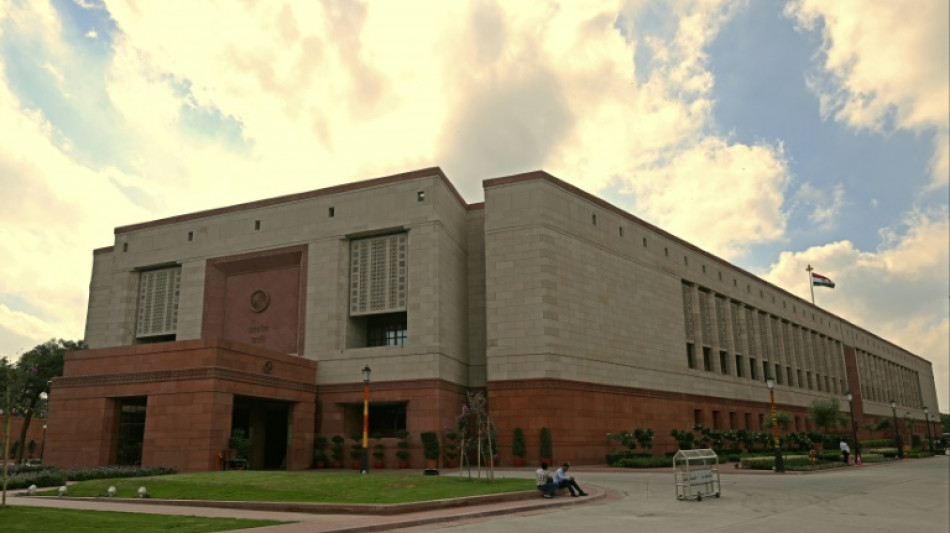
India's lower house votes to reserve third of seats for women: speaker / Photo: Money SHARMA - AFP/File

 Malaysia Sues Google for $146m Over Harmful Content

 Black Wind Turbine Blades Reduce Bird Deaths by 74% in Spain Study

 Brazil’s Landless Movement Partners with China to Build Affordable Tractors for Family Farms

 Raheem Sterling Receives Suspended Sentence After Lamborghini Crash

 Luxembourg Pay Rise Delayed as Regional and World Headlines Develop

 Audience to Choose the Set List at Luxembourg's First FAMIL Jukebox Night

 Twickenham Grounds Team Prepares Pitch for Six Matches in Three Days

 Black Friday Discounts Cut Prices on Two Top-Rated Wiper Blades

 Arizona Gun Regulation Battle Intensifies Under New Democratic Legislative Majority

India's lower house of parliament passed a bill Wednesday that would more than double the number of women lawmakers in its ranks, following several failed attempts to enact the measure stretching back decades.
A total of 454 lawmakers voted for the bill, with only two against.
"The proposal has been passed with more than a two-thirds majority of the members present in the house," said Om Birla, the speaker of parliament.
The proposed law would reserve one-third of seats in India's lower house and state assemblies for women once it takes effect, which could take until at least the end of the decade.
It would not take effect before national elections next year but will be a further fillip to the already commanding position of Prime Minister Narendra Modi's party ahead of that poll.
When prime minister Indira Gandhi took office to lead India in 1966 she became the world's second woman head of government in a parliamentary democracy, following Sri Lanka's Sirimavo Bandaranaike six years earlier.
Two women have served in India's ceremonial presidency and others have been chief ministers, party leaders and powerbrokers in the decades since, but that has not equated to broader political representation.
Just 104 of India's 788 MPs were women after the last national election, according to government figures -- a little over 13 percent.
Those figures reflect a broader under-representation of women in Indian public life. Just under a third of working-age Indian women were in the formal labour force last year, according to government data.
Six earlier attempts to pass the bill stalled in the decades since it was first introduced in 1996, with sometimes vehement resistance from lawmakers.
Mulayam Singh Yadav, at the time the chief minister of India's most populous state, suggested in 2010 that the bill should not be passed because it would compel men to wolf-whistle at their female colleagues in parliament.
The bill proposes a constitutional amendment to enshrine a one-third quota reserved for women, requiring a two-thirds majority in both houses of parliament to succeed.
Its passage through the upper house is expected to be smooth thanks to broad political support for the measure.
The quota would only take effect once India redraws its electoral boundaries after the mammoth undertaking of a census for its 1.4 billion people -- the last due in 2021 was postponed indefinitely because of the coronavirus pandemic.
A.P.Maia--PC

