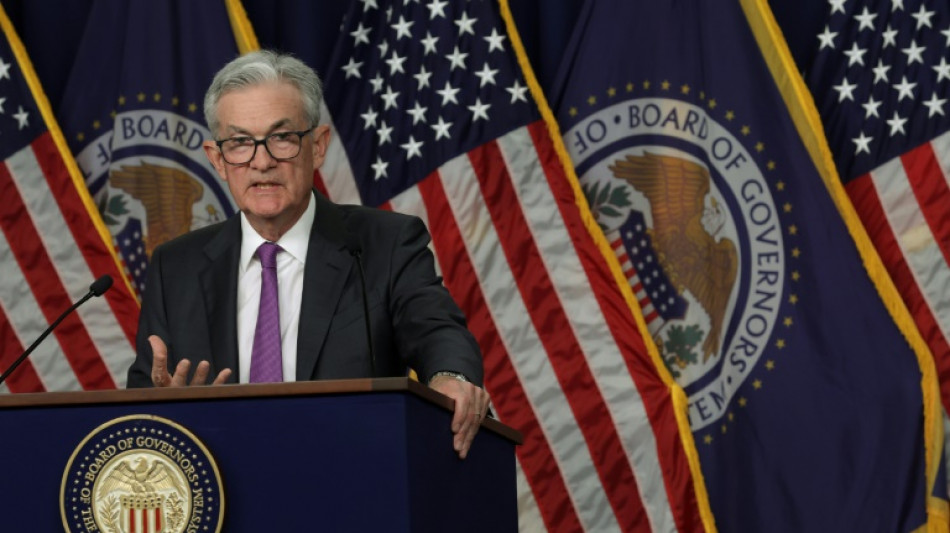
US Fed pauses rate hikes but expects another rise this year / Photo: ALEX WONG - GETTY IMAGES NORTH AMERICA/AFP

 Malaysia Sues Google for $146m Over Harmful Content

 Black Wind Turbine Blades Reduce Bird Deaths by 74% in Spain Study

 Brazil’s Landless Movement Partners with China to Build Affordable Tractors for Family Farms

 Raheem Sterling Receives Suspended Sentence After Lamborghini Crash

 Luxembourg Pay Rise Delayed as Regional and World Headlines Develop

 Audience to Choose the Set List at Luxembourg's First FAMIL Jukebox Night

 Twickenham Grounds Team Prepares Pitch for Six Matches in Three Days

 Black Friday Discounts Cut Prices on Two Top-Rated Wiper Blades

 Arizona Gun Regulation Battle Intensifies Under New Democratic Legislative Majority

The US Federal Reserve voted Wednesday to hold interest rates at a 22-year high while forecasting an additional hike before the end of the year to bring down inflation.
The Fed's decision to keep its key lending rate between 5.25 and 5.50 percent gives policymakers time to "assess additional information and its implications for monetary policy," the US central bank said in a statement.
The decision was in line with the expectations of most analysts and traders.
After 11 interest rate hikes since March last year, inflation has fallen sharply but remains stuck stubbornly above the Fed's long-run target of two percent per year -- keeping pressure on officials to consider further policy action.
On Wednesday, the Fed said economic activity had been expanding "at a solid pace," while noting strong gains and the low unemployment rate.
The recent string of positive economic data has raised hopes that the Fed can slow price increases without triggering a damaging recession.
- Revision to growth -
The rate-setting Federal Open Market Committee (FOMC) also updated members' forecasts for a range of economic indicators, from inflation to growth, as well as expectations of future interest rate policy.
FOMC members left the median projection for interest rates at the end of this year between 5.50 and 5.75 percent, keeping alive the possibility of another quarter percentage point hike before the end of the year to tackle inflation.
At the same time, they raised their forecast for where interest rates will be next year by half a percentage point, suggesting the Fed expects rates will have to stay significantly higher for longer in order to bring inflation down to target.
FOMC members also more than doubled the median projection for economic growth this year to 2.1 percent from 1.0 percent in June, and sharply raised their forecast for next year as well.
The forecast for the unemployment rate in 2023 was lowered slightly from June, suggesting the jobs market is faring better than hoped, while the expectation for headline inflation was raised slightly.
- On the 'golden path' -
Policymakers are looking to keep the country on what Chicago Fed President Austan Goolsbee calls the "golden path," attempting to slow down inflation while averting a surge in unemployment and a major economic slowdown.
"If you look at expectations in the marketplace, there's a growing confidence that we can pull it off," he said during a recent interview broadcast on NPR.
But Goolsbee added that the Fed must remain "attentive to the data," echoing Powell, who has promised to follow a "data-dependent" path going forward.
Analysts at Goldman Sachs recently cut their expectation of a recession in the United States from 20 percent down to 15 percent, while other economists -- including those in the Fed's research team -- say they no longer expect the US economy to contract this year.
T.Vitorino--PC

