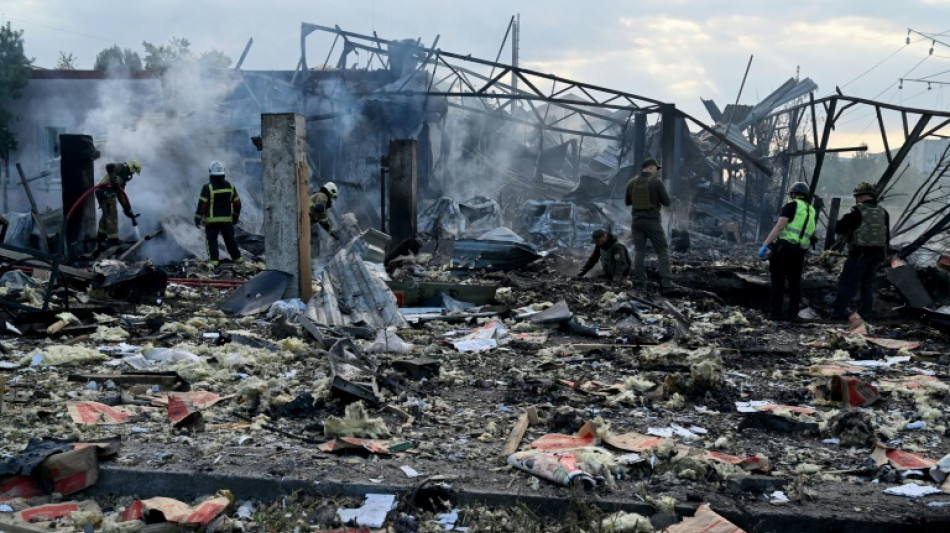
Kyiv warns of 'difficult' winter after deadly strikes / Photo: Sergei SUPINSKY - AFP

 Malaysia Sues Google for $146m Over Harmful Content

 Black Wind Turbine Blades Reduce Bird Deaths by 74% in Spain Study

 Brazil’s Landless Movement Partners with China to Build Affordable Tractors for Family Farms

 Raheem Sterling Receives Suspended Sentence After Lamborghini Crash

 Luxembourg Pay Rise Delayed as Regional and World Headlines Develop

 Audience to Choose the Set List at Luxembourg's First FAMIL Jukebox Night

 Twickenham Grounds Team Prepares Pitch for Six Matches in Three Days

 Black Friday Discounts Cut Prices on Two Top-Rated Wiper Blades

 Arizona Gun Regulation Battle Intensifies Under New Democratic Legislative Majority

Ukraine on Thursday warned that difficult winter months lay ahead after a massive Russian missile barrage targeted civilian infrastructure, killing three in the south and wounding many across the country.
Russia launched the strikes as Ukraine prepares for a third winter during Moscow's 19-month long invasion and as President Volodymyr Zelensky made his second wartime trip to Washington.
"Most of the missiles were shot down. But only the majority. Not all," Zelensky said, calling for the West to provide Kyiv with more anti-missile systems.
The fresh attack came as Poland said it would honour pre-existing commitments of weapons supplies to Kyiv, a day after saying it would no longer arm its neighbour in a mounting row between the two allies.
Moscow hit cities from Rivne in western Ukraine to Kherson in the south, the capital Kyiv and cities in the centre and northeast of the country.
Kyiv also reported power cuts across the country -- in almost 400 cities, towns and villages -- as Russia targeted energy sites, but said it was "too early" to tell if this was the start of a new Russian campaign against its energy sites.
Last winter many Ukrainians had to go without electricity and heating in freezing temperatures as Russia hit Kyiv's energy facilities.
"Difficult months are ahead: Russia will attack energy and critically important facilities," said Oleksiy Kuleba, the deputy head of Kyiv's presidential office.
Ukraine also said that it had struck a military airfield in Moscow-annexed Crimea, a claim denied by Russian-installed authorities.
- 'Ceilings fell down' -
Russia's overnight strikes were deadliest in the southern Kherson, where three people were killed.
In Kyiv's eastern Darnitsky district, frightened residents of a dormitory woke up to their rooms with shattered windows and parked cars outside completely burnt out.
Debris from a downed missile in the capital wounded seven people, including a child.
"God, god, god," Maya Pelyukh, a cleaner who lives in the building, said as she looked at her living room covered in broken glass and debris on her bed.
Her windows and door were blown away, with the 50-year-old saying she crawled out from under a door frame.
Some residents outside were still in dressing gowns as they watched emergency workers put out a fire the authorities said had spread over 400 square meters (4,300 square feet).
In the northeastern city of Kharkiv seamstresses were clearing a damaged clothing factory, with a Russian missile hitting nearby.
"The ceilings fell down. Windows were blown out. There are chunks of the road inside," Yulia Barantsova said, as she cleared a sewing machine from dust and rubble.
- Energy fears -
Tensions over Ukraine's grain exports have built since Russia ended a deal that allowed for cargo ships' safe passage on the Black Sea.
The European Commission -- the EU's executive arm -- last week said it was ending an import ban on Ukraine grain, arguing that "the market distortions in the five member states bordering Ukraine have disappeared".
Poland, Hungary and Slovakia immediately announced they would defy the move.
In a quickly escalating row, Poland said it wouldn't arm Ukraine anymore, but would honour existing commitments.
Slovakia announced, however, that it had reached an agreement on how to handle grain exports.
The Thursday attacks came after over a year and a half of war, with winter -- which can be severe in parts of Ukraine -- weeks away.
Ukraine's energy operator Ukrenergo said 398 settlements were out of electricity as the attacks damaged energy sites across the country.
"There are partial power cuts in Rivne, Zhytomyr, Kyiv, Dnipropetrovsk and Kharkiv region," it said on Telegram.
But it added that it was too early to tell if Russia had launched another campaign on Ukraine's energy sites.
"We should calm down, the volume of gas will be enough to last the next heating season," he said on television.
F.Carias--PC

